
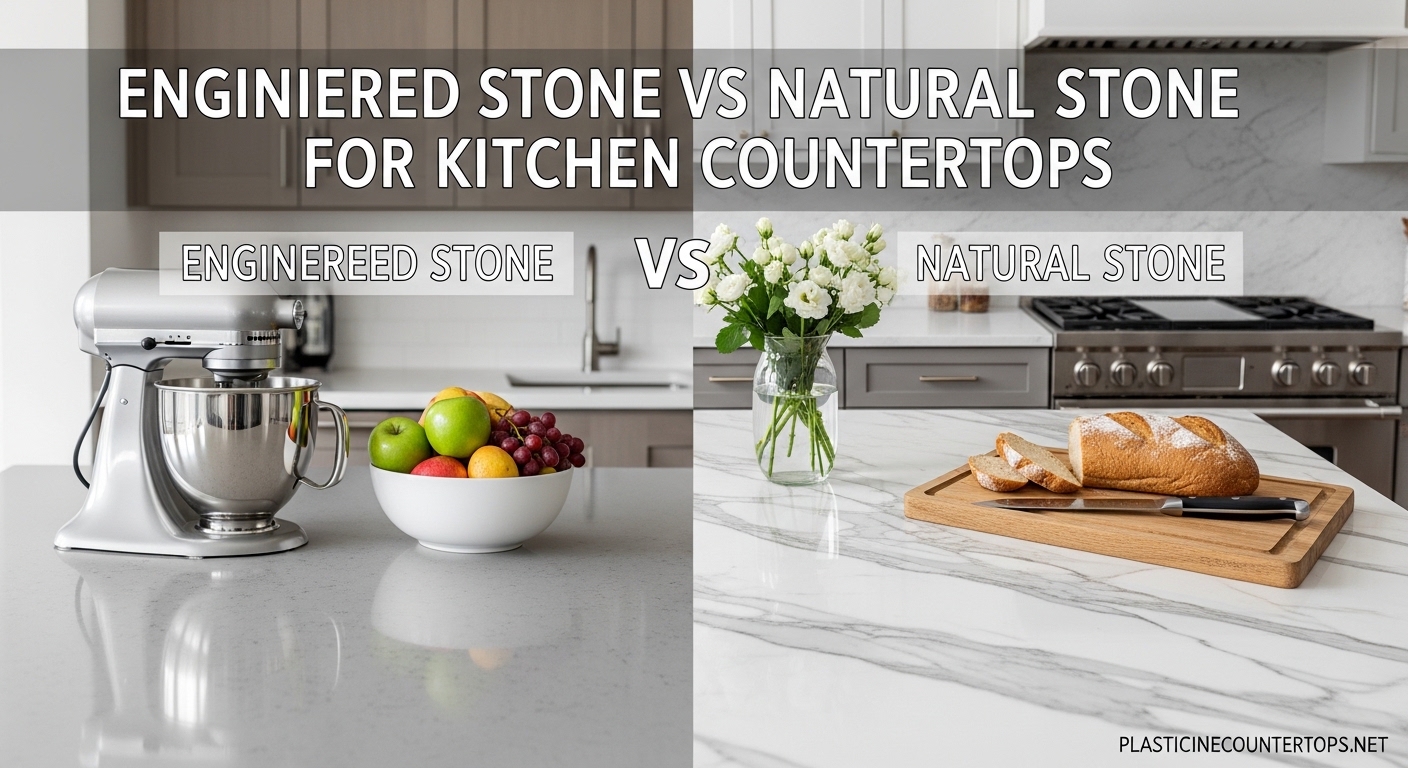
Choosing between engineered stone vs natural stone for kitchen countertops is one of the biggest decisions you’ll make during a kitchen renovation. Both materials offer distinct advantages, but the right choice depends on your lifestyle, budget, and maintenance preferences.
Engineered stone is a manufactured composite material that combines crushed stone with resin binders to create a non-porous surface. Natural stone includes materials like granite, marble, and quartzite that are quarried directly from the earth and cut into slabs.
In this guide, I’ll break down everything you need to know about both options. We’ll compare durability, maintenance requirements, costs, appearance, and more so you can make an informed decision for your kitchen.
Table of Contents
What Is Engineered Stone?
Engineered stone countertops are man-made surfaces created by combining 90-95% crushed natural stone aggregates with 5-10% polymer resins. This mixture is compressed under intense pressure and heat to create a dense, non-porous slab.
The primary material in most engineered stone is quartz, which is why these countertops are often marketed as “quartz countertops.” The crushed quartz is mixed with resin binders and pigmentation to create consistent colors and patterns. Unlike natural stone, every engineered slab has identical veining and coloring because the manufacturing process is controlled.
There are two main types of engineered stone:
Quartz Engineered Stone
Quartz-based engineered stone is the most common type available. It offers excellent durability, stain resistance, and comes in hundreds of color options. Popular brands include Caesarstone, Silestone, and Cambria. These surfaces are ideal for busy kitchens because they require virtually no maintenance beyond basic cleaning.
Sintered Stone
Sintered stone is a newer category of engineered material made from natural minerals and glass that are subjected to extreme heat and pressure. This process mimics how natural stone forms over thousands of years, but in a much shorter timeframe. Sintered stone offers superior heat resistance compared to quartz and can be used for outdoor applications.
What Is Natural Stone?
Natural stone countertops are quarried directly from the earth and cut into slabs. Each piece is completely unique, with variations in color, pattern, and veining that cannot be replicated. This uniqueness is a major selling point for homeowners who want a one-of-a-kind kitchen.
The quarrying process involves extracting large blocks of stone from quarries, which are then sliced into slabs and polished. The three most common types of natural stone for kitchen countertops are granite, marble, and quartzite.
Granite Countertops
Granite is an igneous rock formed from cooled magma. It is incredibly hard and durable, making it one of the most popular choices for kitchen countertops. Granite comes in a wide range of colors, from subtle whites and grays to bold blacks and blues. Each slab has its own unique pattern of mineral deposits.
Marble Countertops
Marble is a metamorphic rock formed from limestone under heat and pressure. It is prized for its elegant veining and timeless beauty. However, marble is softer and more porous than granite, making it more susceptible to scratches and stains. Many homeowners use marble for bathroom vanities or kitchen islands that see less heavy use.
Quartzite Countertops
Quartzite is a natural stone that is often confused with engineered quartz. It is a metamorphic rock formed from sandstone under intense heat and pressure. Quartzite offers the look of marble with the durability of granite. It has become increasingly popular for kitchen countertops because it combines beauty with practicality.
Durability Comparison: Which Lasts Longer?
Both engineered stone and natural stone offer excellent durability, but they have different strengths and weaknesses. Understanding these differences will help you choose the right material for your cooking habits.
Scratch Resistance
Natural stone like granite and quartzite is extremely hard and resistant to scratches. You can cut directly on granite without worrying about damaging the surface, though I still recommend using cutting boards to protect your knives. Engineered quartz is also highly scratch-resistant, ranking just below granite on the Mohs hardness scale.
Marble is the exception among natural stones. It is significantly softer and will scratch more easily than granite, quartzite, or engineered stone. If you are rough on your countertops, marble may not be the best choice.
Chip and Crack Resistance
Engineered stone tends to be more flexible than natural stone, which can make it slightly more resistant to chipping from impacts. However, both materials can chip if you drop heavy objects on the edges. The key difference is repairability. Natural stone chips can often be repaired seamlessly by a professional, while engineered stone repairs are more visible.
Expected Lifespan
With proper care, both engineered stone and natural stone countertops can last 20-30 years or more. Natural stone has been used in buildings for centuries, so longevity is not a concern. Engineered stone is a newer material, but manufacturers typically offer warranties of 10-15 years, and the surfaces are expected to last much longer.
Maintenance Requirements: What You Need to Know
Maintenance is one of the biggest differences between engineered stone and natural stone. If you prefer a low-maintenance kitchen, engineered stone has a clear advantage.
Sealing Requirements
Natural stone countertops are porous and must be sealed regularly to prevent staining. Granite typically needs resealing every 1-3 years depending on use and the specific stone. Marble is even more porous and may require sealing every 6-12 months. Quartzite falls somewhere in between.
Engineered stone is completely non-porous thanks to the resin binder that fills all the microscopic spaces between stone particles. This means it never needs sealing. Spills sit on the surface rather than soaking in, making cleanup much easier.
Cleaning Protocols
For daily cleaning, both materials only require warm water and mild dish soap. However, natural stone requires pH-neutral cleaners because acidic or alkaline cleaners can etch the surface. You should avoid vinegar, lemon juice, and harsh chemical cleaners on natural stone.
Engineered stone is more forgiving with cleaning products, though manufacturers still recommend avoiding harsh chemicals. The non-porous surface means bacteria and germs cannot penetrate, making engineered stone naturally antibacterial.
Long-Term Maintenance Costs
Over a 10-year period, natural stone countertops will cost more to maintain due to sealing products and professional resealing services. Engineered stone has virtually no ongoing maintenance costs beyond basic cleaning supplies.
Stain and Heat Resistance: Critical Differences
How your countertops handle stains and heat can make or break your kitchen experience. Here is what you need to know about each material.
Stain Resistance
Engineered stone is highly stain resistant because it is non-porous. Wine, coffee, oil, and other common kitchen spills will not penetrate the surface. As long as you wipe up spills promptly, staining is not a concern.
Natural stone is more susceptible to staining because of its porous nature. Even sealed granite can absorb stains if spills are left too long. Marble is particularly vulnerable to etching from acidic substances like tomato sauce, citrus, and wine. Quartzite offers better stain resistance than marble but still requires more care than engineered stone.
Heat Resistance
Natural stone wins when it comes to heat resistance. You can place hot pots and pans directly on granite or quartzite without damage. The stone absorbs and dissipates heat naturally.
Engineered stone is more sensitive to heat. The resin binders can discolor or warp if exposed to high temperatures. You should always use trivets or hot pads with engineered stone countertops. Sintered stone is an exception, as it can handle higher temperatures than quartz-based engineered stone.
UV Resistance and Yellowing
One concern with engineered stone is UV sensitivity. Extended exposure to direct sunlight can cause some quartz countertops to yellow over time. This is particularly important if you have large windows in your kitchen or are considering outdoor use.
Natural stone does not have this issue. Granite, marble, and quartzite are UV-stable and will not discolor from sunlight exposure. If you are planning an outdoor kitchen or have a sun-filled kitchen, natural stone may be the better choice.
Forum discussions confirm this concern. Homeowners report that quartz can yellow when exposed to direct sunlight, particularly lighter-colored slabs. Some manufacturers have improved their UV resistance in recent years, but natural stone remains the safer choice for sun-exposed areas.
Appearance Differences: Beauty and Aesthetics
The look of your countertops is a major factor in your decision. Engineered and natural stone offer very different aesthetic qualities.
Uniform Appearance vs Natural Variation
Engineered stone offers consistent color and pattern across the entire surface and between slabs. If you need multiple slabs for a large kitchen, they will match perfectly. This consistency is ideal for modern, minimalist designs where uniformity is desired.
Natural stone features unique veining, color variations, and mineral deposits that cannot be replicated. Each slab is one-of-a-kind. Many homeowners love this uniqueness and consider it a feature rather than a limitation. However, it does make matching multiple slabs more challenging.
Color and Pattern Options
Engineered stone comes in a wider range of colors and patterns, including options that mimic natural marble or concrete. Manufacturers can create consistent colors that are not found in nature, such as bright whites, pure blacks, and bold blues.
Natural stone colors are limited to what occurs in nature. While granite and marble come in many beautiful shades, you cannot get the same bright, consistent colors as engineered stone. Some homeowners find engineered stone looks “too perfect” or artificial compared to natural materials.
Finish Options
Both materials offer various finishes including polished, honed (matte), and leathered (textured). Natural stone tends to show more depth and character with textured finishes, while engineered stone maintains a more consistent appearance.
Cost Comparison: Budget Considerations
Cost is often the deciding factor for many homeowners. Here is a breakdown of what you can expect to pay for each material.
Material Costs Per Square Foot
Engineered stone typically costs between $50 and $150 per square foot installed. Basic colors and patterns fall at the lower end, while premium designs with complex veining cost more.
Natural stone has a wider price range. Basic granite starts around $40 per square foot, while premium granite, marble, and quartzite can cost $200 or more per square foot. Exotic natural stones with rare colors or patterns command premium prices.
Installation Costs
Installation costs are similar for both materials, typically ranging from $30 to $60 per square foot. Natural stone may require additional costs for sealing after installation. Complex edge profiles, sink cutouts, and backsplashes add to the total cost regardless of material.
Long-Term Value
Natural stone countertops can add more resale value to your home than engineered stone. Many buyers view natural materials as premium features. However, the low maintenance of engineered stone is also attractive to potential buyers who want a move-in-ready kitchen.
When factoring in maintenance costs over 15-20 years, engineered stone often ends up being more economical despite similar upfront costs.
Environmental and Safety Considerations
Sustainability and health concerns are increasingly important to homeowners. Here is how engineered and natural stone compare.
Environmental Impact
Natural stone requires quarrying, which involves removing large sections of rock from the earth. This process has environmental impacts including habitat disruption and energy consumption for extraction and transportation. However, natural stone is a completely natural material with no chemical additives.
Engineered stone manufacturing consumes energy and produces emissions. However, some engineered stone uses recycled materials, and the manufacturing process can be more controlled for environmental impact. The longevity of both materials makes them more sustainable than lower-durability options like laminate.
Silica Content Concerns
A growing concern in the countertop industry is silica exposure during fabrication. Both natural and engineered stone contain crystalline silica. During cutting and polishing, silica dust is released, which can cause health issues for workers if proper safety measures are not followed.
Engineered stone typically has higher silica content than most natural stones, making it a greater concern for fabricators. As a homeowner, this does not affect your day-to-day use, but it is worth considering when choosing a fabricator who follows proper safety protocols.
How to Choose: Factors to Consider for Your Kitchen
Deciding between engineered stone and natural stone comes down to your specific needs and priorities. Here are the key factors to consider.
Your Cooking Style
If you cook frequently and use hot pots and pans directly on the counter, natural stone is more forgiving. You do not need to worry as much about heat damage. If you are careful with hot items and prioritize easy cleanup, engineered stone offers excellent stain resistance.
For busy families with children, engineered stone’s low maintenance and stain resistance may outweigh the benefits of natural stone. You will spend less time worrying about sealing and special cleaners.
Your Kitchen’s Lighting
If your kitchen receives a lot of direct sunlight, natural stone is the safer choice. Engineered stone, especially lighter colors, can yellow with UV exposure over time. Consider the orientation of your windows and the amount of direct sun your countertops will receive.
Your Design Preferences
Choose engineered stone if you want consistent color and pattern, modern aesthetics, or specific colors not found in nature. Choose natural stone if you value unique beauty, organic variation, and timeless appeal.
Your Budget
If budget is tight, basic granite offers excellent value and durability at a lower price point than engineered stone. For mid-range budgets, both materials offer good options. For high-end kitchens, exotic natural stones or premium engineered stone can achieve luxury looks.
Outdoor Use Considerations
If you are planning an outdoor kitchen, natural stone is generally the better choice. Engineered stone warranties often exclude outdoor use, and UV exposure can cause yellowing. Granite and quartzite handle outdoor conditions well, though sealing may be needed more frequently.
Resale Value
Natural stone generally adds more perceived value to a home than engineered stone. However, this varies by market and buyer preferences. In some areas, buyers specifically seek low-maintenance engineered stone.
FAQ
Is engineered stone better than natural stone?
Neither material is objectively better – they serve different needs. Engineered stone is better for homeowners who want low maintenance, consistent appearance, and excellent stain resistance. Natural stone is better for those who prioritize heat resistance, unique beauty, and UV stability. Your cooking habits and design preferences should guide your decision.
What is the best stone to use for a kitchen countertop?
The best stone depends on your priorities. Quartzite offers the best combination of beauty and durability among natural stones. Granite provides excellent durability at a lower price point. Engineered quartz is ideal for low-maintenance kitchens. Marble is beautiful but requires the most care. Consider heat resistance, maintenance requirements, and appearance when choosing.
Does engineered stone turn yellow?
Some engineered stone can yellow when exposed to direct sunlight or UV light over time. This is more common with lighter-colored slabs and varies by manufacturer. To prevent yellowing, avoid installing engineered stone in areas with constant direct sun exposure, or choose materials specifically rated for UV resistance. Natural stone does not have this issue.
What are the disadvantages of engineered stone?
The main disadvantages of engineered stone include: sensitivity to heat requiring use of trivets, potential for yellowing with UV exposure, visible repairs if chipped, and higher silica content raising fabrication safety concerns. Some homeowners also feel engineered stone looks too uniform or artificial compared to natural stone’s organic beauty.
Why don’t people use granite anymore?
People still use granite, but its popularity has declined as engineered stone and quartzite have gained market share. Some homeowners perceive granite as outdated compared to newer materials. Engineered stone offers easier maintenance, while quartzite provides a more modern look with similar durability. However, granite remains an excellent choice for durability and value.
Conclusion: Making Your Decision
When comparing engineered stone vs natural stone for kitchen countertops, there is no universal winner. The best choice depends on your specific needs, budget, and lifestyle.
Choose engineered stone if you want low maintenance, consistent appearance, and excellent stain resistance. It is perfect for busy families who do not want to worry about sealing and special cleaners.
Choose natural stone if you value unique beauty, heat resistance, and UV stability. Granite and quartzite offer timeless appeal and can handle the demands of serious cooking.
Both materials will serve you well for decades with proper care. Take time to view slabs in person, compare samples in your own lighting, and consider how you actually use your kitchen. Your countertop is a long-term investment, so choose the material that fits your life.