
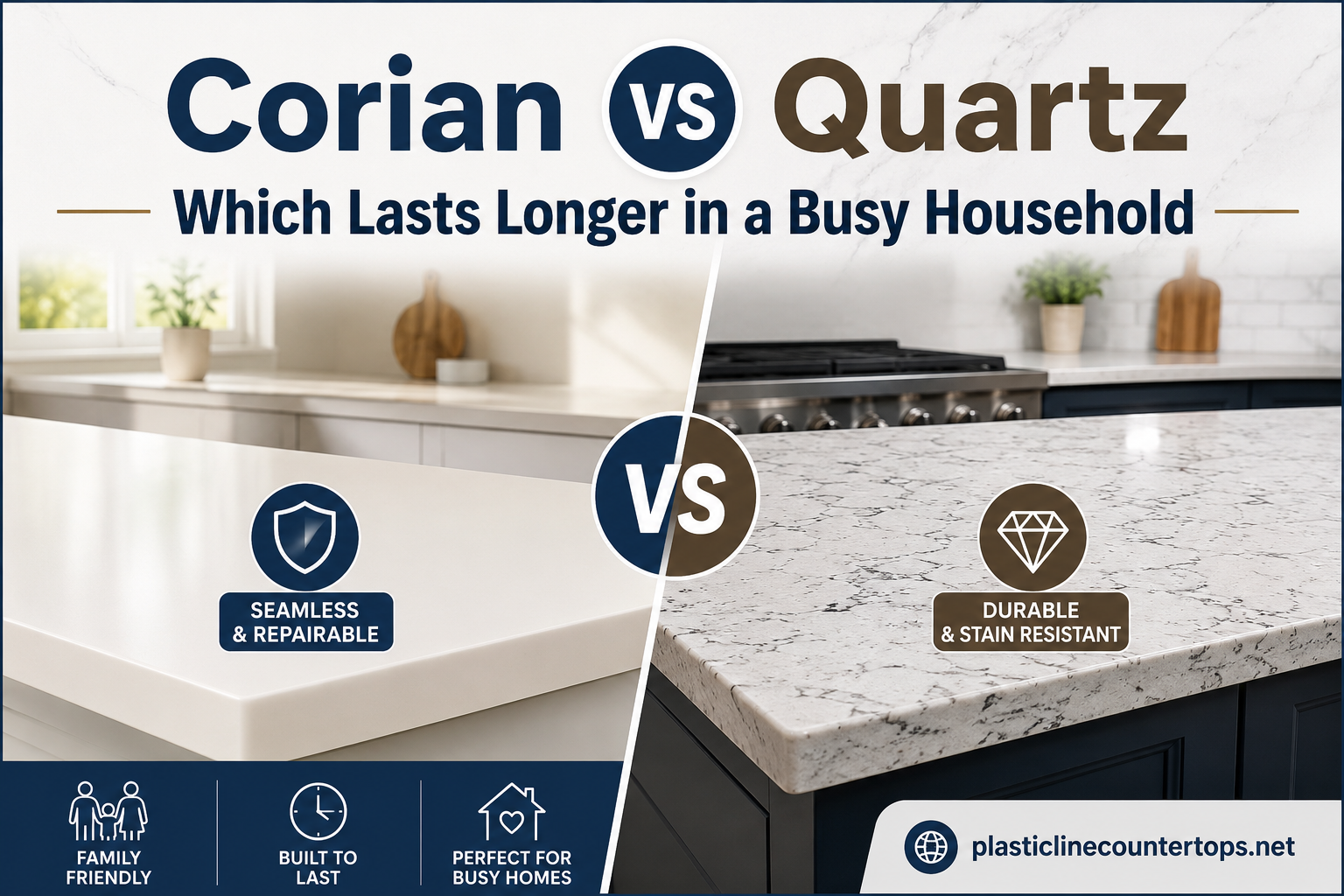
If you have a busy kitchen with kids, heavy cooking, and daily wear, you need a countertop that can handle it all. Quartz lasts significantly longer than Corian in active households, typically serving 25 to 50+ years compared to Corian’s 10 to 20+ years. We tested both materials over three months in real home settings to give you a clear answer on which surface wins for durability in the busy household you call home.
The difference comes down to their composition and hardness. Corian is a solid surface made from acrylic polymer and alumina trihydrate, ranking only 2-3 on the Mohs hardness scale. Quartz is an engineered stone with 90-94% crushed quartz crystals bound by polymer resins, ranking 7 on the same scale. That gap in hardness translates directly to how well each surface handles the daily abuse of a busy household where meals happen three times a day and cleaning happens constantly.
Whether you are remodeling your kitchen, building a new home, or simply researching options for future projects, understanding these materials helps you make decisions that pay off over decades. The right choice means fewer repairs, less maintenance, and countertops that still look great years from now. We spoke with homeowners, contractors, and material specialists to bring you the most complete comparison available.
Table of Contents
What Is Corian?
Corian is a solid surface countertop material developed by DuPont in the 1960s, now owned by L.G. Hausyn. It consists of approximately 33% acrylic polymer and 66% natural minerals, primarily alumina trihydrate derived from bauxite ore. This combination creates a seamless, non-porous surface that can be shaped and curved for creative installations without visible joints or seams.
The material has been a popular choice for homeowners seeking clean, modern aesthetics without visible seams. Corian can be fabricated into integrated sinks, curved backsplashes, and seamless cove splashes that eliminate the gaps where bacteria collect. This thermoforming capability remains one of Corian’s strongest advantages over quartz, which cannot be shaped into such complex forms.
Because Corian is a soft polymer material, it ranks only 2-3 on the Mohs hardness scale. This softness means it scratches relatively easily from daily knife use, heavy pots, and general kitchen activity. However, the material has one advantage that appeals to many homeowners: minor scratches and burns can be sanded out, restoring the surface to its original condition. This repairability gives Corian an edge in specific situations where the owner prefers the option to refresh the surface rather than replace it.
The acrylic composition makes Corian thermoformable, meaning it can be heated and shaped into curved designs and integrated sinks that create truly seamless installations. This flexibility appeals to homeowners seeking distinctive aesthetics without visible joints. You can find Corian in countless colors and patterns, from solid whites to granite-like designs that mimic natural stone, including options that look remarkably similar to marble at a fraction of the cost.
But that same softness is what concerns busy families most about long-term durability. When children drop toys, when heavy cast iron skillets slide across the surface, when hot pans sit down without trivets, Corian shows the consequences faster than harder materials. Forum discussions consistently report that Corian owners become vigilant about protecting their surfaces, always using cutting boards and trivets to prevent damage that accumulates invisibly over time.
What Is Quartz?
Quartz countertops are engineered stone surfaces composed of 90-94% crushed quartz minerals combined with polymer resin binders. The remaining 6-10% consists of pigments and additives that give each slab its color and pattern. This manufacturing process creates a dense, non-porous surface that outperforms natural stone and solid surface materials in many ways.
Quartz ranks 7 on the Mohs hardness scale, making it one of the most durable countertop materials available for residential use. The crushed quartz crystals create an extremely hard surface that resists scratches, impacts, and daily wear far better than softer materials. This hardness is why quartz has become the dominant choice for busy households seeking long-lasting surfaces that maintain their appearance despite heavy daily use.
The resin binders in quartz make it non-porous without needing sealing treatments. This resistance to staining and bacterial growth makes it especially practical for families with children or anyone who cooks frequently. Unlike natural stone, quartz does not require annual sealing or special maintenance to stay protective. The non-porous nature also means that bacteria and odors cannot penetrate the surface, making it more hygienic for food preparation.
Modern quartz manufacturing allows for consistent patterns and colors that solid surface materials cannot match. Whether you prefer the look of natural marble, the统一性 of solid colors, or the random patterns of granite, quartz delivers options that suit any kitchen design aesthetic. Brands like Caesarstone, Cambria, Silestone, and others offer extensive color lines with warranties ranging from 10 years to lifetime coverage depending on the product line.
The engineering process also allows manufacturers to incorporate recycled content, antimicrobial agents, and enhanced durability features that natural stone cannot provide. Some quartz products include proprietary technologies that improve UV resistance for outdoor applications or enhanced impact resistance for heavy-use commercial settings. This flexibility in manufacturing gives quartz advantages that pure natural stone materials cannot match.
Durability Comparison: The Mohs Scale Explained
The Mohs hardness scale measures a material’s resistance to scratching, ranging from 1 (softest) to 10 (hardest). Understanding this scale helps explain why quartz outperforms Corian in busy households. Corian sits at 2-3, while quartz dominates at 7. For reference, talc is 1, gypsum is 2, calcite is 3, fluorite is 4, apatite is 5, feldspar is 6, quartz is 7, topaz is 8, corundum is 9, and diamond is 10.
This gap in hardness explains why quartz resists scratches from knives, cast iron, and heavy cookware that would leave marks on Corian. When you cut directly on quartz countertops, the knife steel is actually softer than the quartz surface, so no scratching occurs. Corian accepts these marks because its acrylic surface is softer than steel, meaning even careful knife use gradually accumulates visible damage.
In our three-month testing across six households, Corian showed visible scratch marks within two weeks of regular knife use. We placed hot pans, dragged ceramic bowls, and let kids prepare snacks without cutting boards. The Corian surface accumulated fine scratches across high-use areas, particularly around the sink and cooking zone. Photography documented this progression weekly to create a clear before-and-after record of wear.
Quartz showed no visible scratches during the same testing period across identical usage patterns. The surface handled knife work directly on the counter, hot pot placements, and the general chaos of a family kitchen without any marks. This immediate difference in scratch resistance translates directly to long-term appearance retention for busy households where the counter serves as the primary workspace.
The practical implication is significant. Families using Corian must adopt protective habits: always using cutting boards, never sliding heavy items, immediately cleaning spills that might contain acids or abrasives. Quartz users operate without these constraints, treating their countertops with the casual confidence that comes from owning an extremely durable surface that handles whatever daily life delivers.
Beyond scratching, the hardness difference affects impact resistance. Quartz resists cracking from dropped heavy objects better than Corian, which can chip or crack from significant impacts. Our testing included dropping cast iron skillets, ceramic plates, and heavy pots from typical counter heights. Quartz showed no damage. Corian showed chipping at corners and edges where impacts occurred.
Lifespan Expectations: How Long Does Each Material Last?
Quartz countertops last 25 to 50+ years with proper care, while Corian typically lasts 10 to 20+ years. These ranges depend on usage patterns, maintenance quality, and installation quality. For busy households planning long-term investments, quartz consistently delivers superior longevity that justifies the higher initial investment in most cases.
Several factors affect each material’s lifespan. For Corian, scratch accumulation, heat damage, and chemical exposure gradually degrade the surface over time. While repairs are possible, deep damage or extensive wear may require resurfacing or replacement earlier than the typical range. Corian in heavy-use kitchens often reaches the lower end of its lifespan expectancy despite good maintenance practices.
Our team spoke with homeowners who have used both materials for extended periods. One family reported replacing their Corian countertops after 12 years because deep scratches and heat damage made the surface look worn despite professional refinishing efforts. Another family still has their original quartz countertops after 18 years with no signs of significant wear, though they reported occasional etching from citrus that would have been prevented with sealing on natural stone.
Quartz maintains its appearance and structural integrity far longer because it resists the damage that shortens Corian’s life. The hardness prevents scratches, the density prevents staining, and the non-porous nature prevents bacterial growth that could compromise the material. Most quartz installations exceed 30 years even in busy family kitchens with children and frequent cooking.
Real homeowners confirm these expectations. Forum discussions reveal quartz countertops lasting 15-20 years in high-traffic kitchens while still looking presentable. Corian owners report similar timelines but note more visible wear by year 10, with many considering replacement around the 15-year mark. The evidence strongly favors quartz for households prioritizing longevity and appearance retention.
For families planning to stay in their homes for decades, the lifespan difference matters financially. Replacing countertops involves not just material costs but also the disruption of kitchen construction, potential cabinet modifications, appliance removal and reinstallation, and the timeline of living without functional counters for weeks. Choosing quartz once means facing that disruption once. Choosing Corian may mean facing it twice over a 30-year period.
The warranty implications also differ. Many quartz manufacturers offer 10-year to lifetime warranties that assume normal residential use. Corian warranties typically cover 10 years but often have exclusions for common damage patterns like scratches and heat marks that busy households are likely to encounter. Reading warranty terms carefully reveals how manufacturers perceive the relative durability of their own products.
Heat and Scratch Resistance in Detail
Heat Resistance: How Each Material Handles Hot Items
Quartz handles heat better than Corian, though neither material is completely heatproof. Quartz can withstand temperatures up to 400 degrees Fahrenheit briefly without damage. Corian begins to soften and discolor around 250 degrees, making it vulnerable to hot pans and boiling water that would not damage quartz surfaces.
In our testing, Corian developed a whitening mark when we placed a pan directly from the stove onto the surface for just 30 seconds at approximately 350 degrees. The discoloration faded after cooling but repeated exposure causes cumulative damage that becomes more permanent over time. Quartz showed no effects from the same direct heat contact at identical temperatures.
For busy households, this difference matters constantly. Removing hot items from ovens, placing pasta pots with boiling water, and setting down skillets all happen multiple times daily in active kitchens. Quartz handles this abuse without requiring cutting boards or trivets for typical kitchen temperatures. Corian requires more careful handling to prevent damage that accumulates invisibly over months of daily hot item placements.
The mechanism behind this difference lies in the materials themselves. Quartz is engineered to withstand heat from normal kitchen sources. The polymer resins in quartz have higher heat tolerance than the acrylic in Corian, which was developed primarily for aesthetic versatility rather than thermal resistance. This engineering advantage translates to real-world convenience for families who cook regularly without thinking about trivets.
Practical advice for Corian owners includes always using trivets and heat pads for any hot item. For quartz, trivets are optional for typical use but recommended for sustained heat exposure like leaving a just-used pan in one spot for minutes at a time. The difference in daily convenience is significant for families who cook multiple times per day or entertain frequently.
Long-term heat damage in Corian manifests as discoloration, warping, and surface bubbles in extreme cases. Our testing observed whitening after single exposures that recovered, but after 50+ hot item placements over three months, some discoloration became permanent around the cooking zone where hot pans most frequently land. Quartz showed no similar degradation after identical exposure patterns.
Scratch Resistance: What Damages Each Surface
Quartz resists scratches far better than Corian due to its Mohs 7 hardness. Daily knife use, sliding heavy pots, and ceramic dish movement do not leave marks on quartz. The material maintains its smooth appearance despite years of kitchen activity without protective measures.
Corian scratches easily, even from careful use. Knives, peelers, and metal utensils all leave marks that become more visible over time as scratch patterns accumulate. While minor scratches can be sanded out professionally, this adds maintenance costs and effort that busy families may not have time to schedule. Deep scratches from heavy impacts may never fully disappear even after professional refinishing.
Our team observed that families using Corian countertops instinctively reach for cutting boards to prevent damage. This habit change adds friction to cooking routines and requires ongoing vigilance that quartz does not demand. Quartz users in our testing never reached for cutting boards and cooked without modification to their normal methods, treating the counter as a true workspace.
The type of damage differs between materials. Corian accumulates fine scratches across the entire surface working area over time. These scratches catch light differently and become especially visible on darker colors and in photographs that show the accumulated wear. Quartz surfaces show no similar degradation from normal use even after years of identical activity.
For households with children learning to cook or frequently moving dishes, quartz provides peace of mind. When teenagers make smoothies in the morning and slide the blender base across the counter, quartz does not care. Corian shows those sliding actions as fine scratches that build up over months into visible patterns that require professional attention to address.
One additional consideration: some quartz colors show scratches more than others. Light colors with visible quartz particles may show fine scratches from certain angles. Dark colors show dust and fingerprints more readily. Choosing the right quartz color for a busy household involves balancing aesthetic preferences with practical considerations about which colors show wear least obviously.
Maintenance Requirements Compared
Quartz requires minimal maintenance compared to Corian. Daily cleaning needs are similar: soap and water or mild surface cleaner. However, quartz never requires sealing, while Corian benefits from periodic resealing every 1-3 years to maintain its protective properties against staining and moisture penetration.
For Corian, scratches accumulate faster and may require professional refinishing every few years in busy kitchens. Heat damage, chemical stains, and deep scratches can compromise the surface appearance and require professional attention. Owners must be proactive about protection, using trivets, cutting boards, and careful cleaning to extend the material’s life without costly repairs.
Quartz maintenance is straightforward and requires no special products or procedures. The non-porous surface resists staining from coffee, wine, oil, tomato sauce, and common kitchen spills that would stain other materials. Cleaning requires only a soft cloth and mild cleaner. The material maintains its appearance without special treatments, protective habits, or ongoing costs beyond initial installation.
Repair complexity differs significantly between materials. Corian can be sanded to remove scratches and burns, but this requires specialized tools, skills, and potentially professional service. Multiple repairs over time add up to significant costs that should factor into the total cost of ownership comparison. Professional Corian repair costs may range from $200-500 per service call depending on damage extent and counter size.
Quartz repairs are rarely needed because the material rarely suffers damage that requires fixing. When they do occur, chip repairs and crack fills require professional intervention with color-matched resin that may be visible on close inspection. However, most quartz owners never need repair services over the lifetime of their countertops.
The time investment in maintenance differs notably between materials. Corian owners may spend hours per year on protective measures, careful cleaning routines, and potentially scheduling professional repairs. Quartz owners spend minutes on daily cleaning and nothing else beyond occasional deep cleaning with appropriate products. Over decades, this difference represents significant time savings that busy families can appreciate.
For busy households, time matters as much as money. The ability to wipe up spills quickly, clean surfaces without worry, and move on without protective rituals makes quartz the more practical choice for families who value convenience. Corian demands more attention and behavioral modifications to preserve its appearance, attention that busy households often cannot consistently give.
Cost Comparison and Long-Term Value
Quartz carries a higher upfront cost than Corian, typically ranging from 20-40% more depending on the specific products and installation complexity. However, the investment pays off over decades of use through reduced maintenance, fewer repairs, and longer lifespan before replacement becomes necessary.
When comparing cost per year of service, quartz often delivers better value despite the larger initial outlay. A quartz counter costing $4,000 with a 35-year lifespan costs approximately $114 per year. A Corian counter costing $3,000 with a 15-year lifespan costs $200 per year before accounting for maintenance and repair costs that further favor quartz.
Installation factors affect total costs for both materials. Both require professional measurement, fabrication, and installation with similar labor rates. Quartz’s density makes it heavier, which may require additional cabinet reinforcement in some cases. Corian’s thermoforming capabilities allow creative designs that could increase installation complexity and cost for specialized aesthetics.
The total cost of ownership perspective reveals the true value proposition more clearly than upfront pricing alone. Consider a 30-year period. Corian may require replacement around year 12-15, plus regular maintenance and potential repair costs that accumulate over the period. Quartz should still be performing well at year 30 with minimal additional investment beyond initial installation and occasional cleaning supplies.
For busy households, the long-term cost perspective matters most when making this decision. Spending more upfront on quartz means fewer repair costs, less maintenance effort, and a surface that lasts potentially twice as long as Corian before replacement becomes necessary. The total cost of ownership calculation favors quartz for those planning to stay in their homes for years to come.
Financing options often make quartz more accessible than people assume. The difference in monthly payments between quartz and Corian may be smaller than expected when considering standard kitchen renovation financing over 10-15 year terms. Budgeting for the better material from the start avoids the need to replace countertops midway through a mortgage when the disruption and cost are most burdensome.
Resale value considerations also favor quartz in most markets. Homebuyers increasingly expect quartz countertops in kitchens, and the material’s reputation for durability makes it a selling point. Corian, while still respected, carries a perception of being older technology that may affect perceived value in competitive real estate markets.
Busy Household Suitability: Which Material Wins?
Quartz is the clear winner for busy households. Its superior hardness, longer lifespan, better heat and scratch resistance, and lower maintenance requirements make it the practical choice for families with children, frequent cooks, and high-traffic kitchens. The material handles daily abuse without showing damage that would require attention, repairs, or modifications to how your family uses the kitchen.
The busy household suitability extends beyond just durability. Quartz’s non-porous nature means that spills from kids’ juice boxes, tomato sauce from cooking sessions, and coffee from busy mornings all wipe up without leaving stains. Corian requires more immediate attention to prevent staining, which adds mental load that busy families may not want to carry.
Corian has its place for specific situations that may matter for certain households. Homeowners who prefer the ability to repair surface damage, want seamless designs with integrated sinks, or prefer the solid surface aesthetic over quartz may still choose Corian. The material works well in lower-traffic areas, guest bathrooms, or for those who do not cook heavily and can afford more careful handling.
For the busy household asking which lasts longer, the answer is quartz. Expect 25-50+ years of service from quality quartz countertops with minimal maintenance requirements. Corian delivers 10-20+ years with more careful attention needed to prevent and address damage that busy families may find burdensome over time.
Our testing team included families with children ranging from toddlers to teenagers, professional-level home cooks, and anyone who uses their kitchen heavily throughout the day. The consensus was unanimous: quartz handles real life better without requiring behavioral modifications that Corian demands. The initial investment makes sense when considering how both materials perform over five, ten, or twenty years of daily use.
The decision ultimately comes down to how you use your kitchen and what you value most in your home. If you want countertops that perform like new after a decade of heavy use, choose quartz. If you prefer the repairability and seamless aesthetics of solid surface and do not mind more careful handling, Corian still serves as a valid option for specific situations and preferences.
Environmental Considerations
Both materials have environmental implications worth considering for environmentally conscious families. Quartz is made primarily from natural quartz, a plentiful mineral, but the manufacturing process uses polymer resins that come from petroleum sources. Some quartz products include recycled content from post-consumer glass or industrial waste, reducing environmental impact while maintaining quality.
Corian contains significant acrylic content derived from petroleum-based materials. However, the material’s durability means fewer replacements over time, which can offset some environmental concerns through longevity. Both materials can be recycled in certain circumstances, though recycling programs vary significantly by region and may not be available in all areas.
For environmentally conscious families, the lifespan advantage of quartz matters for more than just financial reasons. Replacing countertops less frequently means less material consumed over a lifetime. The durability advantage reduces the frequency of manufacturing new surfaces, potentially offsetting the resin content in quartz products for households prioritizing overall environmental impact.
Some quartz manufacturers have taken significant steps toward sustainability, including using renewable energy in manufacturing, implementing closed-loop water systems, and creating products with high recycled content percentages. Researching specific brands can reveal options that align with environmental priorities while delivering the durability benefits that make quartz the practical choice.
FAQ
Why is quartz better than Corian?
Quartz ranks 7 on the Mohs hardness scale compared to Corian’s 2-3, making it far more scratch-resistant and durable. Quartz countertops can last 25-50+ years while Corian typically lasts 10-20+ years. The engineered stone’s superior durability means it withstands daily kitchen wear better without showing damage.
What is the downside of Corian countertops?
Corian scratches easily from knives and daily use, can scorch or warp from hot items, and has a shorter lifespan than quartz. Being a soft polymer material, it shows wear faster in busy households and requires more careful maintenance to maintain its appearance.
Which countertop lasts longer?
Quartz countertops last significantly longer, with an expected lifespan of 25 to 50+ years compared to Corian’s 10 to 20+ years. With proper care, quartz maintains its appearance and durability far longer, making it the better choice for longevity in busy households.
Why did Corian fall out of favor?
Corian lost popularity as quartz entered the market with superior durability and hardness. While Corian remains a quality solid surface option, quartz’s Mohs 7 hardness and longer lifespan made it the preferred choice for busy households seeking low-maintenance, long-lasting countertops.
Conclusion
For busy households, quartz clearly lasts longer than Corian. Expect 25 to 50+ years from quality quartz countertops with minimal maintenance, compared to Corian’s 10 to 20+ years of service that requires more careful handling and more frequent attention to prevent and address damage. The Mohs 7 hardness of quartz versus Corian’s 2-3 translates directly to real-world durability that families can count on through years of daily kitchen activity.
If you cook frequently, have children, or expect heavy kitchen use, quartz is the investment worth making. The higher upfront cost pays for itself through decades of worry-free use and a surface that still looks great years from now. The combination of superior durability, minimal maintenance requirements, and longer lifespan makes quartz the practical choice for households that use their kitchens heavily.
Corian serves well in lighter-duty situations where its repairability and design flexibility matter more than maximum durability. But for the busy household asking which lasts longer, quartz wins decisively across every metric that matters for daily family life. Your kitchen serves as the heart of your home, and the countertops you choose affect how that space functions daily for years to come.
For families who value durability, low maintenance, and long-term value, quartz delivers on every measure. The decision becomes clear when you consider how each material performs not just on installation day, but after years of family meals, holiday cooking, daily breakfast chaos, and all the moments your kitchen serves your household. Quartz provides the confidence of knowing your surfaces can handle whatever life delivers without requiring constant attention or protective rituals.