
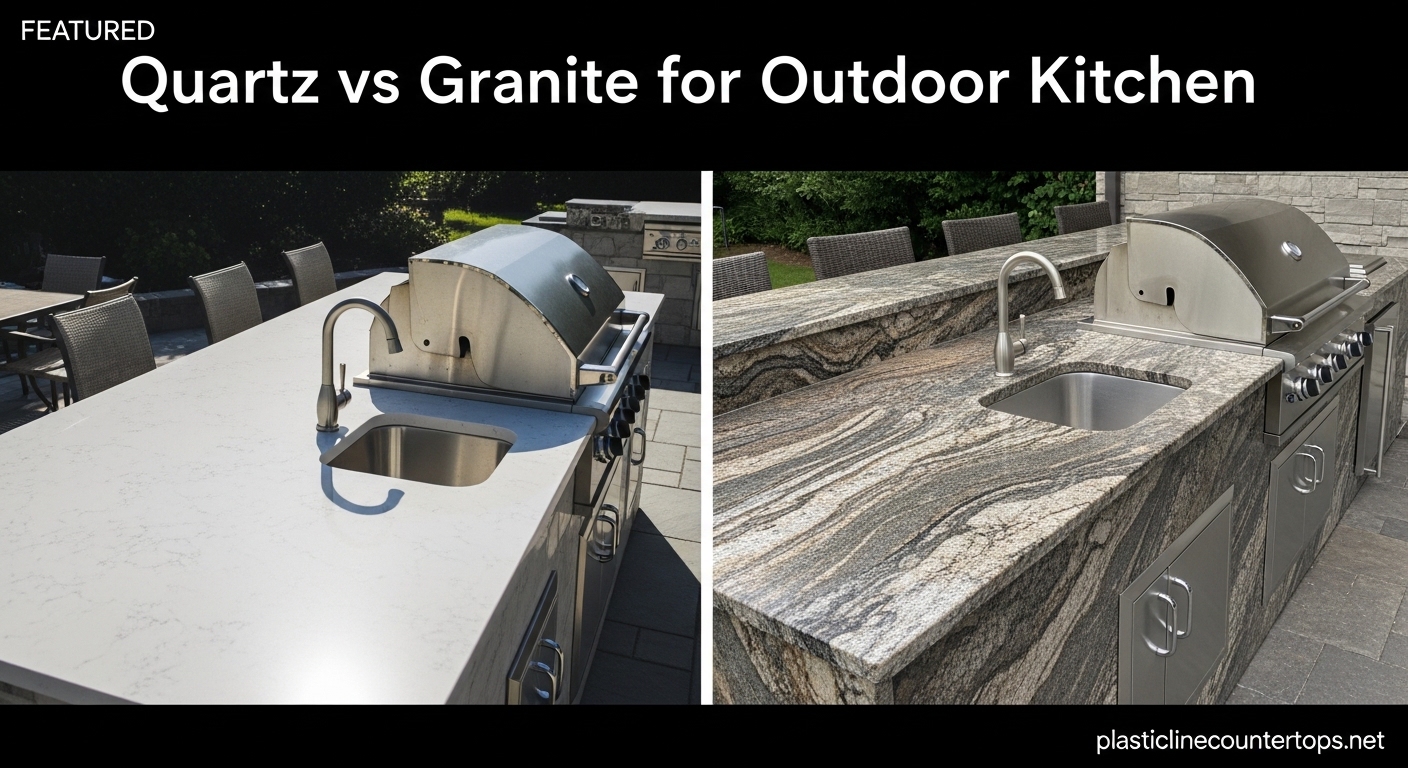
When our team started researching quartz vs granite for outdoor kitchen countertops, we expected a close call. It was not. After digging through real user experiences on Reddit forums, comparing manufacturer warranties, and examining how both materials perform under direct sun and next to hot grills, one material pulled ahead for outdoor use by a wide margin.
Granite wins for outdoor kitchens in most situations. It handles temperatures above 1,200 degrees Fahrenheit without damage, does not fade under UV exposure, and can last over 100 years outdoors with proper sealing. Quartz, while beautiful and low-maintenance indoors, starts degrading in sunlight and can scorch at around 300 degrees Fahrenheit.
That said, quartz does have a place in covered outdoor spaces where it stays shaded and away from direct heat. Our team broke down every factor that matters, from heat resistance and UV stability to maintenance schedules and climate-specific performance, so you can make the right call for your specific setup.
Here is the short version before we get into the details.
Quick answer: Choose granite for uncovered outdoor kitchens, grill stations, and any area with full sun exposure. Consider quartz only for fully covered or shaded outdoor kitchens where the countertop will never see direct sunlight or high heat from a grill.
Table of Contents
What Are Quartz and Granite Countertops?
Before comparing how these materials perform outdoors, it helps to understand what each one actually is. The difference in how they are made explains almost everything about how they behave in an outdoor kitchen.
What Is Granite?
Granite is a natural igneous rock formed deep underground from cooled magma. It is quarried from the earth in massive blocks, then cut into slabs and polished for use as countertops. Every slab is one of a kind, with patterns and colors created by its specific mineral composition, which typically includes quartz, feldspar, mica, and other minerals.
Because granite is a product of nature, it has already survived millions of years of geological pressure and extreme heat. This origin story is exactly what makes it so well-suited for outdoor kitchen environments.
What Is Quartz (Engineered Stone)?
Quartz countertops are an engineered product, not a natural stone slab. Manufacturers grind natural quartz crystals into small pieces, then mix them with polymer resins, pigments, and sometimes recycled glass or metallic flakes. This mixture gets compressed under high pressure and heated to form a dense, uniform slab.
The result is a beautiful, non-porous surface with consistent color and pattern. The polymer resin binder is what gives quartz its stain resistance and makes sealing unnecessary indoors. But that same resin becomes a liability when you take the countertop outside.
Important: Quartz vs Quartzite
This trips up a lot of homeowners, and we see the confusion constantly on forums. Quartzite is not the same as quartz. Quartzite is a natural metamorphic stone that started as sandstone and was transformed by heat and pressure deep in the earth. It looks similar to marble but is much harder.
Quartzite performs extremely well outdoors, often rivaling granite. If you are considering an alternative to granite, natural quartzite is worth a look. Engineered quartz is the one with the outdoor limitations discussed throughout this article.
Heat Resistance: Granite vs Quartz for Outdoor Kitchens
Heat resistance is the single biggest differentiator when comparing quartz vs granite for outdoor kitchen use. Your countertop will sit right next to a grill that generates intense heat, and the material needs to handle that without warping, scorching, or discoloring.
Granite heat resistance: 1,200 degrees Fahrenheit and above. This is a natural stone that formed from molten magma, so it is built to handle extreme temperatures. You can set a hot pan, a grill grate, or even a burning log directly on a granite surface without causing damage.
Quartz heat resistance: approximately 300 degrees Fahrenheit. The polymer resins that bind the quartz crystals together start to soften and discolor at around 300 degrees. Sustained heat above this threshold can cause permanent yellowing, warping, or cracking.
What Real Users Report About Heat
We found consistent reports across Reddit forums from homeowners who learned this lesson the hard way. Multiple users reported that quartz scorches in just 5 to 10 seconds when a hot pan touches the surface. Dark-colored quartz appears to burn even faster, according to several posts on r/OutdoorKitchens.
One user described pulling a hot cast iron skillet off their grill and setting it on their quartz outdoor countertop. By the time they turned around, there was a permanent burn mark. Another reported that even splashing hot water on the corners of a black quartz counter caused discoloration.
These are not isolated incidents. The pattern is clear: if your outdoor countertop will be anywhere near a grill, a pizza oven, or any heat source, quartz is a risky choice.
Direct Sunlight and Surface Temperature
Here is something most comparison articles skip. In direct summer sun, an outdoor countertop surface can reach 140 to 160 degrees Fahrenheit on its own, without anything hot placed on it. That is still below the quartz damage threshold, but it means you have far less margin for error. Add a warm plate from the grill, and you could easily exceed 300 degrees at the contact point.
Granite handles this effortlessly. The surface temperature is irrelevant to its structural integrity, even at 160 degrees in full sun.
UV Stability and Weather Resistance Outdoors
Heat is not the only outdoor threat to your countertop. Ultraviolet radiation from sunlight and exposure to rain, snow, and temperature swings all take a toll over time. This is where the natural vs engineered distinction really matters.
How UV Light Affects Quartz
The polymer resins in engineered quartz are sensitive to UV radiation. Over months and years of sun exposure, these resins break down, causing the countertop color to fade or yellow. White and light-colored quartz shows this yellowing most visibly. Dark quartz can develop a chalky, washed-out appearance.
Most major quartz manufacturers explicitly state that their standard warranties do not cover outdoor use. That should tell you everything you need to know. If the company that made the product will not stand behind it in sunlight, you are taking a real risk installing it outside.
Some manufacturers have started offering UV-resistant quartz lines designed for outdoor applications. These are better than standard quartz, but they still carry the resin-based weaknesses and tend to come at a premium cost without fully solving the heat issue.
How Granite Handles Sun and Weather
Granite is a natural mineral product with no polymer resins to degrade. It does not fade, yellow, or become brittle under UV exposure. The colors you see on day one are the same colors you will see 20 years later, even in full sun.
Granite also handles rain, humidity, and temperature swings well. It has been weathering in the earth for millions of years before it ever became your countertop. As long as it is properly sealed (more on that below), moisture will not penetrate the surface.
Freeze-Thaw Cycle Performance
If you live in a climate where temperatures drop below freezing, this matters. Water that seeps into tiny pores in stone can freeze, expand, and cause cracks over repeated freeze-thaw cycles.
Granite has very low porosity when sealed properly, so freeze-thaw damage is rare with basic maintenance. Quartz is non-porous, which technically gives it an advantage here, but since most outdoor quartz installations face UV degradation long before freeze-thaw becomes a factor, this advantage is mostly theoretical.
The real concern in cold climates is protecting your outdoor kitchen during winter. Our team recommends covering countertops with waterproof covers during the off-season, regardless of which material you choose. This simple step extends the life of both granite and quartz by preventing standing water, ice accumulation, and debris buildup.
Maintenance and Sealing Requirements
This is where quartz has a genuine advantage indoors, but the outdoor picture is more nuanced than most articles lead you to believe.
Granite Sealing Schedule
Granite is a natural stone with microscopic pores. To prevent staining and moisture absorption, it needs to be sealed with a quality stone sealer. For outdoor granite countertops, we recommend sealing once a year, or every two years in milder climates.
The process is straightforward. Clean the surface thoroughly, apply the sealer evenly with a sponge or sprayer, let it sit for the recommended time, then wipe off the excess. It takes about 30 minutes for a typical outdoor kitchen counter. Many homeowners handle it themselves without hiring a professional.
How do you know when it is time to reseal? Sprinkle a few drops of water on the surface. If the water beads up, your seal is still good. If the water absorbs into the stone within 15 to 30 minutes, it is time to reseal.
Quartz Cleaning and Care
One of quartz’s biggest selling points is that it never needs sealing. The non-porous resin surface resists stains naturally, both indoors and outdoors. For regular cleaning, warm water and mild dish soap work fine.
However, there are important cleaning restrictions for quartz. Avoid bleach-based products and acidic cleaners like vinegar or lemon-based solutions, as these can damage the resin surface over time. This answers a common question we see: do not use Clorox wipes on quartz countertops. The bleach in Clorox wipes can discolor and degrade the resin binder with repeated use.
Outdoors, quartz also picks up more dirt and environmental grime than sealed granite because the resin surface can feel slightly tacky in hot weather. This is a minor annoyance but worth knowing about.
Winter Protection Tips for Both Materials
Regardless of whether you choose granite or quartz, winter protection is smart practice for any outdoor countertop.
Our recommendations for winter care:
- Clean the surface thoroughly before the first freeze to prevent stains from setting over winter
- Apply a fresh coat of sealer to granite in late fall, before temperatures drop below 50 degrees
- Cover countertops with fitted waterproof covers to prevent standing water and ice accumulation
- Avoid using de-icing salts near any natural stone surface, as they can cause surface deterioration over time
- Remove leaves and organic debris promptly, as decomposing material can stain both granite and quartz
Cost Comparison and Outdoor Lifespan
Understanding the upfront cost versus long-term value is important for any outdoor kitchen investment. Here is how the two materials compare when you factor in their expected outdoor lifespan.
Initial Installation Cost
Both granite and quartz fall into a similar price range for the material itself. Installed costs vary based on your location, slab quality, edge profiles, and cutouts for sinks or grill openings. In general, you can expect comparable pricing for mid-range options of both materials.
Entry-level granite tends to cost less than entry-level quartz. High-end exotic granite slabs with rare colors and patterns can exceed the cost of premium quartz. Overall, neither material has a dramatic cost advantage over the other.
Outdoor Lifespan: The Real Difference
This is where the comparison gets lopsided, and it is a data point most competitors skip entirely.
Granite outdoor lifespan: 50 to 100+ years with proper sealing and basic care. This is not marketing talk. Granite has been used as a building material for thousands of years. Outdoor monuments, bridges, and building facades made from granite routinely last centuries.
Quartz outdoor lifespan: approximately 15 to 30 years in unprotected outdoor conditions. The limiting factor is UV degradation of the resin binders. Even in shaded areas, ambient UV exposure takes a toll over decades. Once the resins start breaking down, the surface becomes more susceptible to staining, cracking, and color changes.
When you compare these lifespans against the cost, granite offers significantly better long-term value for outdoor installations. A granite outdoor kitchen countertop could outlast your house. A quartz countertop in the same location will likely need replacement within your lifetime.
Maintenance Cost Over Time
Granite requires a yearly sealer application, which costs about 20 to 40 dollars for a quality product that covers a typical outdoor kitchen. Over 30 years, that is roughly 600 to 1,200 dollars in total sealing costs.
Quartz has zero sealing costs. However, if you need to repair or replace a quartz countertop due to UV damage or heat scorching, that expense far exceeds decades of granite sealer.
Climate-Specific Recommendations for Outdoor Countertops
No competitor article we reviewed gives climate-specific advice, but this matters enormously. The right choice in Arizona is different from the right choice in Minnesota.
Hot and Sunny Climates (Southwest, Southern California, Florida)
If you live in an area with intense sun and high temperatures for most of the year, granite is the clear winner. The UV radiation in these regions will degrade quartz resins faster than average. A quartz countertop in Phoenix or Miami that receives direct sun could show visible fading within 3 to 5 years.
Granite thrives in heat. The hotter it gets, the more you will appreciate having a material that simply does not care about temperature.
Cold and Freeze-Thaw Climates (Northeast, Midwest, Mountain West)
In regions with harsh winters, granite remains the better choice, but proper winterization is critical. Sealing your granite before winter and covering it during the off-season prevents any freeze-thaw issues.
Quartz technically resists freeze-thaw damage well because of its non-porous surface, but the winter protection requirements are similar for both materials. Since granite outperforms quartz in every other outdoor category, it still wins here.
Covered vs Uncovered Installations
This is the one scenario where quartz becomes a reasonable option. If your outdoor kitchen is under a solid roof, a pergola with a complete shade cover, or a fully enclosed screen room, quartz can work well. The key conditions are:
- The countertop must receive zero direct sunlight throughout the entire day, including early morning and late afternoon angles
- The grill or heat source must be positioned so that radiant heat does not reach the quartz surface
- You accept that the warranty still may not cover outdoor use, even in covered conditions
If you can meet all three conditions, quartz gives you a low-maintenance, uniform surface that will perform well. For any uncovered or partially covered setup, stick with granite.
How to Choose Between Quartz and Granite for Your Outdoor Kitchen
After researching this topic extensively, our team put together a straightforward decision framework based on your specific situation.
Choose Granite If:
- Your outdoor kitchen is uncovered or partially covered
- The countertop will receive direct sunlight for any part of the day
- Your grill, pizza oven, or smoker is close to the countertop surface
- You live in a hot, sunny climate with intense UV exposure
- You live in a cold climate with freeze-thaw cycles
- You want a countertop that could last a lifetime
- You prefer the look of natural stone with unique patterns
- You are okay with sealing the surface once a year
Consider Quartz If:
- Your outdoor kitchen is fully covered with a solid roof
- The countertop receives zero direct sunlight at all times of day
- No heat sources will be near the countertop surface
- You want a uniform, consistent color and pattern
- You prefer zero sealing maintenance
- You accept a shorter outdoor lifespan of 15 to 30 years
Five Key Questions to Ask Yourself
Before making your final decision, answer these questions honestly:
- Will the countertop see direct sun? If yes, choose granite without question.
- Will hot pans from the grill land on it? If yes, granite only.
- Is the outdoor kitchen fully covered? If no, granite. If fully covered, quartz becomes an option.
- How long do you want it to last? For 50+ years, granite. For 15 to 30 years, either works.
- Are you willing to seal annually? If the idea bothers you and you have full coverage, quartz is viable.
If you answered “granite” to even one of the first three questions, the decision is made. Granite is the safer, more durable, and longer-lasting choice for the vast majority of outdoor kitchen projects
FAQ
Is granite or quartz better for outdoor kitchens?
Granite is better for outdoor kitchens in most situations. It withstands temperatures above 1,200 degrees Fahrenheit, resists UV fading naturally, and lasts 50 to 100+ years outdoors with proper sealing. Quartz is limited to approximately 300 degrees Fahrenheit before the resin binders start to degrade, and UV exposure causes fading and yellowing over time. Choose granite for uncovered or partially covered outdoor kitchens. Quartz can work in fully shaded, covered outdoor spaces where it will never see direct sunlight or high heat.
Can I use Clorox wipes on quartz countertops?
No, you should not use Clorox wipes on quartz countertops. Clorox wipes contain bleach, which can discolor and degrade the polymer resin binder in engineered quartz over time. For routine cleaning, use warm water with a small amount of mild dish soap and a soft cloth or sponge. Avoid any products containing bleach, abrasive powders, or acidic solutions like vinegar and lemon cleaners.
What is the best countertop material for an outdoor kitchen?
Granite is widely considered the best countertop material for outdoor kitchens because it handles extreme heat, UV exposure, rain, snow, and temperature swings without degrading. Natural quartzite is another excellent option with similar outdoor durability. Concrete is a budget-friendly alternative. Engineered quartz ranks last among common outdoor choices due to UV sensitivity and low heat resistance, though it can work in fully covered installations.
Why do some people say granite is outdated?
Granite is not outdated. This perception comes from the surge in quartz marketing over the past decade, which positioned quartz as a modern, low-maintenance alternative. In reality, granite remains one of the most popular countertop materials for both indoor and outdoor use. Its natural variation, heat resistance, and longevity keep it in demand. For outdoor kitchens specifically, granite outperforms quartz in every meaningful category.
Does quartz fade in sunlight?
Yes, quartz fades in sunlight. The polymer resins used to bind engineered quartz crystals are sensitive to UV radiation. With prolonged sun exposure, these resins break down and cause the surface to yellow, fade, or develop a chalky appearance. White and light-colored quartz shows yellowing most visibly, while dark quartz can look washed out. This is why most quartz manufacturers void their warranty for outdoor installations.
How often should granite be sealed outdoors?
Outdoor granite countertops should be sealed once a year in most climates. In milder regions with less rain and fewer freeze-thaw cycles, sealing every two years may be sufficient. To test whether your granite needs resealing, sprinkle a few drops of water on the surface. If the water beads up, the seal is intact. If the water absorbs into the stone within 15 to 30 minutes, it is time to reseal. Apply sealer in late spring or early fall when temperatures are between 50 and 80 degrees Fahrenheit for best results.
Final Verdict: Quartz vs Granite for Outdoor Kitchens
For the vast majority of homeowners building an outdoor kitchen, granite is the right choice. It handles the heat of your grill, the sun beating down all summer, and decades of weather without complaint. The yearly sealing is a small task that takes 30 minutes and pays off with a countertop that can last generations.
Quartz has its place, but that place is indoors or in a fully covered outdoor space where sun and heat never reach the surface. Taking engineered quartz outside into direct exposure is a gamble that real users on Reddit forums consistently regret.
Our recommendation is straightforward: go with granite for your outdoor kitchen, seal it once a year, cover it in winter, and enjoy a surface that will look as good in 30 years as it did on day one.