
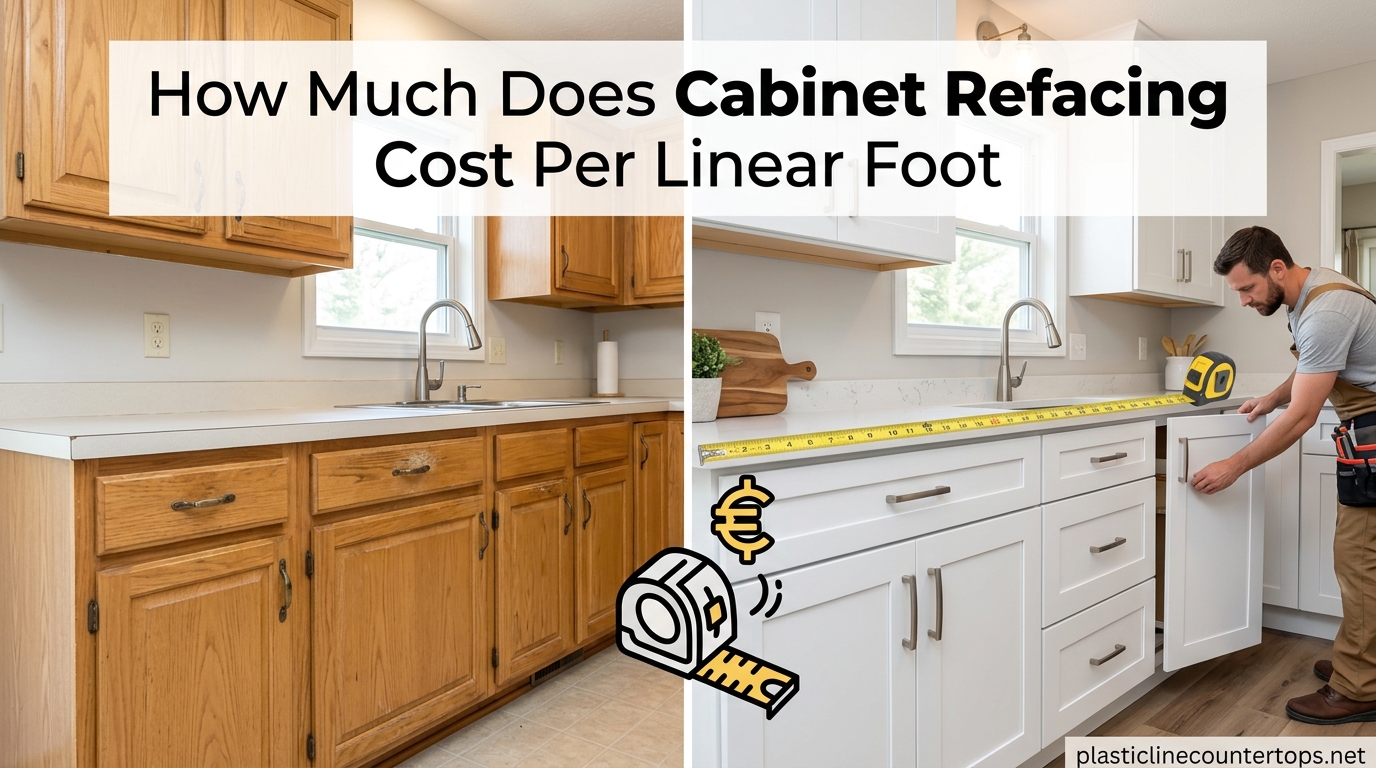
If you are planning a kitchen update and wondering how much does cabinet refacing cost per linear foot, the short answer is $100 to $250 per linear foot on average. Most homeowners pay between $4,000 and $9,500 total for a standard kitchen refacing project in 2026. The exact cost depends on the material you choose, the size of your kitchen, labor rates in your area, and whether you add hardware upgrades.
I have spent years researching kitchen renovation costs, and cabinet refacing consistently comes up as one of the most misunderstood pricing topics. Homeowners often get quotes that surprise them, sometimes matching full replacement costs. This guide breaks down every factor that determines the cabinet refacing cost per linear foot so you can budget accurately and avoid overpaying.
We will cover material pricing tiers, room size calculations, labor breakdowns, hidden costs, and what refacing simply cannot fix. By the end, you will have a clear picture of what your project should cost and how to evaluate contractor quotes with confidence.
Table of Contents
Average Cost to Reface Cabinets Per Linear Foot
Cabinet refacing costs between $100 and $250 per linear foot for most projects in 2026. This price includes new cabinet doors, drawer fronts, veneer or laminate covering on exposed frames, and basic hardware installation. The national average sits around $150 per linear foot.
Here is how that breaks down by pricing tier:
- Budget range: $100 to $150 per linear foot (laminate materials, basic hardware)
- Mid-range: $150 to $250 per linear foot (wood veneer, upgraded hardware, soft-close hinges)
- High-end: $250 to $450 per linear foot (solid wood refacing, custom finishes, premium hardware)
For a typical 10-by-10 kitchen with roughly 25 linear feet of cabinetry, expect to pay $2,500 to $6,250 for budget materials, $3,750 to $6,250 for mid-range, and $6,250 to $11,250 for high-end refacing. These figures align with data from Angi and HomeAdvisor, which report the average total project cost between $4,000 and $9,500.
One important note: some contractors and sources quote up to $450 per linear foot for premium solid wood refacing with extensive custom work. That higher range typically applies to large kitchens with complex layouts, custom stain matching, or specialty wood species like cherry or walnut.
The per-linear-foot measurement covers the visible surface area of your cabinets. This includes all door fronts, drawer fronts, exposed side panels, and the face frame around each cabinet opening. It does not include interior shelving or the inside of cabinet boxes, which remain untouched during refacing.
Cabinet Refacing Cost by Material Type
The material you choose has the single biggest impact on your cabinet refacing cost per linear foot. Three main material options dominate the market, each with distinct price points and durability characteristics.
Laminate Cabinet Refacing ($100 – $150 per linear foot)
Laminate is the most budget-friendly refacing material. It consists of thin synthetic sheets bonded to the cabinet surfaces with adhesive. Modern laminate has improved dramatically from the flat, plasticky look of decades past. Today’s options include textured finishes that mimic wood grain, matte surfaces, and even matte solid colors.
Laminate refacing typically costs $100 to $150 per linear foot installed. The material itself runs $2 to $5 per square foot, with labor making up the remainder. Laminate resists moisture well and cleans easily, but it can chip at edges and is difficult to repair once damaged.
This option works best for homeowners on a tight budget or those planning to sell within a few years. The return on investment is solid because the visual transformation is significant relative to the cost. Just keep in mind that laminate has a shorter lifespan than wood veneer, typically lasting 10 to 15 years before showing wear.
Wood Veneer Cabinet Refacing ($150 – $250 per linear foot)
Wood veneer is the most popular refacing material, and for good reason. Real wood veneer is sliced from actual hardwood logs and applied to cabinet surfaces, giving you the authentic look and feel of solid wood at a fraction of the cost. Veneer refacing costs $150 to $250 per linear foot installed.
Common wood species for veneer include oak, maple, birch, and cherry. The material costs $5 to $12 per square foot, depending on the wood species and cut. You can stain veneer to match existing trim or go with an entirely new color. It also accepts paint well if you want a solid-color finish.
Veneer offers better durability than laminate, with a typical lifespan of 15 to 25 years. It can be refinished or re-stained over time, which extends its useful life. The main downside is that veneer can peel in high-humidity environments if not properly sealed, so bathroom applications require extra attention.
Solid Wood Cabinet Refacing ($250 – $450 per linear foot)
Solid wood refacing is the premium option, involving the installation of new solid wood doors, drawer fronts, and trim pieces rather than applying a thin layer to existing surfaces. This approach costs $250 to $450 per linear foot but delivers the most authentic result.
With solid wood refacing, you get real wood doors with full depth, raised panel profiles, and genuine grain patterns throughout. The material costs $15 to $30 per square foot for premium species. Oak and maple sit at the lower end of the range, while cherry, walnut, and custom-milled exotic woods push toward the top.
This option makes sense when your existing cabinet boxes are in excellent structural condition and you want the look and feel of brand-new solid wood cabinets without the demolition and replacement cost. Solid wood refacing can last 30+ years with proper care and adds the most value to your home.
Cost by Room Size and Linear Footage
Kitchen size directly affects your total refacing bill. More linear feet of cabinetry means more doors, drawer fronts, veneer sheets, and labor hours. Here is what you can expect based on kitchen dimensions.
Small Kitchen (10 – 15 linear feet)
A small kitchen, such as a galley or apartment layout, typically has 10 to 15 linear feet of cabinetry. Refacing costs range from $1,000 to $3,750 total, depending on material choice. These projects usually take 2 to 3 days to complete.
Small kitchens are where refacing delivers the best value. The limited cabinet footprint keeps costs low, and the visual impact of new doors and finishes is dramatic relative to the investment. If you are working with a $5,000 budget, a small kitchen refacing leaves room for new countertops or a backsplash.
Medium Kitchen (20 – 30 linear feet)
Most standard kitchens fall in the 20 to 30 linear foot range. A typical 10-by-10 kitchen has about 25 linear feet of cabinetry. Refacing costs for medium kitchens run $2,000 to $7,500 for laminate, $3,000 to $7,500 for veneer, and $5,000 to $13,500 for solid wood.
This is the size range where you really need to compare refacing against full replacement. As Reddit users in the HomeImprovement community have pointed out, some contractor quotes for refacing a medium kitchen come in surprisingly close to basic cabinet replacement prices. Always get at least three quotes and compare both options.
Large Kitchen (30 – 50+ linear feet)
Large kitchens with islands, pantry cabinets, and extensive upper and lower cabinetry can have 30 to 50 or more linear feet. Total refacing costs range from $3,000 to $22,500 depending on materials and complexity. These projects take 5 to 7 days on average.
Large kitchens benefit most from the cost savings of refacing over replacement. Full cabinet replacement for a large kitchen can easily exceed $25,000, while refacing keeps the project under $15,000 in most cases. The savings become even more significant when you factor in avoiding countertop removal and reinstall, plumbing disconnection, and floor repair.
Factors That Affect Cabinet Refacing Cost Per Linear Foot
Several variables push your per-linear-foot cost up or down beyond just material choice. Understanding these factors helps you evaluate whether a contractor quote is fair or inflated.
Labor Costs
Labor typically accounts for 40% to 60% of your total refacing cost. Professional installers charge $50 to $100 per hour, and a standard 25-linear-foot kitchen takes 3 to 5 days for a two-person crew. That translates to $2,400 to $8,000 in labor alone.
Labor rates vary significantly by region. Urban areas on the coasts often run 30% to 50% higher than the national average. Rural and midwest locations tend to sit 10% to 20% below average. Always ask contractors for a labor line item separate from materials so you can compare quotes accurately.
Hardware and Upgrades
New hardware adds up quickly. Basic cabinet knobs cost $2 to $5 each, while designer pulls run $10 to $30 each. A kitchen with 40 cabinet doors and drawers needs 40 pieces of hardware, which means $80 to $1,200 just for knobs and pulls.
Soft-close hinges are a popular upgrade that adds $5 to $15 per hinge. With most cabinets using two or three hinges per door, a 25-door kitchen could add $250 to $1,125 for soft-close hardware alone. Full-extension drawer slides, pull-out shelving, and lazy Susans are additional upgrades that increase your per-linear-foot cost.
Cabinet Condition and Prep Work
The condition of your existing cabinets affects cost more than most homeowners expect. If your cabinet boxes are warped, water-damaged, or have failing joints, the installer needs to repair these issues before refacing can begin. Prep work adds $200 to $800 to most projects.
Homes built before 1978 may require lead paint testing and abatement before refacing work begins. This adds $300 to $1,500 depending on the scope. Your contractor should address this during the estimate phase, but it is worth asking about proactively.
Regional Price Variations
Where you live matters. Cabinet refacing in California, New York, or the Pacific Northwest typically costs 20% to 40% more than the national average. The Midwest and South generally offer the lowest rates. Even within a single state, urban centers command higher prices than suburban or rural areas.
This regional variation is driven by labor costs, material shipping distances, and local demand for renovation services. If you live in a high-cost area, it may be worth getting quotes from contractors in nearby smaller towns, as some will travel for larger projects.
Number of Doors and Drawers
More individual doors and drawer fronts means more labor and material. A kitchen with 30 small doors costs more to reface than one with 15 large doors covering the same linear footage. Drawers are typically more expensive than doors per unit because they require more precise fitting and additional hardware like slides.
If you have oddly shaped cabinets, arched doors, or custom sizes, expect to pay a premium. Standard-size door and drawer fronts cost less because they can be ordered in bulk from manufacturers. Custom sizes require individual fabrication.
DIY vs Professional Cabinet Refacing Costs
Doing the work yourself can cut your total cost by 40% to 60%. A DIY laminate refacing project for a 25-linear-foot kitchen might cost $800 to $1,500 in materials alone, compared to $2,500 to $6,250 for professional installation. That is a significant savings.
However, DIY refacing comes with real risks. Veneer application requires precise measuring, clean adhesive work, and patience with edge banding. Mistakes are costly because veneer is unforgiving. Once stuck, it is difficult to reposition without damaging the material or the cabinet surface underneath.
Here is a side-by-side comparison for a typical 25-linear-foot kitchen:
- DIY laminate: $800 – $1,500 (materials only, no labor)
- Professional laminate: $2,500 – $3,750 (materials + labor)
- DIY veneer: $1,200 – $2,500 (materials only, no labor)
- Professional veneer: $3,750 – $6,250 (materials + labor)
- Professional solid wood: $6,250 – $11,250 (not recommended for DIY)
I generally recommend professional installation for wood veneer and solid wood refacing. The precision required for seamless joints, proper adhesive application, and hardware alignment makes professional work worth the investment. DIY works best for simple laminate applications on straightforward cabinet layouts.
If you choose the DIY route, factor in the cost of tools you may need to purchase or rent. A laminate roller, edge banding iron, precision cutting tools, and clamps can add $200 to $500 to your project budget. You also need to account for a higher waste factor of 10% to 15% extra material for mistakes.
What Cabinet Refacing Cannot Fix
This is the section most contractors skip, and it is one of the biggest pain points I see in homeowner discussions. Cabinet refacing is a cosmetic upgrade, not a structural one. Knowing its limits prevents expensive disappointment.
Layout Problems Stay the Same
Refacing does not change your kitchen layout. If your dishwasher is crammed next to the refrigerator, or if the workflow between your sink, stove, and refrigerator is awkward, refacing will not solve those problems. The cabinet boxes stay exactly where they are.
Reddit discussions in the HomeImprovement community are full of homeowners who expected refacing to include moving cabinets or changing configurations. It does not. If you need to change the layout, you need at least partial replacement, which increases the cost significantly.
Damaged Cabinet Boxes Remain
Refacing only covers the visible surfaces. If your cabinet boxes have water damage, warping, loose joints, or pest damage, those issues stay hidden under the new veneer. A reputable contractor will flag these problems during the estimate, but not all do.
Before committing to refacing, inspect every cabinet box thoroughly. Open each door and check for soft spots on the floor of sink cabinets, look for discoloration that indicates water damage, and push on side panels to check for structural integrity. If more than 20% of your boxes have issues, replacement may be the better investment.
Interior Storage Does Not Improve
The inside of your cabinets stays exactly the same after refacing. If you have deep, unreachable corner cabinets or shelves with awkward spacing, those issues persist. You can add pull-out organizers and accessories as add-ons, but these increase the project cost and are separate from the refacing process itself.
Countertops and Backsplash Are Separate
Cabinet refacing does not include countertop or backsplash work. If you want a complete kitchen transformation, you need separate budgets for those elements. The good news is that refacing does not require removing your existing countertops, so you can tackle that upgrade later without redoing the cabinet work.
Hidden Costs and Timeline Expectations
Beyond the quoted per-linear-foot price, several costs catch homeowners off guard. Knowing about these upfront helps you budget realistically.
Common Hidden Costs
Moldings and trim often add $5 to $15 per linear foot to your total. Crown molding, light rail molding under upper cabinets, and fillers around appliances are typically quoted separately. Many homeowners do not realize these items are not included in the base per-linear-foot price.
Removal and disposal of old doors and drawer fronts costs $200 to $500 on most projects. Some contractors include this in their base price, while others itemize it separately. Ask upfront to avoid surprises.
Touch-up painting after installation adds $100 to $300 in most cases. Installers may scuff walls or need to caulk around new trim, and repainting the affected areas is usually the homeowner’s responsibility unless negotiated in the contract.
Permit costs are rare for refacing alone, but if your project includes electrical work for new under-cabinet lighting or plumbing changes for a new sink, permits add $100 to $500 depending on your municipality.
Timeline by Project Size
Refacing is significantly faster than full cabinet replacement. Here is what to expect:
- Small kitchen (10-15 linear feet): 2 to 3 days
- Medium kitchen (20-30 linear feet): 3 to 5 days
- Large kitchen (30-50 linear feet): 5 to 7 days
These timelines assume professional installation with a two-person crew. DIY projects typically take 2 to 3 times longer, especially for first-timers. Add 1 to 2 weeks for material ordering and delivery before installation begins.
One often-overlooked factor is the lead time for custom door and drawer front orders. Standard sizes ship in 1 to 2 weeks, but custom or specialty orders can take 4 to 8 weeks. Ask your contractor about lead times before committing to a start date.
ROI and Home Value Impact
Cabinet refacing returns 70% to 80% of its cost in added home value, according to remodeling industry data. This makes it one of the better kitchen renovation investments, especially compared to full cabinet replacement, which returns only 50% to 60%.
The ROI advantage comes from the lower initial investment. Spending $6,000 on refacing and recouping $4,800 in value is more efficient than spending $18,000 on replacement and recouping $10,800. Both add similar visual appeal from a buyer’s perspective.
If you plan to sell your home within 5 years, refacing is almost always the better financial decision. It provides the updated look buyers want without the steep investment that is difficult to recover. For long-term homeowners planning to stay 15+ years, the calculus changes, and replacement may offer better durability and satisfaction.
Real estate agents consistently report that updated kitchens sell homes faster. Even a modest laminate refacing that costs $3,000 to $4,000 can shave weeks off your time on market and generate stronger offers. The key is choosing neutral, broadly appealing finishes rather than trendy or polarizing colors.
Cabinet Refacing vs Full Replacement: Quick Comparison
Understanding how refacing stacks up against full replacement helps you make the right call for your situation and budget.
- Cost: Refacing runs $4,000 to $9,500 on average. Full replacement costs $10,000 to $25,000+.
- Timeline: Refacing takes 2 to 7 days. Full replacement takes 2 to 6 weeks.
- Mess: Refacing produces minimal dust and debris. Full replacement involves demolition, dumpster rental, and disruption.
- Layout changes: Refacing keeps your existing layout. Replacement allows complete redesign.
- Structural issues: Refacing does not address damaged boxes. Replacement gives you all-new construction.
- Countertops: Refacing leaves countertops in place. Replacement usually requires new countertops.
The decision often comes down to the condition of your existing cabinets and whether your current layout works for you. If the boxes are solid and the layout is functional, refacing makes financial sense. If you are fighting a bad layout every day or the boxes are failing, bite the bullet and go with replacement.
FAQ
How much does it cost per linear foot to resurface cabinets?
Cabinet resurfacing costs $100 to $250 per linear foot on average, with most homeowners paying around $150 per linear foot. Laminate resurfacing starts at $100 per linear foot, wood veneer runs $150 to $250, and solid wood refacing can reach $450 per linear foot for premium materials and custom work.
What is the downside of cabinet refacing?
The main downsides of cabinet refacing are that it does not fix layout problems, leaves damaged cabinet boxes untouched, and does not improve interior storage. Refacing is purely cosmetic. Some homeowners also find that contractor quotes for refacing come close to replacement costs, reducing the savings advantage.
What cabinet color is outdated?
Dark cherry, honey oak, and almond or bisque colors are generally considered outdated in 2026. These finishes were popular in the 1990s and early 2000s but now read as dated. Current trends favor white, navy, sage green, warm wood tones, and two-tone combinations.
Can I redo my kitchen for $10,000?
Yes, you can reface kitchen cabinets for under $10,000 if your kitchen is small to medium-sized and you choose laminate or mid-range veneer materials. A 25-linear-foot kitchen refaced with laminate costs $2,500 to $3,750, leaving $6,000 to $7,500 for countertops, backsplash, paint, and hardware. A full cabinet replacement for $10,000 is possible but tight and usually requires stock cabinets and minimal layout changes.
Conclusion
Cabinet refacing costs $100 to $250 per linear foot on average, making it 50% to 78% less expensive than full cabinet replacement. Your actual cost per linear foot depends primarily on the material you choose, with laminate at the low end and solid wood at the high end, plus labor, hardware upgrades, and regional pricing differences.
The key takeaway from our research: get at least three contractor quotes and compare them against full replacement pricing. As homeowners on forums consistently report, refacing quotes sometimes match replacement costs, which defeats the purpose. A fair refacing quote should save you at least 40% compared to equivalent-quality replacement.
Before you commit to refacing, inspect your cabinet boxes for structural damage and honestly evaluate whether your current kitchen layout works. If both check out, cabinet refacing delivers one of the best returns on investment in kitchen renovation. Now that you know how much cabinet refacing costs per linear foot, you can budget with confidence and spot a fair quote when you see one.