
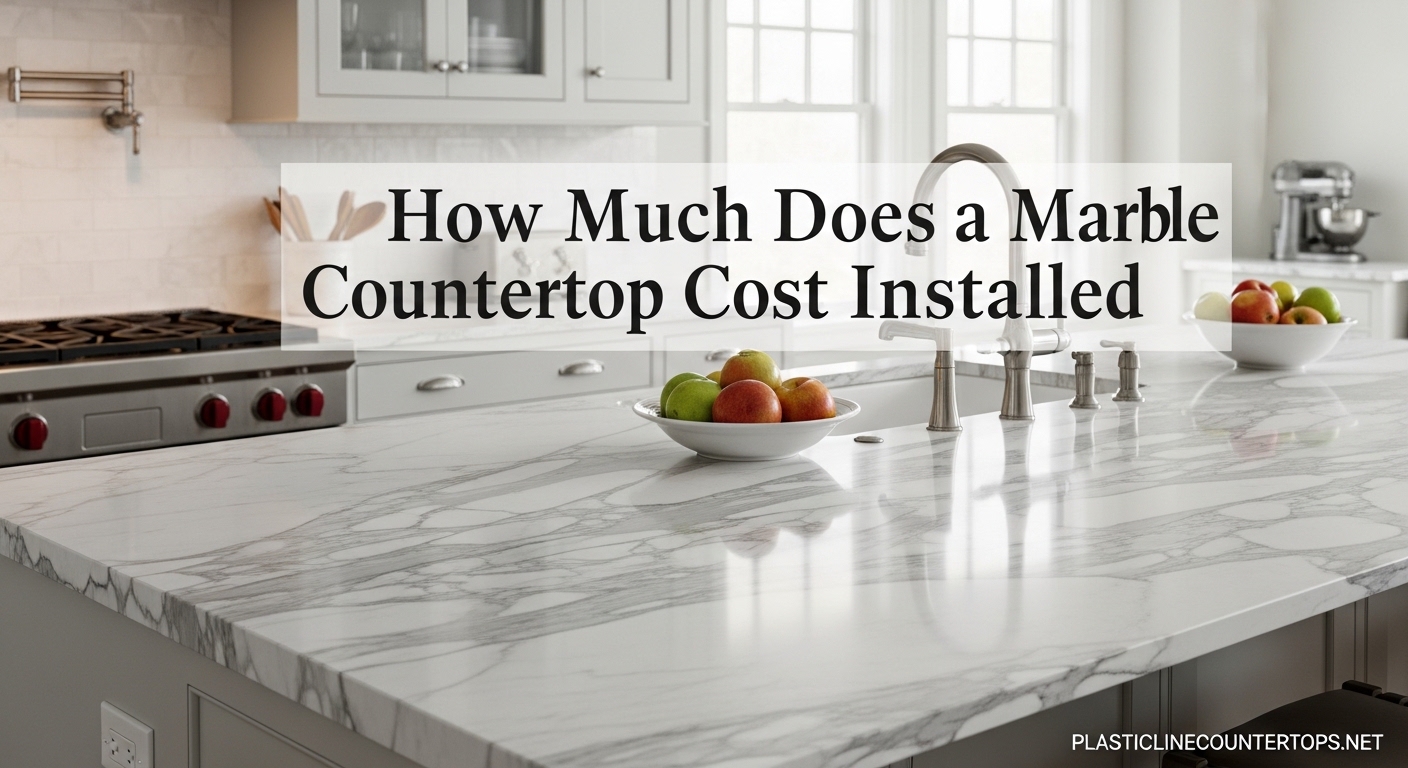
If you are wondering how much does a marble countertop cost installed, the short answer is $50 to $200 per square foot, with most homeowners paying between $1,750 and $7,000 for a full project. The national average sits right around $3,500 for a standard kitchen installation.
I have spent weeks reviewing real homeowner quotes, fabricator pricing sheets, and forum discussions to give you an honest, detailed picture of what marble countertops actually cost in 2026. The price range is wide because marble type, kitchen size, and installation complexity all push the final number up or down significantly.
This guide breaks down every cost factor you need to know before signing a contract. You will find specific pricing for every major marble variety, labor rates, hidden fees most contractors do not mention upfront, comparisons with granite and quartz, and real numbers from homeowners who have been through the process. By the end, you will have a clear understanding of what to budget and how to avoid overpaying.
Table of Contents
Marble Countertop Cost Installed: The Complete Breakdown
The installed cost of a marble countertop includes the stone slab itself, professional fabrication, delivery to your home, and the physical installation. When a contractor gives you a “per square foot installed” price, it should cover all of those components together. In 2026, the most common range homeowners report paying is $60 to $150 per square foot installed.
Here is how the total installed cost breaks down by typical kitchen size:
- Small kitchen (30-40 sq ft): $1,500 – $8,000 installed
- Medium kitchen (50-60 sq ft): $2,500 – $12,000 installed
- Large kitchen (80-100 sq ft): $4,000 – $20,000 installed
- Bathroom vanity (10-20 sq ft): $500 – $4,000 installed
- Kitchen island only (20-30 sq ft): $1,000 – $6,000 installed
The national average for a full kitchen marble countertop installation lands at $3,500, according to data aggregated from contractor estimates across the country. But your actual cost could be half that or double it, depending entirely on the choices you make with marble type, edge profiles, and installation complexity.
One important thing I learned from forum discussions: the total project cost tends to run roughly 2 times the material cost alone. So if you pick a slab that costs $3,000, budget around $6,000 for the full installed project. This catches many homeowners off guard when they get their first real quote, because they only priced the stone without factoring in fabrication and labor.
What Is Included in an “Installed” Price?
A true installed price should cover the slab material, professional templating at your home, fabrication (cutting, polishing, edge profiling), delivery to your home, physical installation, and basic sealing. Some contractors include sink cutouts in their base price, while others charge them as line items. Always ask for an itemized quote so you know exactly what you are paying for.
What is typically not included: demolition and removal of old countertops, plumbing reconnection, backsplash installation, electrical work, and permit fees. These add-ons can tack on $500 to $2,000 or more to your final bill, so budget for them separately from the start.
I always recommend asking your fabricator for a detailed written quote that breaks out every single item. This protects you from surprise charges and makes it easy to compare quotes from different contractors on an apples-to-apples basis.
Marble Types and Their Costs Per Square Foot
The single biggest factor in your marble countertop cost installed is the type of marble you choose. Two kitchens with identical layouts and the same square footage can have a $10,000 price difference just from the stone selection alone. Here is how the major varieties compare.
Cost Comparison by Marble Type
Use this breakdown to compare marble varieties and their installed cost per square foot:
- Carrara marble: $40 – $100/sq ft installed | Soft gray veining on white background, the most common and most affordable genuine marble option
- Calacatta marble: $175 – $400+/sq ft installed | Bold, dramatic veining on bright white background, rare and premium, quarried in limited quantities
- Statuario marble: $75 – $200/sq ft installed | Mixed gray veining on bright white, considered a step between Carrara and Calacatta in both looks and price
- Emperador marble: $50 – $150/sq ft installed | Rich brown tones with light veining, Spanish origin, brings warmth and a distinctive look to kitchens
- Crema Marfil marble: $40 – $100/sq ft installed | Warm cream color with subtle veining, versatile neutral tone, budget-friendly option
- Nero Marquina marble: $60 – $175/sq ft installed | Deep black background with white veins, makes a dramatic statement in modern kitchens
Carrara Marble: The Best Value Pick
Carrara marble comes from quarries in Tuscany, Italy, and it is the most widely available marble variety on the market today. The soft gray veining on a white or blue-gray background gives it that classic, timeless look most people picture when they think of marble countertops.
At $40 to $100 per square foot installed, Carrara is the most affordable way to get genuine marble in your kitchen. I have seen multiple homeowners on Reddit report paying $60 to $85 per square foot installed for Carrara in 2026, which lines up closely with national averages from contractor pricing data.
Because Carrara is abundant and quarried in large volumes, supply is steady and pricing is predictable. If you want the marble look without the premium price tag, this is where you start. It is also the marble you will find most often in home improvement stores and tile showrooms, making it easy to see and touch before you buy.
One thing to keep in mind: Carrara has softer, more linear veining compared to the bold patterns found in pricier marbles. Some people prefer this subtlety, while others find it less dramatic than they want. Visit a stone yard and look at full slabs in person before committing.
Calacatta Marble: The Luxury Choice
Calacatta marble is what you see in luxury kitchen magazines, high-end restaurant interiors, and celebrity home tours. It features bold, thick veining on a stark white background, and it is quarried in extremely limited quantities from a specific region near Carrara, Italy.
The price reflects that scarcity: $175 to $400 or more per square foot installed. Multiple forum users have reported being shocked at Calacatta Viola quotes in particular, with some dramatic slabs commanding $500+ per square foot. This is the most expensive commonly available marble variety.
If your heart is set on Calacatta but the budget is tight, consider using it for a small kitchen island or an accent area and pairing it with a less expensive marble like Carrara on the perimeter countertops. You get the luxury look where it matters most without the luxury price tag everywhere.
Statuario Marble: The Middle Ground
Statuario marble sits between Carrara and Calacatta in both appearance and price. It features bolder veining than Carrara but is typically less dramatic than Calacatta, with a bright white background that many homeowners prefer. At $75 to $200 per square foot installed, it is a strong option for people who want something more distinctive than Carrara without paying Calacatta prices.
Statuario is also quarried in Italy, and like Calacatta, it is available in more limited quantities than Carrara. This limited supply means you may need to special-order slabs from your fabricator rather than selecting from in-stock inventory.
Understanding Marble Grades (A Through D)
Beyond the marble variety, each slab is graded on a letter scale from A to D, and the grade directly affects what you pay. Understanding grades helps you evaluate whether a quote is fair for the quality you are getting:
Grade A: Premium quality with minimal imperfections, consistent color, and few natural fissures. This is the most expensive grade and what high-end fabricators prefer to work with because it behaves predictably during cutting and polishing.
Grade B: Minor imperfections, slight color variation, and small fissures that do not affect structural integrity. Still excellent quality for countertops and costs meaningfully less than Grade A. Most mid-range quotes use Grade B marble.
Grade C: More visible imperfections, noticeable veining inconsistencies, and may require resin filling during fabrication. Budget-friendly but still genuine natural marble. Works well if you like organic, imperfect character.
Grade D: Significant flaws, heavy veining irregularities, and large fissures that require substantial resin or mesh backing during fabrication. Cheapest grade available but may not hold up well for high-traffic kitchen countertops over time.
Ask your fabricator what grade of marble they are quoting. A low price might mean Grade C or D stone, which is not necessarily bad, but you should know what you are getting. Grade A and B marble will give you a more consistent appearance and better long-term durability.
Marble Countertop Installation Cost Factors
Installation labor is the second largest cost component after the marble slab itself, and it often surprises homeowners who focused only on the stone price. Knowing what drives labor costs helps you understand your quote and identify areas where you might be able to save money.
Labor Costs Per Hour
Marble countertop installation labor typically runs $35 to $45 per hour per worker, with most installations requiring a crew of 2 to 3 people working 4 to 8 hours. That puts base labor somewhere in the $300 to $1,100 range for a standard kitchen. However, the actual labor charge on your quote will usually be bundled into the per-square-foot price rather than listed as an hourly rate.
Fabrication is where the real labor cost lives. Cutting marble requires specialized diamond-blade CNC equipment, and mistakes are expensive because you cannot patch or repair a slab once it is cut wrong. A skilled fabricator will template your kitchen with digital precision, program the cuts, and polish the edges to your chosen profile. This expertise is what you are paying for, and it is worth paying for quality here.
Forum discussions consistently confirm that going with the cheapest fabricator is a mistake with natural stone. One Reddit user shared a story about a low bid that resulted in visible seams, uneven edges, and a chipped corner that could not be fixed without replacing the entire slab.
What Affects Installation Cost Beyond Labor
Number of cutouts: Each sink cutout, cooktop cutout, or faucet hole adds $100 to $300 to your installation cost. A kitchen with an undermount sink, a separate prep sink, and a cooktop cutout will cost significantly more than one with a simple single-basin top-mount sink.
Seam placement and count: Most kitchens need at least one seam because marble slabs come in standard sizes (typically around 5 by 8 feet to 6 by 10 feet). Each seam requires careful color-matching, precision fitting, and color-matched epoxy work. Complex L-shaped or U-shaped kitchens with multiple seams take more time and cost more. Your fabricator should plan seam placement to be as inconspicuous as possible.
Finish type: A polished finish is standard and included in most base installation prices. A honed (matte) finish costs extra, typically $5 to $15 per square foot, because it requires additional processing at the fabrication shop. However, as one forum user pointed out, honed marble hides etching much better than polished marble, which can save you significant money on maintenance and repairs over the years.
Slab thickness: Standard countertop thickness is 3cm (about 1.25 inches). Thinner 2cm slabs cost less for material but may require a built-up edge or plywood substrate, which adds labor cost back. Thicker slabs (5cm or more) are premium and significantly more expensive both in material and fabrication difficulty.
Layout complexity: A simple rectangular kitchen with straight runs costs less to install than a kitchen with multiple angles, curved sections, or unusual shapes. The National Kitchen and Bath Association notes that complex layouts require more templating time, more fabrication work, and more on-site fitting.
Additional Costs Beyond the Marble Itself
The sticker price of your marble slab is only part of the equation. I have seen homeowners get caught off guard by these additional costs, so let me walk through each one in detail so you can budget accurately.
Edge Profiles
The edge profile you choose affects both the visual style and the final cost of your countertops. More intricate profiles require more fabrication time, more skill, and sometimes different tooling:
- Straight/flat edge: $10 – $15 per linear foot | Clean, modern look, the most affordable option
- Beveled edge: $12 – $20 per linear foot | Angled cut along the top or bottom, adds subtle character
- Eased edge: $10 – $15 per linear foot | Slightly rounded top corners, very popular in contemporary kitchens
- Half bullnose: $15 – $25 per linear foot | Rounded on top with a flat bottom edge
- Full bullnose: $20 – $30 per linear foot | Fully rounded on both top and bottom, classic traditional look
- Ogee edge: $25 – $40 per linear foot | S-curve profile that is ornate and premium, found in high-end installations
A typical kitchen with 25 linear feet of visible countertop edge will add $250 to $1,000 to the total project cost depending on the profile you select. If you want to keep costs down, go with a straight or eased edge. Both look clean and contemporary without the premium price. The eased edge is my personal recommendation because the slight rounding makes the edge feel more comfortable while maintaining a modern profile.
Sealing and Protection
Marble is a porous natural stone, which means it needs to be sealed to resist stains and water damage. Initial sealing is sometimes included in the installation price, but you should confirm this with your contractor before the work begins. If sealing is not included, expect to pay $3 to $7 per square foot for professional-grade sealing.
You will also need to reseal your marble countertops every 6 to 12 months if they see daily kitchen use. DIY penetrating sealer costs $20 to $50 per application and takes roughly 30 minutes to apply yourself. Professional resealing services charge $200 to $400 per visit. Over a 10-year period, you can expect to spend $200 to $4,000 on sealing depending on whether you do it yourself or hire a professional each time.
Demolition and Removal
If you are replacing existing countertops, someone has to remove and properly dispose of the old material. Demolition costs range from $100 to $800 depending on the material being removed, the condition of the existing countertops, and whether special disposal is required.
Laminate removal is on the cheaper end of the range and usually straightforward. Tile or natural stone removal costs more because it is labor-intensive and can potentially damage underlying cabinetry if not done carefully. If your existing countertops contain materials that require special handling or disposal, expect the cost to be at the higher end of that range.
Other Add-On Costs
Backsplash installation: A matching marble backsplash runs $10 to $30 per square foot installed. A typical 30-square-foot backsplash area adds $300 to $900 to your project total. Many homeowners skip the marble backsplash and choose tile instead to save money while still getting a beautiful result.
Plumbing reconnection: Budget $100 to $300 to have a licensed plumber disconnect your existing sink and faucet before the countertop swap, then reconnect everything after the new marble is installed. Some contractors include basic plumbing reconnection, but many do not.
Delivery and transportation: $100 to $500 depending on the distance from the fabrication shop to your home. Marble slabs are heavy and fragile, requiring specialized equipment and careful handling during transport. Some quotes include delivery in the base price, others list it separately.
Permit fees: Permit fees are rarely required for a straight countertop replacement, but if your project involves moving plumbing lines, adding electrical outlets, or modifying the kitchen layout, budget $50 to $200 for local permits.
Marble vs Other Countertop Materials: Cost Comparison
Marble is beautiful, but it competes with several other popular materials at different price points. Understanding how the costs compare helps you decide whether marble is the right investment for your specific situation.
Cost Comparison Table
- Marble: $50 – $200/sq ft installed | Pros: Timeless beauty, natural veining, heat resistant, each slab unique | Cons: Porous, etches from acids, requires regular sealing and maintenance
- Granite: $40 – $150/sq ft installed | Pros: Extremely durable, stain resistant when sealed, wide range of colors and patterns | Cons: Needs periodic sealing, less elegant veining than marble
- Quartz: $50 – $200/sq ft installed | Pros: Non-porous, never needs sealing, consistent patterns, very low maintenance | Cons: Not fully heat proof, can discolor with prolonged UV exposure
- Corian (solid surface): $40 – $120/sq ft installed | Pros: Seamless joints, scratches can be buffed out, non-porous | Cons: Scratches easily, not heat resistant, lower perceived value
- Laminate: $10 – $40/sq ft installed | Pros: Very affordable, huge color and pattern selection, easy to install | Cons: Not repairable, visible seams, low resale value, short lifespan
- Soapstone: $50 – $150/sq ft installed | Pros: Naturally non-porous, heat resistant, develops unique patina over time | Cons: Limited to dark colors, scratches show, requires oiling
Is Marble More Expensive Than Granite?
This is one of the most common questions homeowners ask, and the honest answer is: slightly, but the overlap is significant. Marble runs $50 to $200 per square foot installed, while granite runs $40 to $150 per square foot installed. The two ranges overlap heavily in the $50 to $150 per square foot zone.
Entry-level Carrara marble ($40-$100/sq ft installed) actually costs about the same as mid-range granite. The real price gap opens up when you move to premium marbles like Calacatta or Statuario, which have no real equivalent in the granite world at those elevated price points.
Is Marble Worth the Extra Cost?
That depends entirely on what you value most in your kitchen. Marble offers a visual warmth and natural beauty that no engineered stone can fully replicate. The veining patterns are unique to each individual slab, which means your countertop is truly one of a kind. For some homeowners, that exclusivity and character is worth every penny.
On the practical side, marble is softer than granite (measuring 3 to 4 on the Mohs hardness scale compared to granite at 6 to 7) and more prone to etching from acidic foods like lemon juice, tomato sauce, wine, and vinegar. If you do a lot of heavy cooking and want a surface that can take daily abuse without showing wear, quartz or granite will serve you better for the same or less money.
Forum discussions reveal that most people who choose marble are happy with their decision long-term, even after experiencing some etching and staining. The key is going in with realistic expectations about what marble needs from you as a homeowner. If you love the look and are willing to maintain it properly, marble delivers an unmatched aesthetic.
Ways to Save Money on Marble Countertops
You do not have to empty your savings to get marble countertops in your home. These practical strategies can save you hundreds or even thousands of dollars on your project without sacrificing quality.
Choose Carrara over Calacatta. Carrara marble gives you the classic marble look at a fraction of the price. The difference between Carrara and Calacatta is mostly about veining boldness and background whiteness. In a real working kitchen, most guests will not be able to tell which one you selected.
Ask about remnants for smaller areas. Fabricators often have leftover slab pieces from larger jobs that they sell at a discount. These remnants work perfectly for bathroom vanities, bar tops, pastry stations, or small kitchen sections and typically cost 30 to 50 percent less than buying a full slab.
Stick with a simple edge profile. A straight or eased edge looks clean and contemporary, and it saves you $15 to $25 per linear foot compared to ogee or full bullnose profiles. On a kitchen with 30 linear feet of visible edge, that savings adds up to $450 to $750.
Get at least three detailed quotes. Pricing varies dramatically between fabricators, even in the same city. I have seen quotes for the same project differ by $2,000 or more. Getting three to five written, itemized quotes ensures you find a fair price without overpaying. Make sure each quote lists the same marble type, grade, thickness, and edge profile so you can compare accurately.
Consider marble for select areas only. Use marble on a kitchen island or a baking area where it will be the visual focal point, and pair it with a more affordable material like quartz or granite on the perimeter countertops. You get the luxury marble look where it matters most without the premium cost everywhere.
Shop during off-peak seasons. Countertop fabricators are busiest during spring and summer renovation season. Scheduling your installation for late fall or winter can sometimes yield better pricing as shops look to fill gaps in their schedule and keep their crews busy.
Look at stock slabs rather than special orders. Fabricators keep popular marble varieties in stock at their warehouses. Choosing from their in-stock selection avoids special-order fees and wait times. You also get to see and approve the exact slab before committing.
Marble Countertop Maintenance and Long-Term Costs
The cost of marble countertops does not end at installation day. Marble requires ongoing care to keep it looking its best, and those maintenance costs add up over the years. Understanding what you are signing up for helps you decide if marble fits your lifestyle and budget.
Sealing Requirements
Marble must be sealed regularly because it is a naturally porous stone. Without proper sealing, liquids penetrate the surface and cause permanent stains that cannot be removed. Most professionals recommend sealing kitchen marble countertops every 6 to 12 months, depending on how heavily the surface is used.
DIY sealing is straightforward and costs about $20 to $50 for a quality penetrating sealer. The process takes roughly 30 minutes: clean the surface, apply the sealer evenly, let it absorb for 15 to 20 minutes, and wipe off any excess. Professional sealing services charge $200 to $400 per visit. Over a 10-year period, you can expect to spend $200 to $4,000 on sealing depending on whether you handle it yourself or hire it out each time.
What Not to Use on Marble
This is critical and I cannot stress it enough: never use Windex, vinegar, bleach, ammonia, lemon cleaner, or any acidic or abrasive cleaner on marble. These products will chemically react with the calcium carbonate in the stone and etch the surface, leaving dull, light-colored spots that cannot simply be wiped away.
One forum user described the heartbreak of discovering etch marks spread across their entire kitchen island after a cleaning service used the wrong product on their newly installed marble. The repair required professional polishing that cost over $500. Use only pH-neutral cleaners specifically designed for natural stone. A quality stone cleaner costs $10 to $20 per bottle and lasts several months under normal use.
Etching and Staining
Etching is the single biggest complaint from marble countertop owners, and it is important to understand that etching and staining are two different things. Stains happen when a colored liquid absorbs into the stone. Etching happens when an acidic substance chemically reacts with the marble surface and dissolves a microscopic layer of the stone, leaving a dull mark.
Common culprits include lemons, limes, tomatoes, wine, coffee, soda, and many household cleaning products. Even a small splash of orange juice left on the surface for a few minutes can leave a visible etch mark on polished marble.
Honed marble hides etching significantly better than polished marble because the surface is already matte and uniform in sheen. This is why many experienced fabricators recommend honed finishes for kitchen countertops, even though it adds $5 to $15 per square foot to the initial cost. That small upfront investment can save you from costly polishing repairs down the road.
Longevity and Lifespan
With proper care and regular maintenance, marble countertops last 50 to 100 years or even longer. Many historic buildings in Europe have original marble surfaces that are centuries old and still beautiful. This extraordinary lifespan makes the annual cost of ownership quite reasonable when you spread the initial investment over decades.
Professional polishing to remove etching, minor scratches, and surface wear costs $200 to $600 per session. Most marble countertops only need professional restoration every 5 to 10 years if you maintain them properly with regular sealing and careful daily use. Think of it like refinishing hardwood floors: an occasional investment that keeps the surface looking fresh.
Marble develops character over time. Small imperfections, subtle patina changes, and the natural aging of the stone contribute to its appeal for many homeowners. If you want a surface that looks exactly the same on day 1,000 as it did on day 1, marble is not the right choice for you.
Making the Right Decision for Your Home
Understanding how much a marble countertop costs installed comes down to three main factors: the marble type you choose, the size of your space, and the complexity of the installation. At $50 to $200 per square foot installed, marble is a meaningful investment, but one that lasts for decades and even generations with proper care.
For the best balance of beauty and budget, Carrara marble delivers the classic marble look at $40 to $100 per square foot installed. It is what I would recommend to most homeowners who want genuine marble without the luxury-tier price tag. Get at least three detailed, itemized quotes from local fabricators, ask what is included in their installed price, and compare every line item carefully before committing.
Marble is not the right choice for everyone, and that is okay. If you want zero maintenance and maximum durability for a busy family kitchen, quartz or granite will serve you better for a similar or lower price. But if you value natural beauty, one-of-a-kind character, and a surface that only improves with age, marble remains one of the finest countertop materials available in 2026. The key is going in with your eyes open, knowing what it costs and what it takes to keep it beautiful.