
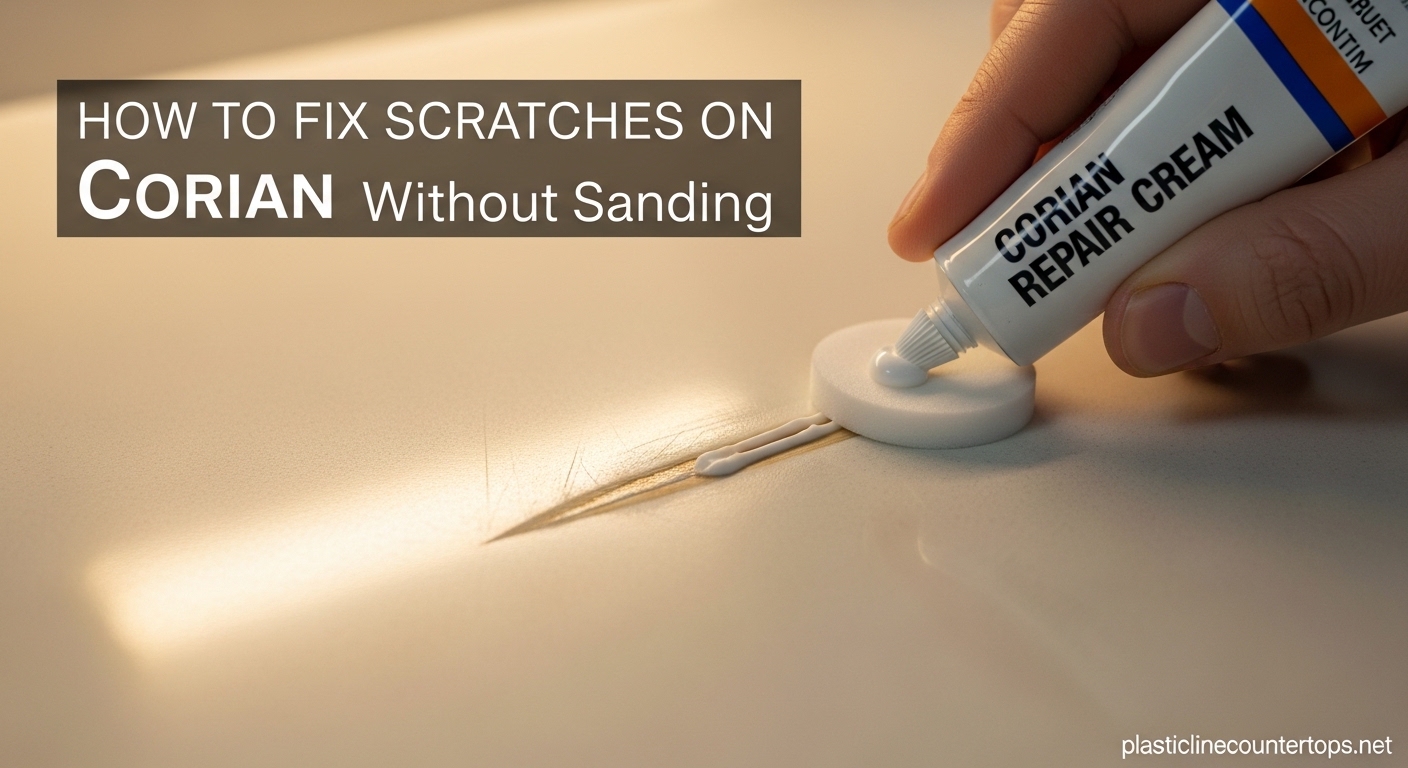
Yes, you can fix scratches on Corian without sanding. Light surface scratches respond well to a wet abrasive pad technique using a Scotch-Brite pad and light circular pressure. The method takes about 15 minutes per scratch, requires zero power tools, and restores the surface finish without the dust and effort of traditional sanding.
I have worked with Corian countertops for years, and the number one question homeowners ask me is how to fix those annoying surface marks without breaking out the sander. The good news is that most everyday scratches — the kind caused by plates, utensils, and regular kitchen use — come out with simple hand techniques. In this guide, I will walk you through exactly how to fix scratches on Corian without sanding, step by step.
Here is what we will cover: how to tell if your scratch can be fixed without sanding, the best no-sanding methods that actually work, common myths to avoid, and how to match your repair to your specific Corian finish type.
Table of Contents
What Is Corian and Why It Can Be Repaired Without Sanding
Corian is a solid surface material originally developed by DuPont. It is made from an acrylic polymer blended with natural minerals, creating a dense, non-porous surface used widely in kitchen countertops and bathroom vanities. What makes Corian unique among countertop materials is its homogeneous structure — the color and pattern run all the way through the material, not just on the surface.
This matters for scratch repair because it means you can renew the surface without worrying about wearing through a thin top layer. Granite and quartz have a sealed surface finish that can be damaged permanently. Corian, on the other hand, is a renewable surface. You can remove material from the top and the same color remains underneath.
That said, Corian is softer than stone. It scratches more easily than granite or quartz, which is why scratches are such a common complaint. But that same softness is exactly what allows you to remove scratches with nothing more than an abrasive pad and some water. The material responds well to friction-based renewal when done correctly.
The key word here is “light.” Not every scratch can be removed without sanding. But for the vast majority of everyday surface marks, the no-sanding approach works effectively and saves you significant time and effort.
How to Assess Scratch Depth on Corian
Before you start any repair, you need to determine what kind of scratch you are dealing with. The depth of the scratch directly affects which method will work and whether you can skip the sanding step entirely.
The fingernail test is the quickest way to assess scratch depth. Run your fingernail gently across the scratch. If your nail glides over it without catching, you have a light surface scratch. These are the easiest to fix without sanding. If your nail catches slightly but the groove is shallow, you have a medium scratch that may still respond to no-sanding methods with some extra effort.
If your fingernail clearly drops into a groove or the scratch looks like a visible channel in the surface, that is a deep scratch or gouge. Deep damage like this usually requires sanding with progressive grits or professional repair. The no-sanding methods in this guide focus on light to medium scratches.
One important note: dark-colored Corian surfaces show scratches much more readily than light colors. A scratch that is barely visible on a white Corian countertop might be very obvious on a dark brown or black one. This does not mean the scratch is deeper — it just means the contrast makes it more visible. The repair technique remains the same regardless of color.
Also, take a moment to distinguish between actual scratches and scuff marks. Scuffs from rubber, plastic, or even shoe soles can look like scratches but often wipe away with a gentle abrasive cleaner. Test a small area with a damp cloth before committing to a full repair process.
How to Fix Scratches on Corian Without Sanding
This section covers three proven methods for removing Corian scratches without any sanding. Start with Method 1, which handles most light scratches. Move to Method 2 or 3 only if the first approach does not fully remove the mark.
Method 1: The Wet Abrasive Pad Technique
This is the most effective no-sanding method and the one I recommend trying first. It works by using a mildly abrasive pad to blend the scratched area into the surrounding surface. The water acts as a lubricant to prevent creating new scratches.
What you need:
- A Scotch-Brite 7447 pad (maroon color) for matte or satin finishes
- A Scotch-Brite 7448 pad (gray color) for semi-gloss finishes
- Clean water in a spray bottle or bowl
- A clean microfiber cloth
- Mild dish soap
Step-by-step process:
Step 1: Clean the area thoroughly. Wash the scratched area with warm soapy water and a soft cloth. Dry it completely. Any dirt, grease, or film left on the surface will interfere with the repair and can actually create new micro-scratches as you work. I use a drop of Dawn dish soap on a damp microfiber cloth for this step.
Step 2: Wet the abrasive pad. Run the Scotch-Brite pad under water until it is fully saturated. A dry pad on dry Corian will create more scratches rather than removing them. Keep the pad wet throughout the entire process. I keep a spray bottle handy to mist the surface as I work.
Step 3: Rub in circular motions with light pressure. Place the wet pad on the scratch and rub in small circles. Use light to moderate pressure — you are not trying to grind the scratch away. You are blending the scratched area into the surrounding surface. Work in circles about 2 to 3 inches in diameter, covering an area slightly larger than the scratch itself.
Step 4: Feather the edges outward. After about 30 seconds of circular rubbing, start moving outward from the center. This feathering technique blends the repaired area with the untouched surface so you do not end up with a visible patch. Think of it like blending paint at the edges.
Step 5: Wipe clean and inspect. Use a damp microfiber cloth to wipe away the residue. Dry the area and check your progress under good lighting. If the scratch is still visible but lighter, repeat Steps 2 through 4. Most light scratches disappear after 2 to 3 rounds of this process.
Step 6: Match the finish. If your Corian has a semi-gloss or high-gloss finish, follow up with a Scotch-Brite 7448 gray pad using the same wet circular technique. For high-gloss finishes, finish with a countertop polish and a soft cloth to restore the shine. Matte finishes need no further treatment after the maroon pad.
Method 2: The Abrasive Cleaner Approach
For very light scratches and scuff marks, an abrasive household cleaner can do the job. This method is gentler than the pad technique and works well on matte and satin finishes.
Apply a small amount of a mild abrasive cleaner like Soft Scrub (without bleach) or Bar Keepers Friend to a damp microfiber cloth. Rub the scratched area in circular motions with moderate pressure. Keep the surface wet as you work. Rinse thoroughly with clean water and dry with a soft cloth.
This method is also my go-to for everyday Corian maintenance. A weekly cleaning with a mild abrasive cleaner helps prevent the buildup of surface marks that eventually turn into visible scratches. Reddit users in home improvement forums consistently recommend this approach for routine care.
However, do not use this method on high-gloss Corian. Abrasive cleaners can dull a glossy finish, creating a visible matte patch in the repaired area.
Method 3: Countertop Polish for Finish Restoration
Sometimes what looks like a scratch is actually a dulled area in the finish. In these cases, a countertop polish can restore the surface without any abrasive action at all.
Apply a Corian-safe countertop polish to a soft cloth and buff the area in circular motions. Products labeled for solid surface countertops work best. Avoid automotive waxes or polishes, which leave a residue that attracts dirt and can yellow over time.
This method is particularly effective for water spots, minor heat marks, and areas where the finish has dulled from regular cleaning. It will not remove an actual physical scratch, but it will improve the overall appearance of the surface and make minor imperfections less noticeable.
Debunking Common Corian Scratch Myths
There is a lot of questionable advice floating around online about Corian scratch repair. Let me address the most common myths I see repeated in forums and blog comments.
Does WD-40 Remove Corian Scratches?
No, WD-40 does not remove Corian scratches. It only creates a temporary oily film that fills the scratch and makes it less visible. Once the oil evaporates or washes away during regular cleaning, the scratch returns. I have seen homeowners recommend this trick in Facebook groups, but it is not a real repair. In fact, the oily residue can attract dust and make your countertop feel greasy. Skip the WD-40 and use a proper abrasive pad method instead.
Can You Use a Magic Eraser on Corian?
I do not recommend using a magic eraser on Corian countertops. Magic erasers are made from melamine foam, which is essentially a very fine abrasive. On Corian, this can create a dull, cloudy patch that is difficult to blend with the surrounding finish. While it might make a scratch less visible in the short term, you are essentially creating hundreds of tiny micro-scratches across the surface. For dark-colored Corian especially, magic eraser use can leave a very noticeable hazy area.
What About Toothpaste?
Toothpaste contains mild abrasives, which is why some people suggest it for scratch removal. In my experience, it has limited effectiveness on Corian. It might improve very faint surface marks, but the abrasive level is inconsistent between toothpaste brands and the results are unreliable. You are better off using a product designed for the job.
What About Car Wax?
Car wax or automotive polish is not designed for acrylic solid surfaces. It can leave a sticky residue that attracts dirt, turns yellow over time, and makes future cleaning harder. Some automotive products also contain solvents that can damage the Corian surface. Stick with solid surface countertop polishes instead.
Finish-Specific Restoration Tips for Corian
Corian countertops come in three main finish types, and each one requires a slightly different approach to scratch repair. Matching your repair technique to your finish is critical for getting a seamless result.
Matte or Satin Finish: This is the most common Corian finish and the easiest to repair. Use a Scotch-Brite 7447 maroon pad with water in circular motions. The maroon pad actually matches the factory matte texture, so your repaired area will blend naturally with the surrounding surface. No further polishing needed — just clean and dry.
Semi-Gloss Finish: Start with the Scotch-Brite 7447 maroon pad to remove the scratch, then follow up with a Scotch-Brite 7448 gray pad to restore the semi-gloss sheen. The gray pad is finer and creates a smoother surface. Work in the same circular motion with water, then wipe clean and inspect. You may need to go over the area with the gray pad two or three times to match the surrounding finish.
High-Gloss Finish: High-gloss Corian is the most challenging to repair without sanding. After using both the maroon and gray pads, you will need to apply a countertop polish specifically formulated for solid surfaces. Buff with a soft cloth in circular motions until the repaired area matches the surrounding gloss level. If you cannot match the gloss, blending the repaired area over a wider radius can help hide the transition.
If you are unsure what finish your Corian has, check in an inconspicuous area like under the counter overhang. The manufacturer documentation or your installer can also confirm the finish type.
How to Prevent Future Corian Scratches
The best scratch repair is the one you never need to do. Corian is a durable surface, but it does require some basic care to keep it looking its best. These prevention tips come directly from what I have seen work — and what I have seen fail — in real kitchens.
Always use cutting boards. Never cut food directly on Corian. Even light knife contact creates fine scratches that accumulate over time. Keep a cutting board within arm’s reach of your main prep area so it becomes second nature.
Use trivets or hot pads under hot cookware. Corian is heat resistant, but extreme heat can cause thermal shock that leads to cracking or surface damage. A trivet is a simple precaution that prevents both heat marks and scratches from sliding heavy pots.
Clean with the right products. Use a damp microfiber cloth for daily cleaning. For deeper cleaning, a mild abrasive cleaner like Soft Scrub works well on matte and satin finishes. Avoid scouring powders, bleach-based products, and anything containing strong solvents.
Avoid dragging objects across the surface. Sliding heavy appliances, ceramic dishes, or metal objects across the counter is a primary cause of scratches. Lift items when repositioning them, even if it seems easier to slide.
Be extra careful with dark colors. Dark Corian shows every mark. If you have a dark countertop, extra diligence with cutting boards and gentle cleaning goes a long way. Many Reddit users with dark Corian mention this as their biggest regret — not the scratches themselves, but how visible they are.
When to Call a Professional for Corian Repair
Not every scratch is a DIY job. Knowing when to call a professional saves you from potentially making the damage worse.
Call a professional Corian fabricator or repair specialist if you are dealing with deep gouges that catch your fingernail prominently, damage covering a large area, cracks or fractures, or damage near seams and joints. Professional technicians have orbital sanders, a full range of grit progressions, and color-matched epoxy for filling deep damage.
Professional Corian repair typically ranges from $200 to $600 depending on the extent of the damage and your location. For a full countertop refinishing, expect higher costs. Many fabricators offer free estimates, so it costs nothing to get a professional opinion before committing to a DIY approach that might not work.
If you do decide to try the no-sanding methods first, there is no risk in attempting it. You cannot make a light scratch worse by using a wet abrasive pad with proper technique. The worst case is that it does not fully remove the scratch, and you move on to a professional solution.
FAQ
Can scratches be removed from Corian countertops?
Yes, scratches can be removed from Corian countertops. Corian is a homogeneous solid surface material, meaning the color runs all the way through. Light scratches can be buffed out using a wet Scotch-Brite abrasive pad with circular motions. Deeper scratches may require progressive grit sanding or professional repair, but most everyday surface scratches are removable with basic hand techniques.
Does WD-40 really remove scratches from Corian?
No, WD-40 does not remove scratches from Corian. It creates a temporary oily film that fills the scratch and makes it less visible, but the scratch returns once the oil washes away or evaporates. WD-40 is not a repair method — it is a cosmetic cover-up at best. Use a wet abrasive pad method instead for actual scratch removal.
Can I use a magic eraser on Corian countertops?
It is not recommended. Magic erasers are made from melamine foam, which is a fine abrasive. On Corian, they can create a dull, hazy patch of micro-scratches that is difficult to blend with the surrounding finish. This is especially noticeable on dark-colored Corian and high-gloss finishes. Use a proper Scotch-Brite pad with water instead.
Can you buff out Corian?
Yes, you can buff out Corian. Light surface scratches can be buffed out using a wet abrasive pad in circular motions. For semi-gloss and high-gloss finishes, follow up with a finer pad and countertop polish. The key is matching your buffing technique to the existing finish type and keeping the surface lubricated with water during the process.
How do you remove knife scratches from Corian countertop?
Knife scratches on Corian can be removed by cleaning the area with soapy water, then using a wet Scotch-Brite 7447 maroon pad in circular motions with light pressure. Work in circles slightly larger than the scratch, feathering outward at the edges to blend the repair. For matte finishes, this is usually sufficient. For glossier finishes, follow with a gray Scotch-Brite 7448 pad and polish. Repeat the process 2 to 3 times if needed until the scratch disappears.
How much does it cost to repair Corian countertops?
Professional Corian countertop repair typically costs between $200 and $600 depending on the extent of the damage, the size of the area needing repair, and your location. Full countertop refinishing costs more. Many Corian fabricators offer free estimates. For light surface scratches, the DIY approach using a Scotch-Brite pad costs under $15 in materials.
Conclusion
Learning how to fix scratches on Corian without sanding comes down to one main technique: the wet abrasive pad method. Clean the area, use a wet Scotch-Brite 7447 pad in circular motions with light pressure, feather the edges outward, and match your finish with the appropriate follow-up pad or polish. Most light and medium scratches respond well to this approach.
Remember to match your repair technique to your finish type — matte, semi-gloss, or high-gloss each need slightly different handling. And skip the WD-40, magic erasers, and other internet shortcuts. They do not work as advertised and can make the problem worse.
With basic prevention habits like using cutting boards, trivets, and gentle cleaning products, you can keep your Corian countertops looking great for decades. Corian remains one of the most repair-friendly countertop materials available, and that is a major advantage over stone surfaces that cannot be renewed once damaged.