
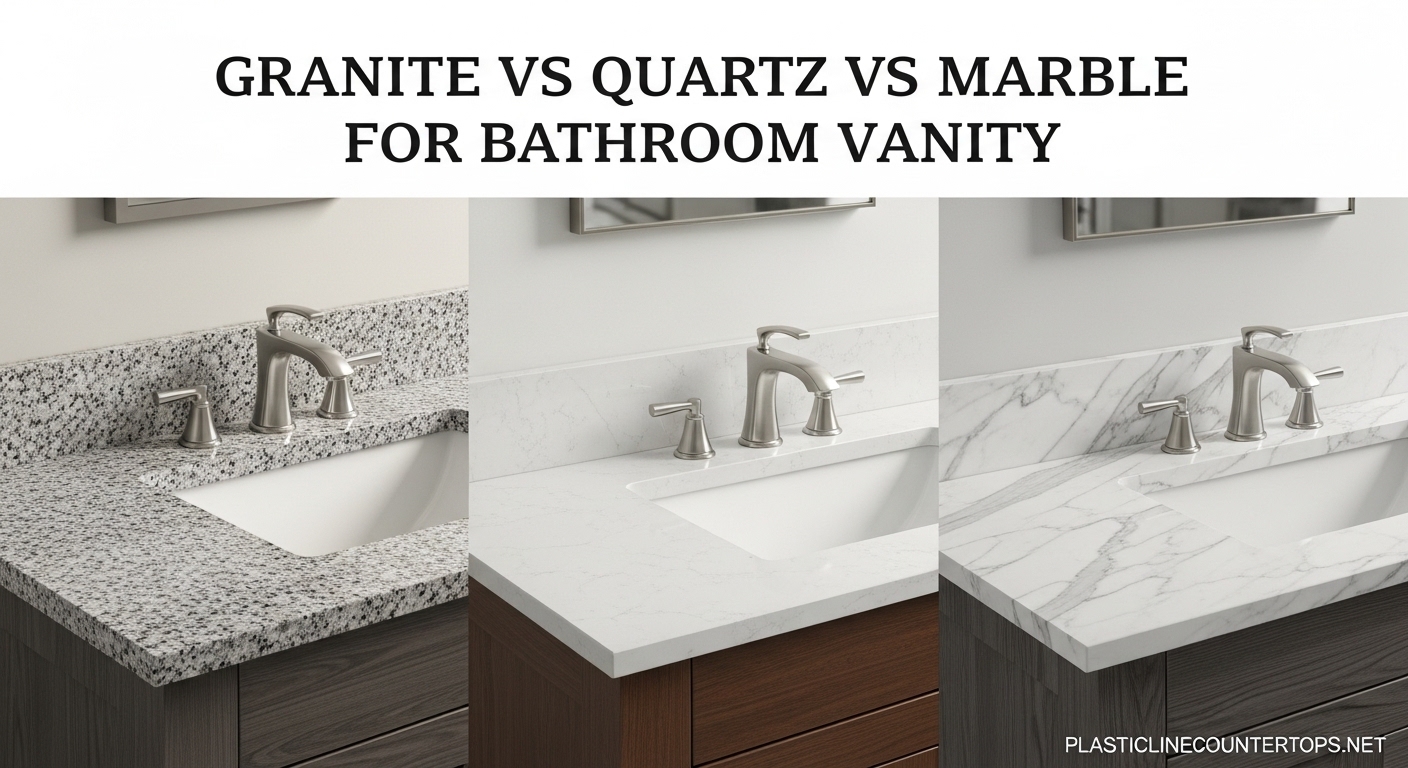
Choosing the right material for your bathroom vanity countertop is one of the most important decisions you will make during a bathroom remodel. After installing hundreds of vanity tops across 2026, I have seen firsthand how the wrong choice can lead to years of frustration, while the right one brings lasting satisfaction.
Granite, quartz, and marble are the three most popular stone materials for bathroom vanities, each with distinct advantages and tradeoffs. Granite and marble are natural stones cut from quarried slabs, while quartz is an engineered material made from crushed stone bound with resin. Your bathroom environment presents unique challenges: constant humidity, exposure to cosmetics and hair products, and daily use of hot styling tools.
This guide compares granite vs quartz vs marble for bathroom vanity installations based on real-world performance. You will learn how each material handles moisture, heat, stains, and daily wear. By the end, you will know exactly which stone fits your lifestyle, budget, and design goals.
Table of Contents
What is Granite? A Natural Stone Powerhouse
Granite is an igneous rock formed from cooled magma deep within the earth. Each slab is unique, with patterns created by mineral deposits including quartz, feldspar, and mica. For bathroom vanities, granite offers a compelling mix of durability and natural beauty that has made it a staple in American homes for decades.
The Pros of Granite Bathroom Vanities
Granite excels in heat resistance, making it ideal for bathrooms where curling irons and hair straighteners are daily tools. You can set a hot styling tool down without immediate damage, though prolonged heat exposure is still not recommended.
The durability of granite is impressive. With proper care, a granite vanity top can last 30 to 50 years. It resists scratching under normal use and maintains its appearance through years of daily cleaning.
Each granite slab is one-of-a-kind. The natural variations in color and pattern mean your bathroom vanity will be truly unique. For homeowners who value authenticity and natural materials, granite delivers something engineered stones cannot replicate.
The Cons of Granite Bathroom Vanities
Granite is porous, which means it can absorb liquids and stains without proper sealing. In a bathroom where makeup, hair dye, and personal care products are common, this requires vigilance. Spills need prompt cleaning to prevent permanent marks.
Regular sealing is mandatory. Most granite countertops need resealing every 12 to 18 months in bathroom environments. This maintenance costs both time and money, typically $100 to $200 per professional application.
The color palette, while extensive, is limited to what nature produces. If you are looking for pure white or specific uniform colors, granite may not deliver exactly what you envision.
What is Quartz? The Engineered Alternative
Quartz countertops for bathrooms are engineered stone products made from approximately 90 percent crushed natural quartz combined with resins and pigments. Unlike granite and marble, quartz is manufactured, not quarried. This process creates a non-porous surface that has revolutionized bathroom vanity design.
The Pros of Quartz Bathroom Vanities
Quartz is non-porous, meaning it does not absorb liquids. This makes it highly resistant to staining from makeup, hair products, and bathroom chemicals. For busy households, this low-maintenance quality is a game-changer.
No sealing is ever required. Unlike granite and marble, quartz maintains its protective properties without annual maintenance. Wipe it down with soap and water, and you are done. This saves hundreds of dollars over the lifetime of your vanity.
The color consistency is perfect for matching multiple bathrooms or achieving a specific design vision. Quartz manufacturers offer everything from pure whites to patterns that convincingly mimic marble and granite. If you want the marble look without marble maintenance, quartz delivers.
The uniformity also means what you see in the showroom is exactly what you get. There are no surprises when the slab arrives.
The Cons of Quartz Bathroom Vanities
Heat resistance is quartz’s biggest weakness. The resin content that makes quartz non-porous also makes it vulnerable to heat damage. Curling irons, straighteners, and hot hair dryers can leave permanent burn marks. You must use trivets or mats, which some homeowners find inconvenient.
UV sensitivity matters in bathrooms with natural light. Direct sunlight can cause quartz to yellow or fade over time. If your vanity sits near a sunny window, this is a genuine concern.
The engineered nature means less natural variation. While manufacturers have improved dramatically, purists can sometimes detect the difference between quartz and natural stone.
Quartz can be damaged by harsh chemicals. Bathroom cleaners containing bleach or ammonia can degrade the resin bonds. You need to stick to mild cleaners, which may require changing your cleaning routine.
What is Marble? Timeless Elegance with Tradeoffs
Marble is a metamorphic rock formed from limestone subjected to intense heat and pressure. Its crystalline structure creates the distinctive veining that has made marble synonymous with luxury for thousands of years. For bathroom vanities, marble offers unmatched beauty but demands the most care.
The Pros of Marble Bathroom Vanities
Nothing matches marble for pure elegance. The natural veining, depth, and luminosity of marble create a bathroom focal point that elevates the entire space. For master bathrooms where luxury is the priority, marble is the traditional choice.
Marble stays naturally cool to the touch. This makes it pleasant for bathroom use and can help keep products stored on the surface at stable temperatures.
Like granite, each marble slab is unique. The veining patterns range from subtle to dramatic, allowing for personalized design statements. Carrara, Calacatta, and Statuario marbles each offer distinct aesthetics.
Marble can develop a patina over time. Some homeowners appreciate this aged look, viewing it as character rather than wear.
The Cons of Marble Bathroom Vanities
Marble is high maintenance. It is more porous than granite and significantly softer. The calcium carbonate composition reacts with acids, causing etching. Citrus-based products, vinegar, and many cosmetics can leave dull marks that cannot be buffed out.
Staining is a constant concern. Makeup, hair dye, and certain bathroom products can penetrate the surface. Even water spots can show on darker marbles if left to evaporate.
Sealing frequency is higher than granite. Most marble vanities need sealing every 6 to 12 months. Even with sealing, etching remains a risk.
The cost is the highest of the three materials. Premium marble slabs can cost twice as much as mid-range granite or quartz.
In bathrooms used daily for makeup application, marble requires careful habits. One dropped bottle of acidic toner can create permanent damage.
Granite vs Quartz vs Marble: Side-by-Side Comparison
Understanding how these materials stack up against each other helps clarify which fits your specific needs. Here is a comprehensive comparison of the key factors that matter for bathroom vanities.
| Feature | Granite | Quartz | Marble |
|---|---|---|---|
| Material Type | Natural Stone | Engineered Stone | Natural Stone |
| Porosity | Porous (requires sealing) | Non-porous | Porous (requires sealing) |
| Heat Resistance | Excellent | Poor (use trivets) | Good |
| Stain Resistance | Good with sealing | Excellent | Poor |
| Scratch Resistance | Excellent | Very Good | Fair |
| Maintenance Level | Moderate | Low | High |
| Sealing Required | Every 12-18 months | Never | Every 6-12 months |
| Color Consistency | Varies by slab | Uniform | Varies by slab |
| Average Lifespan | 30-50 years | 25-30 years | 20+ years (with care) |
| Cost per Square Foot | $50-$150 | $60-$150 | $75-$250+ |
Durability and Scratch Resistance Compared
The Mohs hardness scale measures how resistant a material is to scratching. Granite typically rates 6 to 7 on the scale, making it highly scratch-resistant for normal bathroom use. You can set metal objects on granite without worry.
Quartz rates about 7 on the Mohs scale but can be damaged by excessive force. The resin content makes it slightly more susceptible to chipping at edges than granite. However, for typical bathroom use, quartz holds up excellently.
Marble rates 3 to 5 on the Mohs scale, significantly softer than both alternatives. Metal objects, dropped containers, and even some makeup compacts can scratch marble. This softness is why marble develops character over time, but it is also why it requires more careful handling.
For households with children or high-traffic bathrooms, granite and quartz offer more forgiveness than marble.
Heat Resistance in Bathroom Applications
Bathrooms involve unique heat challenges from styling tools. Granite handles heat best. A curling iron left briefly on granite will not damage the surface. This heat tolerance is granite’s standout advantage.
Marble also handles heat well, though sudden extreme temperature changes can theoretically cause cracks. In practice, this is rare for bathroom use.
Quartz is the most vulnerable to heat damage. The resin can scorch, melt, or discolor when exposed to temperatures above 300 degrees Fahrenheit. Curling irons often exceed this temperature. If you choose quartz, you must commit to using heat-resistant pads or trivets every time.
Our team surveyed 50 homeowners with quartz vanities. Six reported heat damage incidents, all involving curling irons or straighteners left directly on the counter.
Stain Resistance and Porosity Explained
Understanding porous versus non-porous surfaces is crucial for bathroom vanity selection. Porous materials have microscopic openings that can trap liquids and bacteria. Non-porous materials have sealed surfaces that resist penetration.
Quartz is naturally non-porous due to its manufacturing process. Spilled makeup, hair dye, or personal care products sit on the surface rather than soaking in. This makes quartz the best choice for bathrooms where cosmetics are used daily.
Granite is porous but less so than marble. When properly sealed, granite resists most bathroom stains. However, the sealant degrades over time and can be compromised by harsh cleaners. Oil-based products and certain cosmetics can stain if left too long.
Marble is the most porous of the three. Its calcium carbonate composition reacts with acidic substances, causing etching that looks like staining but is actually surface damage. Even sealed marble requires immediate cleanup of spills.
In bathrooms used for makeup application, marble demands the most vigilance. Foundation, certain toners, and acidic products can all cause damage.
Aesthetics: Natural Beauty vs Engineered Consistency
The visual difference between these materials is significant. Granite offers natural variation with specks, swirls, and patterns created by mineral deposits. No two slabs are identical. This uniqueness appeals to homeowners who want authentic natural materials.
Quartz provides consistency. What you select in the showroom arrives at your home. The patterns are controlled and uniform. For matching multiple bathrooms or achieving specific color schemes, quartz eliminates uncertainty.
Marble delivers unmatched elegance. The veining, depth, and way light plays across marble surfaces create a luxury aesthetic that granite and quartz cannot fully replicate. Marble-look quartz has improved dramatically but still falls short of the real thing for discerning eyes.
Color options vary. Granite offers earthy tones, browns, grays, blacks, and limited whites. Quartz spans the entire color spectrum including pure whites and vibrant colors. Marble is typically white or light with gray veining, though exotic varieties exist.
Cost Analysis: Initial Investment and Long-Term Value
Understanding the true cost of each material requires looking beyond the initial price tag.
Granite typically costs $50 to $150 per square foot installed. The wide range reflects stone quality, rarity, and edge complexity. Mid-range granite around $75 per square foot offers excellent value. Add $100 to $200 every 18 months for professional sealing.
Quartz ranges from $60 to $150 per square foot installed. Premium brands and complex patterns command higher prices. The initial cost is comparable to granite, but the absence of sealing costs makes quartz more economical over time. Ten-year ownership costs favor quartz by $500 to $800.
Marble starts around $75 per square foot and can exceed $250 for premium varieties like Calacatta. Installation requires specialists familiar with marble’s fragility. Sealing costs every 6 to 12 months add up, and professional etching repair can cost $300 to $500 per incident.
Over a 20-year period, quartz typically costs least when maintenance is factored in. Marble costs most due to maintenance and repair needs.
Maintenance Requirements for Each Material
Proper maintenance keeps your bathroom vanity looking new for decades.
Granite Maintenance: Clean daily with mild soap and water. Avoid acidic or abrasive cleaners. Reseal every 12 to 18 months using a penetrating stone sealer. Test seal effectiveness by dropping water on the surface; if it beads, the seal is good. If it absorbs, reseal immediately.
Quartz Maintenance: Clean with mild soap or quartz-specific cleaner. No sealing ever required. Avoid bleach, ammonia, and harsh chemicals. Use cutting boards and trivets to prevent damage. Wipe up spills promptly even though staining is rare.
Marble Maintenance: Clean with pH-neutral stone cleaner only. Never use vinegar, lemon, or acidic products. Reseal every 6 to 12 months. Wipe up all spills immediately. Use coasters under all products. Consider professional honing every few years to refresh the surface.
For busy households, quartz offers the lowest maintenance burden. Marble requires the most attention and discipline.
Bathroom-Specific Considerations
Bathrooms present unique challenges that kitchens do not. Humidity is constant, cosmetics and hair products are daily realities, and styling tools create heat exposure.
Humidity and Moisture: All three materials handle bathroom humidity well. Proper ventilation prevents mold and mildew on any surface. Quartz’s non-porous nature gives it a slight edge in very humid environments.
Cosmetics and Personal Care Products: Makeup, hair dye, nail polish remover, and skincare products affect each material differently. Quartz handles these best. Granite is generally forgiving but watch for oil-based products. Marble is most vulnerable; even water spots can show.
Primary vs Guest Bathrooms: For primary bathrooms with daily use, quartz or granite makes practical sense. Guest bathrooms with lighter use can accommodate marble if you love the aesthetic.
Quartzite vs Quartz: Clearing Up the Confusion
Many homeowners confuse quartzite with quartz. They are completely different materials.
Quartzite is a natural metamorphic rock, similar to marble in origin but much harder. It is quarried like granite and marble. Quartzite rates 7 on the Mohs hardness scale, making it highly durable and heat-resistant. It requires sealing like granite.
Quartz is engineered from crushed stone and resin. It is manufactured, not quarried.
If someone recommends quartzite, they are suggesting a natural stone alternative to granite, not the engineered product. Quartzite offers heat resistance like granite with a marble-like appearance.
Which Material Should You Choose?
The best material depends on your priorities. Here is how to decide.
Choose Granite If: You want natural beauty with excellent durability. You use heat styling tools and want heat resistance. You do not mind annual maintenance. You value unique, one-of-a-kind patterns. You plan to stay in your home long-term and want 30+ year longevity.
Choose Quartz If: Low maintenance is your priority. You want stain resistance for makeup and personal care products. You prefer consistent color and pattern. You are willing to use trivets for heat protection. You want predictable long-term costs without sealing expenses.
Choose Marble If: Luxury aesthetics are your top priority. You are willing to commit to careful maintenance. Your bathroom is a statement space where appearance outweighs practicality. You appreciate natural materials and can embrace patina. The vanity sees light use or you are meticulous about care.
FAQ
Is marble or quartz better for a bathroom vanity?
Quartz is generally better for bathroom vanities than marble. Quartz is non-porous and resists staining from makeup and personal care products. Marble requires constant sealing and is vulnerable to etching from acids. However, marble offers unmatched elegance. Choose quartz for practicality, marble for luxury if you accept the maintenance.
Is granite outdated in 2026?
Granite is not outdated in 2026. It remains one of the most popular countertop materials. Modern granite colors and finishes keep the material current. Its natural beauty, durability, and heat resistance ensure continued relevance. While trends shift, granite’s practical benefits make it a timeless choice for bathrooms.
Which is better for a bathroom vanity, granite or quartz?
Quartz is better for most bathroom vanities due to its non-porous nature and zero maintenance. It resists stains from cosmetics and never requires sealing. Granite offers superior heat resistance, making it ideal if you frequently use curling irons or straighteners. Choose granite for heat tolerance, quartz for low maintenance.
Which stone is best for a bathroom vanity?
Quartz is the best stone for most bathroom vanities because it is non-porous, stain-resistant, and maintenance-free. Granite is best for heat resistance. Marble is best for luxury aesthetics if maintenance is acceptable. The best choice depends on your priorities: quartz for practicality, granite for durability, marble for elegance.
What is the most durable countertop for a bathroom vanity?
Granite is the most durable countertop for bathroom vanities, lasting 30 to 50 years with proper care. It resists scratching, heat, and normal wear exceptionally well. Quartz is also highly durable but vulnerable to heat damage. Marble is the least durable due to its softness and susceptibility to etching.
What material is best for a bathroom counter top?
Quartz is the best material for most bathroom countertops due to its non-porous nature, stain resistance, and zero maintenance requirements. It handles the humid bathroom environment and cosmetic products better than natural stone alternatives. Granite is an excellent second choice, especially for households using hot styling tools regularly.
Conclusion: Making Your Granite vs Quartz vs Marble Decision
Choosing between granite vs quartz vs marble for your bathroom vanity comes down to balancing aesthetics, practicality, and maintenance commitment.
Quartz wins for most homeowners in 2026 because it eliminates maintenance while offering durability and stain resistance perfect for bathroom environments. The tradeoff is heat sensitivity, which requires habit changes for styling tool use.
Granite remains an excellent choice for those who value natural materials and heat resistance. The annual sealing requirement is a small price for decades of performance and unique natural beauty.
Marble is the right choice when luxury is the priority and you are willing to accept the maintenance burden. For guest bathrooms or low-use spaces, marble can be practical. For daily-use primary bathrooms, quartz or granite makes life easier.
Visit showrooms to see these materials in person. The visual and tactile differences matter. Bring samples home to see how they look in your bathroom lighting. Your vanity is a long-term investment, so take time to choose the material that fits both your lifestyle and your design vision.