
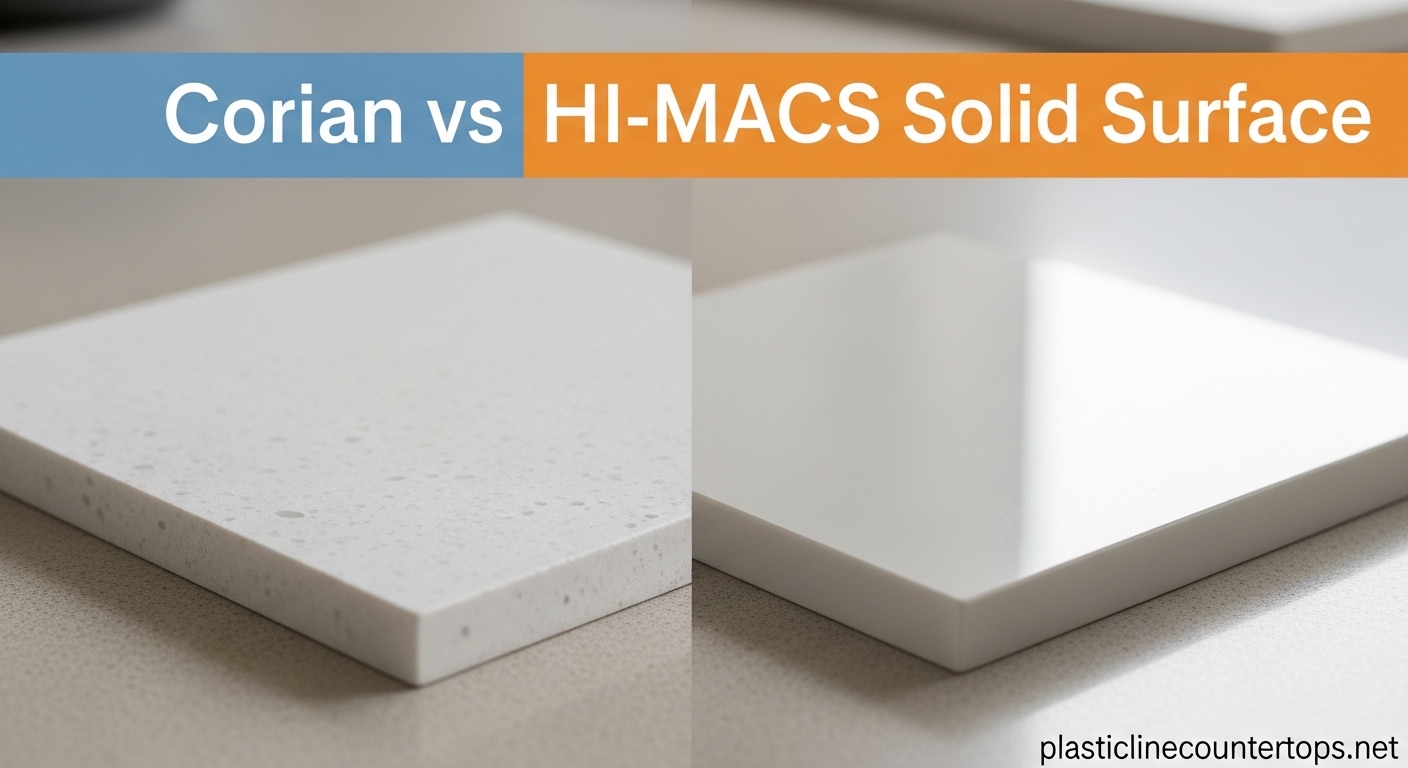
When it comes to the Corian vs HI-MACS solid surface comparison, both materials are premium acrylic solid surface products that perform almost identically in daily use. The real differences come down to color availability, brand reputation, warranty terms, and where you live. In this guide, our team breaks down every detail you need to make the right choice for your kitchen or bathroom project in 2026.
I have spent years working with solid surface materials, and this Corian vs HI-MACS solid surface comparison is one of the most common questions homeowners ask. Both materials offer seamless joints, non-porous surfaces, and the ability to integrate sinks directly into the countertop. But the nuances matter when you are investing in a surface that needs to last 15 to 20 years.
We will walk through material composition, durability, design options, pricing, and real user experiences so you can walk away with a confident decision. Let us get into it.
Table of Contents
What Is Solid Surface Material?
Solid surface is a man-made countertop material created from a blend of acrylic resin or polyester resin and natural mineral fillers, typically aluminum trihydrate. The result is a homogenous sheet material that is the same color and pattern all the way through. Unlike laminate, which is a thin layer over particleboard, solid surface is consistent from top to bottom.
This matters because it means you can sand out scratches, buff away stains, and even repair chips without the damage showing a different layer underneath. That renewability is one of the biggest selling points of solid surface countertops compared to natural stone.
The material is classified as a thermoplastic. When heated to around 350 degrees Fahrenheit, it becomes pliable enough to bend into curves, wrap around corners, and form seamless transitions between countertop and backsplash. Fabricators use standard woodworking tools to cut, route, and join sheets with color-matched adhesive that creates invisible seams.
Both Corian and HI-MACS fall into the acrylic solid surface category, meaning they use acrylic resin as their primary binder rather than polyester. Acrylic-based solid surfaces tend to be more impact-resistant, less brittle, and easier to repair than polyester-based alternatives like Avonite or Formica Solid Surface. This shared acrylic foundation is why the two materials feel and perform so similarly.
For anyone considering a Corian vs HI-MACS solid surface comparison, understanding this shared composition is the first step. The differences are not in the base chemistry but in the brand-specific formulations, color development, and distribution networks.
Corian: The Original Solid Surface
Corian was invented by DuPont in 1967 and is widely credited with creating the entire solid surface category. For decades, the brand name became so dominant that people used “Corian” as a generic term for all solid surface materials, much like people say “Kleenex” for tissues.
That brand recognition carries real weight. When homeowners ask their fabricator about solid surface, Corian is usually the first name mentioned. DuPont invested heavily in research, color development, and a certified fabricator network that helped establish quality standards across the industry.
In 2026, Corian is manufactured and distributed by DuPont (now part of Chemours). The product line includes over 100 colors across several collections, ranging from solid whites and neutrals to veined patterns that mimic marble and granite. Their DeepColor technology and Veilfinishing techniques give certain lines a depth and translucency that were not possible a decade ago.
Key strengths of Corian include its massive color library, extensive certified fabricator network, and a 10-year residential warranty when installed by a certified professional. The brand has also been aggressive about developing thermoformable patterns that can be heated and shaped for curved installations, waterfall edges, and integrated cove backsplashes.
However, Corian does face criticism. Some homeowners consider the brand “dated” because it became popular in the 1990s and early 2000s. This perception is not about performance but about style association. The material itself performs every bit as well as newer competitors.
There is also the question of cost. Because Corian carries premium brand positioning, fabricators sometimes charge more for it compared to comparable solid surface brands. Whether that premium is worth it depends on how much you value the brand reputation and warranty support.
One Reddit user shared a perspective I hear often: “I love my solid surface Corian and will replace it with Corian when I redo my kitchen. I have had it for 20 years and it is indestructible.” That kind of long-term loyalty is something no other solid surface brand has achieved at the same scale.
HI-MACS: The Modern Challenger
HI-MACS is manufactured by LX Hausys, a South Korean company that was originally the materials division of LG Group before being spun off as an independent entity. The brand has been producing solid surface since the early 2000s and has grown into one of the most recognized Corian alternatives worldwide.
What sets HI-MACS apart is its aggressive approach to color development and pattern innovation. The brand has invested heavily in creating hyper-realistic veined patterns that closely mimic natural marble and stone. Their Lucent collection even features translucent sheets that can be backlit for dramatic bar tops, reception desks, and feature walls.
In terms of composition, HI-MACS uses the same acrylic resin and mineral filler base as Corian. The sheets are homogenous, non-porous, and fully repairable. Fabricators work with HI-MACS using identical tools and techniques, and the material thermoforms at similar temperatures.
HI-MACS offers around 80 to 90 colors across multiple collections, including solid colors, particulate patterns, and veined designs. While their color library is smaller than Corian’s, the quality and realism of their patterns have earned strong reviews from designers and fabricators alike.
The brand also backs its product with a 10-year residential warranty when installed by a certified fabricator, matching Corian’s warranty terms in most markets. In some regions, HI-MACS has been competitive on price, positioning itself as a premium product at a slightly lower cost than Corian.
Where HI-MACS has a disadvantage is in brand recognition and fabricator availability, particularly in the United States. Corian’s decades-long head start means more fabricators are certified to install it, and more suppliers stock Corian sheets. In the UK and parts of Europe and Asia, HI-MACS has stronger distribution and may actually be easier to source.
For homeowners doing a Corian vs HI-MACS solid surface comparison, HI-MACS often wins on design innovation and value, while Corian wins on brand trust and installer availability. The right pick depends heavily on your local market.
Corian vs HI-MACS: Head-to-Head Comparison
This is where the Corian vs HI-MACS solid surface comparison gets practical. Below, we break down the key specification differences between the two brands so you can see exactly how they stack up.
Material Composition
Both Corian and HI-MACS are made from approximately one-third acrylic resin and two-thirds natural mineral filler (aluminum trihydrate). This gives both materials their characteristic warm-to-the-touch feel, non-porous surface, and thermoformable properties. There is no meaningful chemical difference between the two in terms of base composition.
Some fabricators report subtle differences in how the materials handle during fabrication. HI-MACS sheets may thermoform slightly more predictably at specific temperatures, while Corian’s adhesive system is sometimes described as more forgiving during seam joining. These are professional-level nuances that most homeowners will never notice in the finished installation.
Heat Resistance
Neither Corian nor HI-MACS should have hot pans placed directly on the surface. Both materials can scorch or discolor at temperatures above 250 degrees Fahrenheit for prolonged exposure. This is a shared limitation of all acrylic solid surfaces and one of the main trade-offs compared to granite or quartz.
Our team always recommends using trivets or hot pads with any solid surface countertop, regardless of brand. Brief contact with warm cookware will not cause damage, but a cast iron skillet fresh off a 500-degree burner absolutely can leave a permanent mark.
Scratch Resistance
Both materials rank similarly on the Mohs hardness scale for solid surface, which means they scratch more easily than quartz or granite but are far easier to repair. A light sanding with fine-grit sandpaper followed by a polishing compound can remove most surface scratches from either brand.
One forum user summarized this well: “Solid surfaces can scorch easier than granite or quartz, and they scratch easier too. But from everything I can tell, they are easier to repair.” That repairability is the defining advantage of solid surface over harder countertop materials.
Warranty Comparison
Both Corian and HI-MACS offer a 10-year limited residential warranty when installed by a certified fabricator. The warranty covers manufacturing defects but typically excludes damage from improper use, heat exposure, or unauthorized repairs. Always register your warranty and keep your installation documentation.
Fabrication and Installation
Because both materials use the same acrylic chemistry, fabrication processes are nearly identical. Both are cut with standard CNC routers, joined with color-matched acrylic adhesive, and thermoformed in ovens at similar temperatures. A certified fabricator experienced with one brand can typically work with the other with minimal adjustment.
The bigger consideration is finding a certified fabricator in your area. Corian has a larger certified network in North America, while HI-MACS may have advantages in parts of Europe and Asia. Always ask your fabricator which brands they are certified to install before making your final decision.
Durability and Maintenance
In our Corian vs HI-MACS solid surface comparison, durability is where both materials shine and struggle in equal measure. Neither brand has a clear durability advantage over the other.
On the positive side, both materials are non-porous, meaning they do not absorb liquids, harbor bacteria, or require sealing like natural stone. This makes them excellent choices for kitchens, bathrooms, healthcare facilities, and food preparation areas. Spills wipe clean with soap and water, and there is no grout line or seam crevice where grime can accumulate.
The main durability concern with both brands is scratch sensitivity. Solid surface countertops will develop fine scratches over time from normal use, especially around high-traffic areas like the sink and cooktop. These scratches are cosmetic, not structural, and can be buffed out by a professional or even a handy homeowner with the right sanding pads.
Heat damage is the second concern. As mentioned earlier, direct contact with hot cookware can cause scorch marks or discoloration that may require professional refinishing to repair. This is not unique to Corian or HI-MACS but applies to all acrylic solid surfaces.
For routine cleaning, both manufacturers recommend warm soapy water and a soft cloth. Avoid abrasive cleaners, scouring pads, and harsh chemicals like acetone or strong solvents. For tougher stains, a gentle scrub with a mild abrasive cleaner like Bar Keepers Friend works on both surfaces without causing damage.
Long-term durability is one of the strongest arguments for solid surface. That Reddit user who reported 20 years of trouble-free Corian use is not unusual. Many solid surface installations from the 1990s and early 2000s are still in service today, often looking as good as new after a professional refinishing.
Colors and Design Options
Color selection is one of the most significant differences in the Corian vs HI-MACS solid surface comparison, and it could be the deciding factor for your project.
Corian offers over 100 colors across collections like Corian Solid Surface, Corian Quartz (a separate quartz product line), and various limited editions. Their range includes solid neutrals, small particulate patterns, large veined designs, and even metallic accents. The color library has been refined over more than 50 years, so the depth of options is substantial.
HI-MACS counters with around 80 to 90 colors, and while the total count is lower, the quality of their pattern realism is impressive. Their veined collections, in particular, have earned praise for closely mimicking the look of Calacatta marble and other natural stones. The Lucent translucent collection is another unique offering that Corian does not directly match.
Both brands offer sheets in standard thicknesses of 6mm, 12mm, and occasionally 19mm for special applications. The 12mm thickness is the most common for residential countertops. Thinner sheets can be used for vertical applications like backsplashes and wall cladding.
For homeowners who want a specific veined marble look, I recommend ordering physical samples from both brands before deciding. Colors look very different on a website versus in your kitchen under your lighting conditions. Most fabricators will provide free or low-cost sample chips.
Design flexibility is another area where both brands excel. Because the material is thermoformable, you can create curved countertops, rounded corners, integrated cove backsplashes, and seamless sink basins. Neither brand limits your design options in terms of what can be fabricated.
Price Comparison
Pricing is always a key factor in the Corian vs HI-MACS solid surface comparison, though exact numbers vary by region, fabricator, and color selection.
Generally speaking, HI-MACS tends to be priced slightly lower than Corian for comparable colors and patterns. This is not always the case, and the difference may be negligible in some markets, but it is a pattern our team has observed across multiple projects and quotes.
Several factors affect the final installed cost regardless of brand. Complex edge profiles, integrated sinks, curved thermoformed sections, and unusual color choices all add to the price. Installation labor typically represents a significant portion of the total cost, and this is where choosing a local certified fabricator can save you money regardless of which brand you select.
For context, one forum user shared their quote experience: “Laminate is $85, Corian is $110, quartz is $135-165 per square foot installed.” These figures vary widely by region and are influenced by the complexity of the installation, but they illustrate how solid surface typically sits between laminate and quartz in terms of installed cost.
When budgeting, factor in the long-term value. Solid surface’s repairability means you can refinish the surface rather than replace it after years of wear. That extends the useful life significantly compared to materials that cannot be repaired once damaged.
Pros and Cons Summary
Corian Pros
Strongest brand recognition and consumer trust in solid surface. Over 100 colors across multiple collections. Largest certified fabricator network in North America. Proven track record spanning more than 50 years. 10-year residential warranty.
Corian Cons
Perceived as dated by some homeowners due to 1990s popularity. Often carries a price premium over comparable solid surface brands. Scratch and heat sensitivity shared with all acrylic solid surface. Fewer translucent or backlit options compared to HI-MACS.
HI-MACS Pros
Excellent veined patterns with realistic marble looks. Unique translucent Lucent collection for backlit designs. Often priced slightly lower than Corian. Strong distribution in Europe and Asia. 10-year residential warranty matching Corian.
HI-MACS Cons
Smaller certified fabricator network, especially in the United States. Fewer total colors compared to Corian’s extensive library. Less brand recognition among consumers. Newer to market with a shorter proven track record.
FAQ
Which is better, Corian or Hi-MACS?
Neither material is objectively better. Both are acrylic solid surfaces with nearly identical performance characteristics. Corian offers more colors and has stronger brand recognition, especially in the US market. HI-MACS often provides better value and has superior veined pattern realism. The best choice depends on your local fabricator availability, preferred color options, and budget.
How much does HI-MACS solid surface cost?
HI-MACS solid surface typically costs between $70 and $120 per square foot installed, depending on the color selection, edge profiles, and complexity of the installation. Pricing varies significantly by region and fabricator. Generally, HI-MACS is priced slightly below Corian for comparable products, making it an attractive option for homeowners seeking premium solid surface at a competitive price point.
Why did Corian fall out of favor?
Corian did not fall out of favor due to performance issues. The perception shift happened because granite and then quartz surged in popularity during the 2000s and 2010s, driven by trends toward natural stone aesthetics. Solid surface also became associated with 1990s and early 2000s kitchen design, giving it a dated image in some circles. However, Corian remains one of the best-selling solid surface brands worldwide and continues to innovate with new colors and patterns.
Who makes HI-MACS solid surface?
HI-MACS is manufactured by LX Hausys, a South Korean building materials company that was originally the materials division of LG Group. LX Hausys produces a range of surface materials including HI-MACS acrylic solid surface, HI-MACS volcanic stone, and various flooring and wall covering products. The company operates manufacturing facilities in South Korea and distributes HI-MACS globally.
Which Solid Surface Should You Choose?
After walking through this full Corian vs HI-MACS solid surface comparison, the bottom line is straightforward. Both materials deliver the same core benefits: seamless joints, non-porous hygiene, thermoformable design flexibility, and full repairability. You cannot make a wrong choice from a performance standpoint.
Pick Corian if you value the largest color selection, want a brand with 50-plus years of proven performance, and live in an area with plenty of certified Corian fabricators. It is the safe, trusted choice.
Pick HI-MACS if you are drawn to their realistic veined patterns, want the translucent Lucent collection for a backlit feature, or prefer a brand that often comes in at a slightly lower price point for similar quality.
Either way, the most important decision is not which brand you choose but which fabricator installs it. A skilled, certified installer will make either material look flawless and last for decades. Get multiple quotes, ask to see past installations, and request physical color samples before committing.