
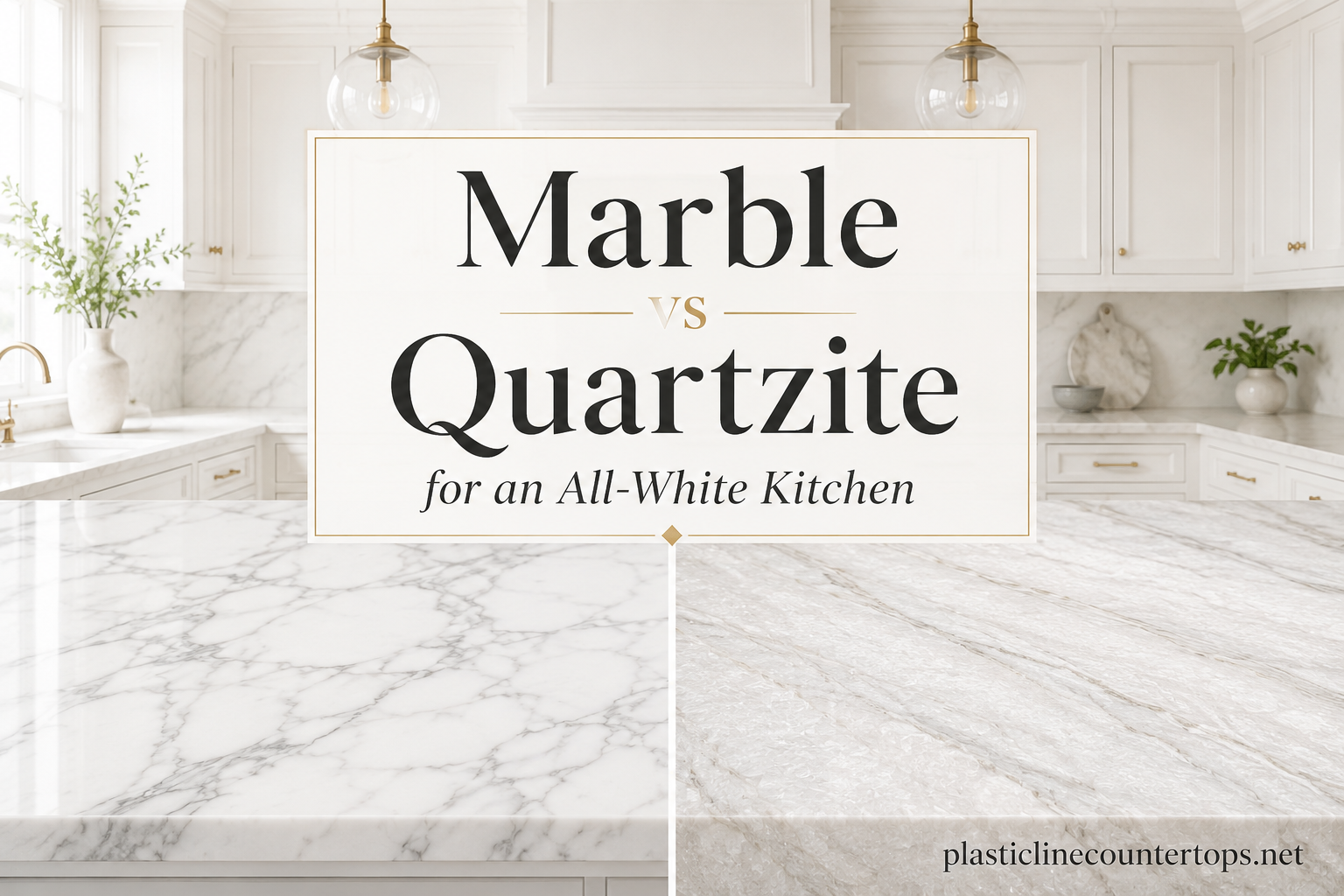
Choosing between marble vs quartzite for an all-white kitchen comes down to one question: do you want raw beauty that ages with character, or stunning looks that stay pristine with barely any effort? I have spent months researching both stones, talking to fabricators with 30-plus years of experience, and reading through hundreds of homeowner discussions to give you an honest answer. Both materials deliver that clean, luminous look that makes all-white kitchens feel open and airy. But they behave very differently under real kitchen conditions.
Marble ranks 3 to 5 on the Mohs hardness scale and etches when acidic foods touch its calcite surface. Quartzite sits at 7 to 8 on the same scale, making it nearly as hard as granite and completely resistant to acid etching. That single difference shapes everything that follows in terms of maintenance, longevity, and daily satisfaction. In this guide, our team walks through every factor that matters when choosing between these two natural stones for your white kitchen.
Table of Contents
What Is Marble and How Does It Form
Marble is a metamorphic rock that starts as limestone. Over millions of years, intense heat and pressure deep within the earth recrystallize the calcium carbonate (calcite) in limestone, creating the distinctive veining patterns marble is known for. Different mineral impurities during formation produce the range of colors and vein styles you see across marble varieties.
European builders have used marble in kitchens, bathrooms, and grand architecture for centuries. Walk into any centuries-old Italian kitchen and you will likely find marble counters that have weathered decades of cooking. The stone has earned its reputation as a luxury material through thousands of years of use in some of the most beautiful spaces ever built.
For an all-white kitchen, marble delivers something no other material can truly replicate. The depth of its veining, the way light plays off its crystalline surface, and the organic movement in each slab create a sense of timeless elegance. No two marble slabs are ever identical, which means your kitchen becomes one of a kind the moment those counters go in.
What Is Quartzite and Why It Confuses People
Quartzite is also a metamorphic rock, but it starts as sandstone rather than limestone. When sandstone gets subjected to extreme heat and pressure, the quartz grains fuse together into an incredibly hard, dense stone. This process creates a material that looks similar to marble but performs much closer to granite on durability tests.
Here is where most of the confusion happens. Quartzite is not the same thing as quartz countertops. Quartz countertops are engineered surfaces made from ground stone, resin, and pigments manufactured in a factory. Quartzite is 100 percent natural stone pulled from quarries, just like marble and granite. I have seen countless homeowners walk into a showroom asking for “quartzite” when they actually mean engineered quartz, or vice versa. Knowing the difference before you shop saves time and prevents costly misunderstandings.
The reason quartzite has become so popular for white kitchens is simple. It gives you marble aesthetics with granite-level toughness. Many white quartzite varieties feature soft veining and warm undertones that pair beautifully with white cabinetry, making them a natural fit for the all-white kitchen aesthetic.
Durability Comparison: How Marble and Quartzite Really Hold Up
This is where the marble vs quartzite comparison gets real. Durability matters in every kitchen, but it matters even more in an all-white kitchen where every scratch, stain, and etch mark shows up against that bright backdrop.
On the Mohs hardness scale, marble sits between 3 and 5. That means it can scratch from everyday objects like knives, keys, or even heavy ceramic plates dragged across the surface. Quartzite registers between 7 and 8, which is comparable to granite. You would need something harder than steel to scratch quartzite under normal kitchen use.
Heat resistance is solid for both materials. You can set a hot pan directly on either stone without worrying about burning or scorching the surface. Both marble and quartzite can handle temperatures well above what any stovetop or oven produces, making them reliable choices near cooktops and ranges.
Then there is etching, which is the biggest dividing line between these two stones. Marble contains calcite, which reacts chemically with acids. When lemon juice, wine, tomato sauce, or vinegar contacts marble, it literally dissolves a microscopic layer of the stone surface. This creates a dull spot called an etch mark. It is not a stain. The stone itself has been chemically altered. On a white marble countertop, etch marks appear as slightly darker or shinier patches that catch light differently than the surrounding surface.
Quartzite contains no calcite, so acid exposure causes zero etching. You can spill lemon juice, red wine, or coffee on quartzite and wipe it away without any chemical reaction. For busy family kitchens where spills happen daily, this single property makes quartzite the more practical white stone choice.
Appearance in an All-White Kitchen Setting
The whole point of an all-white kitchen is visual cohesion. White cabinetry, white walls, white fixtures, and a white stone countertop should feel unified and intentional. Both marble and quartzite deliver on this front, but they create different visual effects.
Marble offers depth and movement that engineered surfaces struggle to match. The veining in natural marble ranges from subtle gray wisps in Carrara to bold, dramatic strokes in Calacatta. These veins create visual interest without breaking the monochromatic palette. Under kitchen lighting, marble has a luminous quality where the crystalline structure catches and reflects light in a way that makes the surface feel alive.
Quartzite tends to have softer, more diffused veining compared to marble. The patterns often look like watercolor washes rather than sharp, defined lines. Many homeowners actually prefer this gentler aesthetic because it feels less busy against white cabinets. White quartzite varieties range from nearly pure white with minimal patterning to warm cream tones with subtle gold or gray movement.
Lighting plays a bigger role with white stone than most people realize. Under warm LED lights, white marble can take on a slightly yellow or creamy cast. The same slab under cool daylight LEDs stays crisp and bright. I always recommend viewing your actual slab under the same lighting you plan to use in your kitchen before making a final decision. This is especially important for all-white kitchens where the stone and cabinetry need to coordinate seamlessly.
One more visual consideration: marble develops a patina over time. The surface softens, small marks accumulate, and the stone takes on a lived-in character. Some homeowners find this charming and authentic. Others find it frustrating, especially in an all-white kitchen where the contrast between pristine cabinets and aging stone becomes more noticeable. Quartzite maintains its original appearance year after year with no patina development.
Popular White Marble Varieties for Kitchens
Not all white marble is the same. Different quarries produce stone with distinct coloring, veining, and performance characteristics. Here are the white marble varieties most commonly used in kitchen countertops.
Carrara Marble comes from quarries in Tuscany, Italy, and is the most widely available white marble. It features a soft white to blue-gray background with fine, feathered gray veining. Carrara is the most affordable white marble option and works well in all-white kitchens where you want subtle movement without overwhelming the space.
Calacatta Marble is often confused with Carrara but is rarer and more dramatic. It has a brighter white background with bold, thick veins that range from gray to gold. Calacatta pairs beautifully with bright white cabinetry because the contrast between the pure white background and strong veining creates a high-end, designer look.
Statuario Marble sits between Carrara and Calacatta in both rarity and appearance. It features a crisp white background with medium-to-bold gray veining. Statuario is less common than both Carrara and Calacatta, making it a strong choice if you want something distinctive for your white kitchen.
Danby Marble is quarried in Vermont and offers a unique advantage for American homeowners: it is domestically sourced. Danby marble has a warm white background with subtle gray veining and tends to be denser than Italian marbles, which some fabricators say makes it slightly more resistant to staining. Several homeowners on forums report positive long-term experiences with Danby marble in family kitchens.
Popular White Quartzite Varieties for Kitchens
White quartzite options have expanded significantly over the past several years as demand has grown. These are the varieties our team sees most recommended for all-white kitchens.
Taj Mahal Quartzite is far and away the most popular white quartzite for kitchens. It features a warm white to creamy background with soft gold and gray veining that closely resembles Calacatta marble. If you want the marble look with quartzite durability, Taj Mahal is the variety most fabricators recommend first. Forum discussions consistently name Taj Mahal as the quartzite that looks most like real marble.
White Macaubas Quartzite has a cleaner, brighter white background than Taj Mahal with more defined gray veining. It works particularly well in contemporary all-white kitchens where you want crisp lines and a cooler tone. White Macaubas also tends to have more consistent patterning across slabs, which makes it easier to match if you have a large kitchen island.
Sea Pearl Quartzite offers a subtle, almost watery appearance with soft gray and white movement. Several homeowners on design forums chose Sea Pearl specifically because it reads as nearly solid white from a distance but reveals gentle patterning up close. This makes it an excellent choice when you want the all-white kitchen to feel layered rather than flat.
Bianco Romano Quartzite features a white background with gray and taupe veining. It has a slightly warmer tone than White Macaubas, making it a good match for white kitchens that lean warm rather than stark. Bianco Romano is also one of the more readily available white quartzite varieties, which can mean shorter lead times from suppliers.
Maintenance: The Honest Side-by-Side Truth
Maintenance is where the marble vs quartzite debate gets personal. Your tolerance for upkeep should weigh heavily in your decision, especially for a kitchen you use every day.
Both stones need to be sealed, but the frequency and urgency differ. Marble is more porous than quartzite, which means it absorbs liquids faster and stains more easily. A quality impregnating sealer helps, but even sealed marble can etch from acidic spills. Most fabricators recommend resealing marble every 6 to 12 months depending on use. Quartzite is less porous and many fabricators say resealing every 1 to 2 years is sufficient, though some dense quartzite varieties need even less frequent sealing.
Cleaning marble requires more care. You need pH-neutral cleaners specifically formulated for natural stone. Anything acidic, including many common household cleaners, vinegar solutions, or lemon-based products, can etch the surface on contact. Quartzite tolerates a wider range of cleaning products, though sticking with pH-neutral stone cleaners is still the safest practice for any natural stone.
The staining question comes up constantly in forum discussions. I have read dozens of accounts from marble owners who spilled red wine, coffee, or tomato sauce and dealt with visible stains. Some were able to remove them with poultice treatments, but others were not. Quartzite owners rarely report staining issues, even with sealed surfaces. The harder, less porous structure simply does not absorb liquids the way marble does.
Honed finishes reduce the visibility of etch marks on marble because there is no polished surface to disrupt. However, honed marble shows stains more visibly than polished marble because the slightly rougher surface holds onto pigments. This trade-off is worth understanding before you choose a finish for your white kitchen countertops.
Cost Factors That Affect Both Stones
Neither marble nor quartzite is what anyone would call budget-friendly, but understanding what drives cost helps you make smart decisions. Several factors influence the final cost of both materials beyond the stone itself.
Rarity and origin play a major role. Italian Calacatta marble commands higher cost than Carrara because it is rarer and quarried in smaller quantities. Similarly, Taj Mahal quartzite tends to cost more than Bianco Romano because of demand and limited supply from Brazilian quarries. Domestically sourced Danby marble can offer savings on transportation costs compared to imported Italian stones.
Slab thickness matters too. Standard 2-centimeter slabs cost less than 3-centimeter slabs, but thinner stone may require additional support and lamination at the edges, which adds fabrication cost. Most kitchen countertops use 3-centimeter stone for structural integrity and visual presence at the edge profile.
Fabrication complexity affects the bottom line. Intricate edge profiles, cutouts for farmhouse sinks, and seam placement for large islands all add labor cost. A simple straight-edge profile on both marble and quartzite keeps fabrication cost down while still looking clean in an all-white kitchen.
Generally speaking, quartzite and marble fall in similar cost ranges for comparable quality. However, installation and long-term maintenance costs tilt the total ownership cost in favor of quartzite since it requires less frequent sealing and is less prone to damage that needs professional repair.
How to Tell Real Quartzite from Marble and Dolomite
One problem that comes up repeatedly in forum discussions is mislabeled stone. Some slabs sold as quartzite are actually dolomite or marble, which are softer and less durable than true quartzite. This is not always intentional deception. The stones can look very similar, and suppliers sometimes misclassify them.
There are two simple tests you can do in the showroom to verify you are getting genuine quartzite. First, try to scratch the surface with a piece of glass. True quartzite (Mohs 7-8) will scratch the glass, not the other way around. Marble (Mohs 3-5) will get scratched by the glass.
Second, place a few drops of lemon juice or vinegar on the stone and wait a few minutes. If the surface dulls or fizzes, it contains calcite, which means it is marble or dolomite, not quartzite. Genuine quartzite will show zero reaction to acid. Some fabricators recommend doing this test on the polished side of a sample rather than the raw edge for the most accurate result.
Asking your fabricator directly about the Mohs rating and composition of the stone you are considering is always a good idea. Reputable suppliers will know this information and share it openly. If they cannot answer basic questions about hardness and composition, find another supplier.
Marble vs Quartzite for an All-White Kitchen: Decision Framework
After all the research and comparisons, the decision really comes down to your lifestyle, your cooking habits, and your personality. Here is a straightforward framework to help you decide.
Choose marble if:
You love the look of natural patina and do not mind that your counters will show signs of use over time. You cook occasionally rather than every day, or you are comfortable wiping up spills immediately. Your kitchen is more of a showpiece or entertaining space than a high-traffic family work zone. You want the absolute most authentic, storied natural stone available and accept that maintenance comes with the territory.
Choose quartzite if:
You want the beauty of natural stone but need it to hold up under daily family use. You have kids who spill things, cook meals involving acidic ingredients regularly, or simply do not want to stress about every drop of lemon juice that hits the counter. You prefer that your all-white kitchen looks as pristine in year five as it did on day one. You want lower maintenance without giving up the organic beauty that only natural stone provides.
Forum discussions strongly skew toward quartzite for family kitchens. Parents of young children almost universally recommend quartzite for the peace of mind alone. One user on a kitchen remodeling forum summed it up well: they chose Taj Mahal quartzite over Calacatta marble and have never once worried about their kids leaving a juice glass on the counter.
That said, marble still has devoted fans who would not trade it for anything. These tend to be homeowners who embrace the living quality of the stone and view etch marks and patina as character rather than damage. If that mindset resonates with you, marble in an all-white kitchen is genuinely stunning and has been the luxury standard for centuries.
FAQ
Is marble or quartzite better for kitchens?
Quartzite is generally better for kitchens because it ranks 7-8 on the Mohs hardness scale compared to marble at 3-5, making it far more resistant to scratches, etching, and staining. Quartzite does not react to acidic foods like lemon juice or tomato sauce, while marble etches on contact. However, marble offers unmatched veining depth and a luminous quality that many homeowners prefer if they are willing to maintain it.
Why is marble not used in kitchens?
Marble is used in kitchens, but many designers and fabricators caution against it for busy households because it etches when acidic substances contact its calcite surface. Common kitchen items like lemon juice, wine, vinegar, and tomato sauce all cause chemical etching. Marble also scratches more easily than harder stones and requires more frequent sealing. It is not that marble cannot work in kitchens, but it demands more attention and care than most homeowners expect.
Does quartzite come in solid white?
Quartzite does not come in a pure, flat solid white like engineered quartz can. All natural quartzite has some degree of veining, movement, or color variation. However, varieties like White Macaubas and Sea Pearl come very close to solid white with only subtle gray veining. Taj Mahal quartzite has a warm creamy white tone. If you need a perfectly uniform solid white, engineered quartz is a better match than any natural stone.
Is Taj Mahal a marble or quartzite?
Taj Mahal is a quartzite, not marble. It is quarried in Brazil and is classified as natural quartzite because it formed from sandstone fused under heat and pressure, not from limestone like marble. Taj Mahal quartzite is popular specifically because it closely resembles Calacatta marble with its warm white background and soft gold-gray veining, but it offers the superior durability and acid resistance of quartzite.
What is the downside of quartzite countertops?
The main downsides of quartzite are cost, limited color consistency compared to engineered surfaces, and the risk of purchasing mislabeled stone. True quartzite can be expensive, and some slabs sold as quartzite are actually softer dolomite or marble. Quartzite also does not come in perfectly uniform colors, so each slab is unique and may not match samples exactly. It still requires sealing, though less frequently than marble.
Final Thoughts on Marble vs Quartzite for an All-White Kitchen
The marble vs quartzite decision for an all-white kitchen comes down to what you value more: authentic character or lasting perfection. Marble gives you unmatched depth, luminosity, and centuries of prestige, but it demands vigilance and accepts that your counters will age. Quartzite gives you marble-inspired beauty with the durability to handle real family life, keeping that all-white kitchen looking sharp for years with minimal stress.
Our team recommends viewing full slabs of both materials in person before committing. Photographs and samples do not capture how light interacts with natural stone in your actual kitchen space. Visit a reputable local fabricator, bring a sample of your cabinet door, and see how each stone looks under lighting that matches your kitchen. That hands-on comparison does more than any article can to confirm which stone is right for your home.