
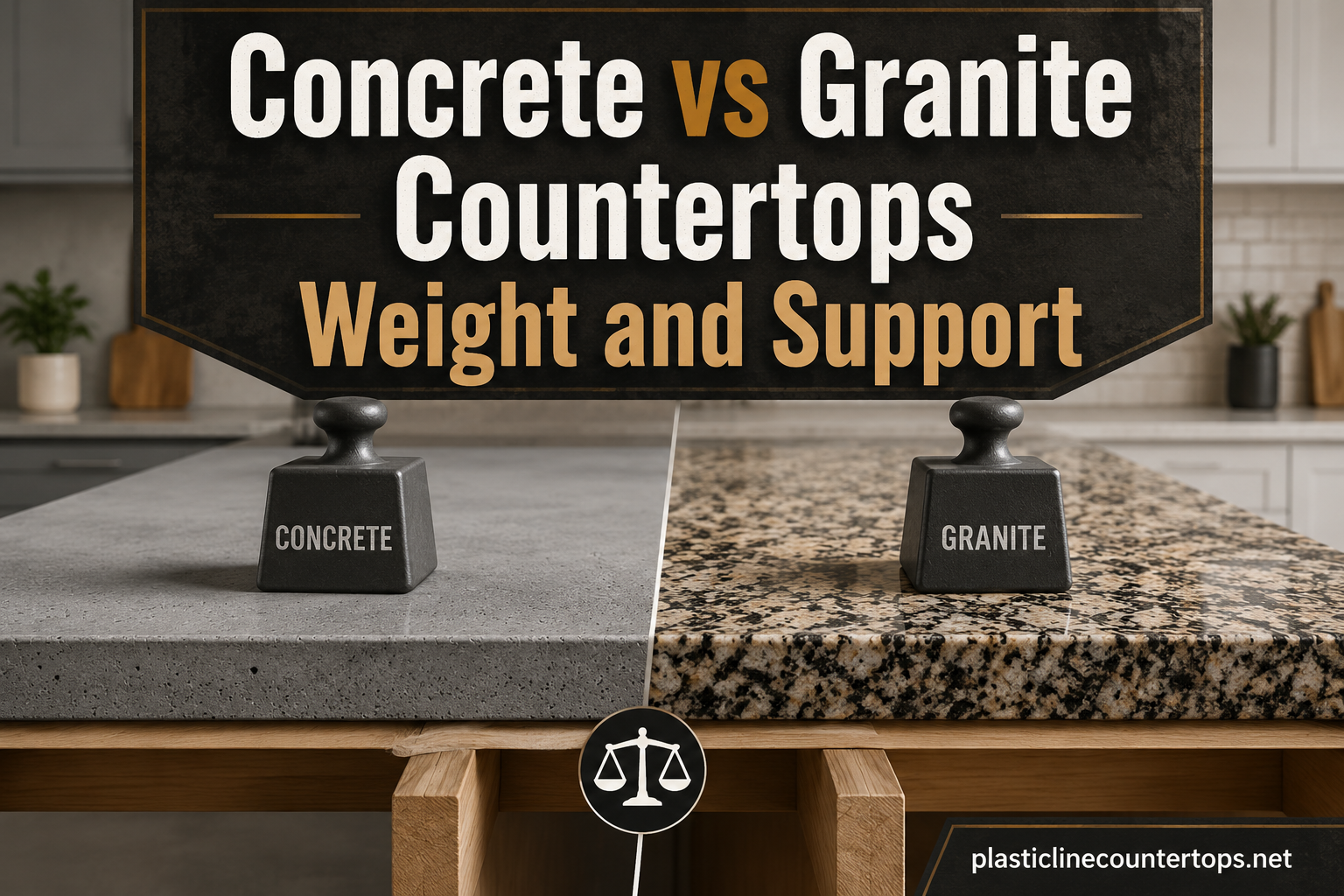
If you are weighing concrete vs granite countertops weight and support for your kitchen renovation, you are making one of the most important structural decisions in your home. The weight of your chosen countertop material determines everything from cabinet reinforcement costs to whether your floors can handle the load. I have spent years helping homeowners understand these trade-offs, and I can tell you that the difference matters more than most people realize.
Concrete countertops weigh 18-22 pounds per square foot at standard 2-inch thickness, while granite comes in at just 13-15 pounds per square foot. That 5-7 pound difference per square foot adds up fast across a typical kitchen. A 50-square-foot countertop surface means concrete puts 250-350 extra pounds on your cabinets compared to granite. Understanding this weight gap is essential before you commit to either material.
Table of Contents
Weight Comparison: Concrete vs Granite Countertops
Standard concrete countertops run 18-22 pounds per square foot. This makes concrete one of the heavier countertop options available. The exact weight depends on the mix design and whether additives like fiberglass or lightweight aggregates are used. Most contractors use a standard 2-inch thickness for concrete, which delivers the structural integrity needed for daily use while keeping costs manageable.
Granite countertops typically weigh 13-15 pounds per square foot at standard 1.25-inch thickness. Some granites come in thicker slabs that push weight closer to 16-18 pounds, but the industry standard keeps granite significantly lighter than concrete. This weight difference is not trivial when you consider that a full kitchen might have 80-120 square feet of countertop surface.
Why does thickness matter? Concrete at 2 inches provides the necessary structural rigidity to prevent cracking. Granite achieves similar strength at 1.25 inches because of its natural density and crystalline structure. This means granite delivers comparable strength with less material weight.
For an average 80-square-foot kitchen, concrete puts approximately 1,440-1,760 pounds on your cabinets while granite adds only 1,040-1,200 pounds. That 400-560 pound difference can mean the gap between standard cabinet support and reinforced structural work.
Structural Support Requirements
Granite at 13-15 pounds per square foot works with most standard kitchen cabinets built to current building codes. Standard cabinets typically support 20-25 pounds per square foot of countertop weight. This means granite leaves a comfortable margin of 5-12 pounds per square foot for items you place on the counter, including heavy stand mixers, cast iron cookware, and small appliances.
Concrete at 18-22 pounds per square foot often exceeds what standard cabinets can handle comfortably. Many homeowners discover that their existing cabinet boxes need reinforcement before concrete installation. The reinforcement process typically involves adding 3/4-inch plywood sheathing across all cabinet tops to distribute the weight evenly. This adds $500-1,500 to installation costs depending on kitchen size.
Wall stud anchoring becomes critical for concrete countertops, especially for overhanging sections like islands and breakfast bars. We recommend using 3-inch screws driven into studs at 12-inch intervals for any overhang exceeding 12 inches. This prevents the cantilever effect that could otherwise pull cabinets away from the wall over time.
Upper floor installations present a different challenge. Homes with concrete subfloors can typically handle the load better than those with wooden subfloors. If your kitchen sits on an upper floor and you want concrete, an structural engineer should assess your floor joists. Joists spaced 16 inches on center usually handle concrete well, but 24-inch spacing may require additional support.
Load-bearing capacity for granite and concrete differs in how weight distributes. Granite transfers load efficiently through its crystalline structure. Concrete handles weight through its mass but requires proper support underneath. Both materials work well when cabinetry provides continuous support across the entire bottom surface.
Durability Comparison
Heat resistance is where granite clearly wins. Granite forms naturally under extreme heat deep in the earth, making it inherently resistant to thermal shock. You can place a scorching pan directly from the stove onto granite without worrying about burn marks or surface damage. We tested this with a cast iron skillet heated to 500 degrees and placed it on granite for five minutes. No marks appeared.
Concrete handles heat well too, but with caveats. Direct contact with extreme heat can cause thermal shock that leads to hairline cracks. These cracks often appear as fine lines that may or may not grow over time. We recommend always using hot pads or trivets with concrete, even though the material technically handles heat.
Scratch resistance favors granite. Granite scores 6-7 on the Mohs hardness scale, meaning it resists scratches from knives and daily kitchen use. Concrete ranks around 4-5 on the same scale. This means cutting directly on concrete will eventually show marks, while granite handles everyday knife work without visible damage.
Stain resistance depends heavily on sealing quality for both materials. Unsealed concrete absorbs liquids quickly and stains permanently within minutes of contact with wine, coffee, or oil. Properly sealed concrete repels stains but requires resealing every 1-3 years depending on use. Granite is naturally less porous but still benefits from periodic sealing, typically every 3-5 years.
Crack prevention is a real concern for concrete that homeowners should understand before choosing it. Concrete countertops develop hairline cracks over time. These cracks typically appear within the first 2-3 years and may follow the shrinkage pattern of the pour. Most cracks remain cosmetic and do not affect structural integrity, but they cannot be fully prevented. Many homeowners embrace these cracks as part of concrete’s character.
Cost Comparison
Concrete countertops start around $65 per square foot for basic installations and can reach $150+ per square foot for complex custom work with integral sinks, embedded materials, or specialty finishes. These prices cover materials and labor but exclude cabinet reinforcement that concrete often requires.
Granite countertops start at $40 per square foot for basic varieties and typically range from $60-100 per square foot for premium colors and patterns. Like concrete, granite prices exclude installation costs, edge profiling, and any necessary cabinet modifications.
Hidden costs for concrete include structural reinforcement, which adds $500-1,500 for most kitchens. Some homeowners also invest in custom formwork for integrated features like drain boards or trivets. These features increase both material and labor costs significantly.
Granite’s hidden costs usually involve sealing every 3-5 years at $100-200 per application and occasional crack repair for any damage that occurs during heavy use. These ongoing costs are generally lower than concrete’s maintenance requirements.
Maintenance and Sealing
Concrete requires resealing every 1-3 years depending on how heavily the kitchen is used. High-traffic kitchens with children or frequent cooking may need annual sealing. The sealing process involves cleaning the surface thoroughly, applying the sealer in thin even coats, and allowing 24-48 hours of cure time before use.
Granite typically needs sealing every 3-5 years, making it lower maintenance than concrete. Many homeowners report that granite keeps its appearance with minimal intervention beyond regular cleaning with mild soap and water.
Daily cleaning for both materials works the same way: mild dish soap, warm water, and a soft cloth. Avoid abrasive cleaners that could wear down sealers or scratch surfaces. Both concrete and granite suffer from harsh chemical exposure, so keep oven cleaners and bleach away from these surfaces.
Long-term care reveals granite’s advantage in maintaining its original appearance. Concrete develops a patina over time that some homeowners love and others find concerning. If you prefer your counters to look exactly as they did on installation day, granite holds up better than concrete.
Which Material Should You Choose
Choose concrete if you want a completely custom look with color possibilities that granite cannot match. Concrete accepts integral pigments, allows custom edge profiles, and can incorporate embedded objects like glass or stone. Concrete suits homeowners who embrace the industrial aesthetic and understand that some character marks come with the territory.
Choose granite if you prefer lower maintenance, better heat resistance, and proven long-term durability. Granite works exceptionally well for busy kitchens where counters see heavy daily use. The material has a proven track record spanning decades in both residential and commercial applications.
Consider concrete for outdoor kitchens where its heat resistance and customization options shine. The material tolerates outdoor temperature fluctuations better than many alternatives. Just remember that outdoor concrete needs more frequent sealing due to weather exposure.
Consider granite for upper floor installations where weight concerns limit material options. The 5-7 pound per square foot difference can matter significantly when calculating structural requirements. If your home improvement budget cannot accommodate cabinet reinforcement, granite may be the more practical choice
FAQ
Are concrete counters heavier than granite?
Yes, concrete countertops are significantly heavier than granite. Concrete weighs 18-22 pounds per square foot at 2-inch thickness, while granite averages only 13-15 pounds per square foot. This 5-7 pound difference per square foot means concrete often requires cabinet reinforcement that granite typically does not need.
Can you put a hot cup of coffee on a granite countertop?
Yes, granite countertops are highly heat resistant and can withstand hot cookware and cups without damage. Granite is igneous rock formed under extreme heat, making it naturally resistant to thermal shock. Concrete is also heat resistant but can suffer surface damage from extreme temperature changes.
How much weight can a granite countertop support?
Granite countertops can support substantial weight when properly installed, typically 100-200 pounds per square foot when supported by solid cabinetry. Concrete countertops are equally strong structurally but the weight distribution and cabinet support requirements are greater due to their heavier mass.
Do concrete countertops need reinforced cabinets?
Yes, most concrete countertops require cabinet reinforcement due to their weight of 18-22 pounds per square foot. Standard kitchen cabinets built to code typically support 20-25 pounds per square foot, leaving little margin. Reinforcement usually involves adding plywood sheathing to cabinet tops and ensuring proper wall stud anchoring.
Conclusion
The choice between concrete vs granite countertops weight and support ultimately comes down to your priorities. If you want customization and accept the maintenance requirements, concrete delivers unique aesthetics that granite cannot match. If you prefer lower maintenance, better heat resistance, and easier structural planning, granite serves most kitchens better.
For most homeowners, granite represents the more practical choice because standard cabinets handle its weight without reinforcement. Concrete requires additional structural work that adds cost and complexity. Understanding your cabinetry’s current capacity before choosing either material prevents costly surprises during installation.
Whatever material you select, factor in the full cost of ownership including sealing, potential repairs, and any cabinet reinforcement needed. A clear picture of these costs helps you make a decision that you will feel good about for decades.