
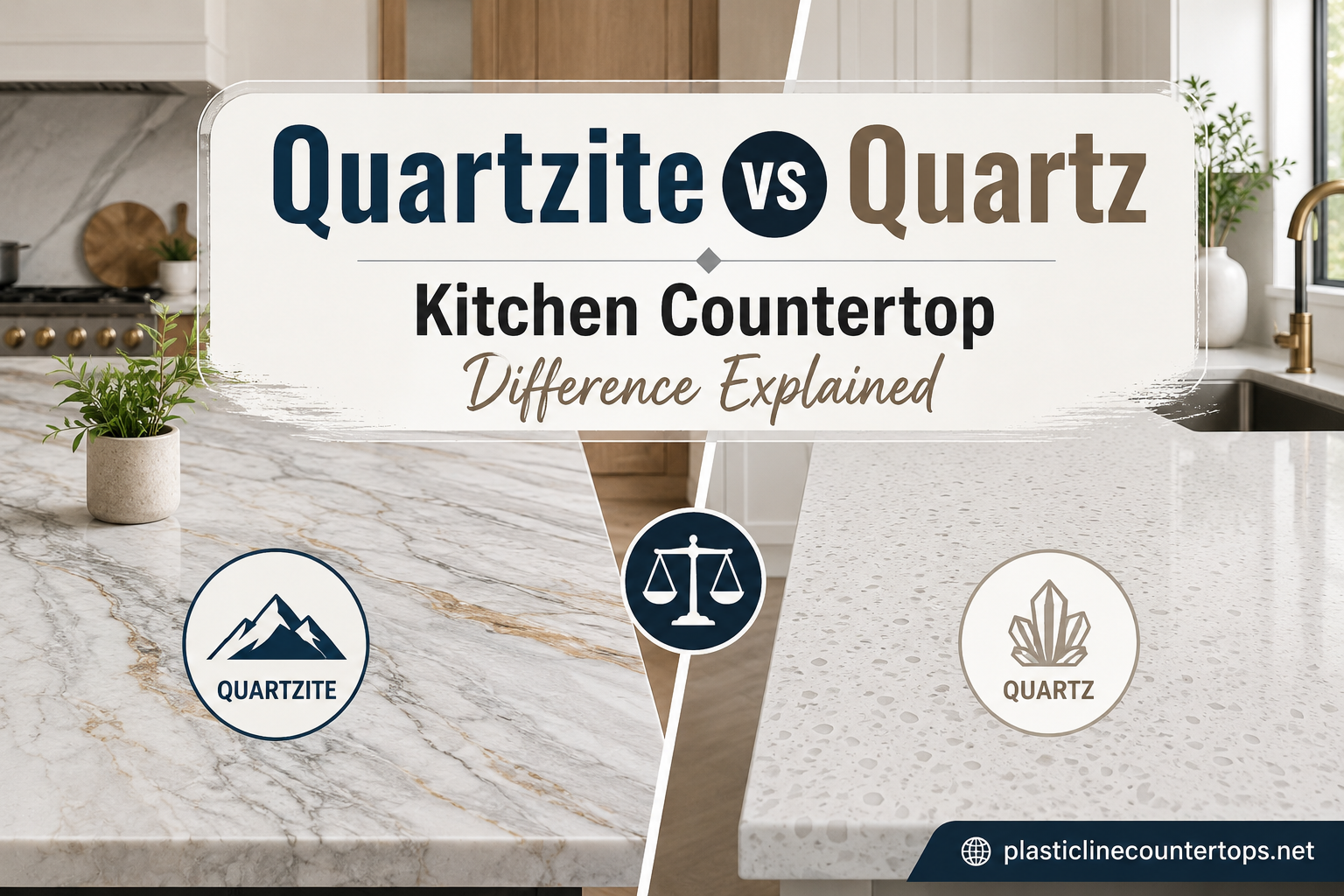
If you are planning a kitchen remodel or building new countertops, you have probably encountered the confusing debate between quartzite vs quartz. These two materials sound almost identical, but they are fundamentally different in how they are made, how they perform, and what kind of maintenance they require. I have spent hours researching this topic and talking to fabricators, and I want to give you a clear, honest breakdown so you can make the best decision for your home.
The core difference is this: quartzite is a natural metamorphic stone that forms deep underground over millions of years, while quartz is an engineered surface made by combining crushed stone with resins and pigments. That distinction affects everything from heat resistance to maintenance needs, and understanding it will save you from making a costly mistake.
In this guide, I will walk you through exactly what each material is, how they compare on the factors that matter most, and which one I would recommend based on your specific situation. By the end, you will know precisely which countertop belongs in your kitchen.
Table of Contents
What is Quartzite
Quartzite is a natural stone that starts as ordinary sandstone. Over millions of years, deep within the Earth is crust, that sandstone gets exposed to extreme heat and tremendous pressure. That heat and pressure cause the sand-sized quartz grains to recrystallize and fuse together, transforming sandstone into something entirely new. The result is a hard, dense metamorphic rock with a texture that looks something like sugar crystals fused together.
When you look at a quartzite slab, you will notice it has a distinctive crystalline appearance. The color typically ranges from white to gray, but it can also appear in shades of pink, red, purple, blue, green, orange, and yellow depending on the mineral impurities present during formation. The famous Taj Mahal quartzite, for instance, displays warm cream and gold tones with elegant flowing veining.
The key characteristic that makes quartzite valuable for countertops is its hardness. On the Mohs hardness scale, which measures a stone is resistance to scratching, quartzite typically registers between 7 and 8. For reference, granite rates around 6 to 7, and marble sits at about 3 to 5. That means quartzite is exceptionally scratch-resistant and can handle the daily abuse of a busy kitchen without showing wear.
Quartzite forms in locations around the world where tectonic activity has subjected sandstone to the right conditions. Brazil, Norway, and parts of the United States are known for producing high-quality quartzite. The stone is quarried in large blocks, cut into slabs, and polished to a smooth finish before reaching your kitchen.
What is Quartz
Quartz is an engineered stone, which means it is manufactured in a factory rather than formed by natural geological processes. The basic recipe involves combining roughly 90 to 95 percent crushed quartz crystals with 5 to 10 percent polymer resins and pigments. Those resins act as a binder that holds everything together and creates a surface that is solid all the way through.
The manufacturing process starts with crushed quartz, which is often a byproduct of other quarrying operations. This crushed material gets mixed with the resins and any color pigments needed to achieve specific looks. The mixture then goes into a mold and gets pressed under extreme pressure while being heated to cure the resins. The result is a slab that can be cut and fabricated into countertops just like natural stone.
Because quartz is engineered, manufacturers have significant control over the final appearance. They can create uniform colors, replicate the look of natural stone with incredible accuracy, and even add materials like recycled glass or metallic flecks for visual interest. Brands like Caesarstone, Cambria, and Silestone have built entire product lines around these design possibilities.
The polymer resins used in quartz also make the material non-porous, which is one of its biggest selling points. Unlike natural stone, quartz does not require sealing to resist stains and moisture. That convenience has driven quartz is popularity dramatically over the past two decades, and it now accounts for a significant share of the countertop market.
Quartzite vs Quartz: Appearance Differences
The visual difference between quartzite and quartz is one of the most obvious ways to tell them apart. Quartzite, as a natural stone, displays the unique patterns that formed over millions of years underground. Each slab is genuinely one-of-a-kind, with characteristic veining that often resembles marble. When light hits quartzite, you might notice a subtle shimmer from the crystalline quartz structure.
Quartz, being engineered, can be produced with much more consistency. If you order the same color and style from a manufacturer, you can expect slabs that look virtually identical. This predictability appeals to homeowners who want a specific look without the variability that comes with natural stone. Manufacturers can also create colors and patterns that do not exist in nature, opening up design possibilities that natural stone simply cannot match.
Quartzite tends to feature softer, more flowing veining in earth tones, particularly whites, grays, creams, and occasionally warmer hues. The most popular quartzite varieties, like Taj Mahal, Macauba, and Mont Blanc, evoke the elegance of marble with the durability of granite. Pure white quartzite has become especially popular in recent years for its clean, minimalist aesthetic.
Quartz offers virtually unlimited color options, from solid blacks and whites to patterns that imitate Carrara marble, Calacatta gold, and exotic granites. If you want a specific countertop color to match your kitchen cabinets or design scheme, quartz can typically deliver it. This design flexibility is something that natural stone cannot consistently provide.
The finish options also differ between the two materials. Quartzite almost always comes with a polished finish to enhance the natural shine and depth of the stone. Quartz can be finished in polished, honed, leathered, or textured surfaces depending on the manufacturer and the desired look. This variety gives quartz an edge in design versatility.
Durability and Hardness Comparison
When it comes to durability, both materials perform well in kitchen environments, but they achieve that durability in different ways. Quartzite is the harder of the two, typically rating 7 to 8 on the Mohs scale. This hardness means it is highly resistant to scratches from knives, cast iron pans, and daily kitchen activity. I have talked to homeowners who have used quartzite for years without ever seeing a scratch on the surface.
Quartz rates slightly lower on the Mohs scale, generally around 6 to 7, but that does not mean it is fragile. The engineered construction creates a tough, durable surface that handles normal kitchen use without issues. The resins that bind the crushed quartz actually add some flexibility, which can be beneficial in certain installation situations.
One area where quartz has an advantage is in its resistance to chipping. The polymer resins give quartz a slight flex, which helps it absorb impact without cracking. Quartzite, being pure natural stone, can be more brittle and may chip if struck by a heavy object at just the right angle. Both materials can be repaired if damage occurs, but chipping is less common with quartz.
For everyday kitchen use, both materials hold up well. The real question is whether you prioritize scratch resistance (quartzite wins) or chip resistance (quartz has a slight edge). In my experience talking to fabricators, neither material tends to have major durability issues in properly installed kitchens.
Heat Resistance Comparison
Heat resistance is where quartzite truly shines, and it is one of the most common questions I see from homeowners. Quartzite can withstand temperatures well above what you would typically expose a countertop to in daily life. You can place a hot pan directly on quartzite without worrying about scorch marks or thermal shock damage. This heat tolerance comes from the natural formation process that subjected the stone to extreme conditions deep underground.
Quartz is a different story. The polymer resins that make quartz non-porous and convenient to maintain actually have a relatively low heat tolerance. Exposing quartz to temperatures above approximately 300 degrees Fahrenheit can cause the resins to soften, discolor, or even crack. That means putting a searing hot pan directly on quartz is not a good idea, even if the surface seems fine at first.
The practical implication is that quartzite requires less caution in the kitchen. You can pull a pot off the stove or a pan from the oven and set it down without reaching for a trivet first. This convenience matters to people who cook frequently and do not want to think twice about where they place hot cookware. Multiple homeowners in online forums have shared that this heat resistance was a deciding factor in choosing quartzite for their kitchens.
If you choose quartz, you will need to use trivets or hot pads consistently. The risk of permanent damage from a single moment of carelessness is real, and I have seen quartz countertops with obvious scorch marks that could not be repaired. For busy families or anyone who cooks regularly, this maintenance consideration is significant.
Maintenance and Sealing Requirements
Quartz has a major advantage when it comes to maintenance: it is essentially maintenance-free. Because the polymer resins create a non-porous surface, quartz does not absorb liquids, which means stains cannot penetrate the material. You can spill wine, coffee, tomato sauce, or oil on quartz, wipe it up within a reasonable time, and not worry about staining. This convenience is why quartz became so popular in the first place.
Quartzite, being natural stone, is porous and requires sealing to resist stains. Unsealed quartzite will absorb liquids, and over time that absorption leads to staining, etching, and potential damage. The good news is that sealing quartzite is straightforward. You apply a quality stone sealer every one to two years, or whenever water stops beading on the surface. This process takes maybe 20 minutes and costs very little, but it is a step you simply cannot skip.
Some homeowners worry about the consequences of skipping the sealer. If quartzite goes unsealed for an extended period, liquids will gradually work their way into the stone. You might notice rings or discoloration from acidic liquids like wine or orange juice. Eventually, the stone can become stained in a way that requires professional refinishing to fix. Forum discussions reveal that people who neglected sealing for several years faced costly remediation.
When it comes to cleaning, both materials are easy to maintain with mild soap and water. Avoid abrasive cleaners or scrub brushes that could damage the surface. For quartz, you should never use bleach or harsh chemicals, as they can break down the resins over time. For quartzite, avoid acidic cleaners that could etch the stone, even though sealed quartzite is generally resistant to mild acids.
Cost Comparison
Quartzite and quartz are in similar price ranges, though quartzite tends to be slightly more expensive on average. For materials alone, you can expect to pay between $60 and $120 per square foot for quartzite, while quartz typically ranges from $50 to $100 per square foot. These prices vary based on the specific variety, rarity, brand, and your geographic location.
Keep in mind that material cost is only part of the total investment. Fabrication and installation typically add another $40 to $100 per square foot, depending on your region and the complexity of the job. Edge profiles, cutouts for sinks and cooktops, and special finishes all add to the final bill. A typical kitchen with 50 square feet of countertop space might cost $5,000 to $10,000 total for either material.
Rare quartzite varieties command premium prices. Exotic options like Blue Fantasy, Volcano, or exotic Macauba varieties can run $150 to $300 per square foot for the material alone. If you have your heart set on a specific look, it is worth shopping around because price differences between suppliers can be substantial for the same material.
Neither material is inexpensive, but both represent solid long-term investments in your home. The resale value of either countertop is comparable, and both materials will last for decades with proper care. When comparing costs, factor in the long-term maintenance requirements: quartzite needs periodic sealing, while quartz does not.
Pros and Cons Summary
Quartzite offers several compelling advantages that make it worth considering. The natural beauty of each slab means your countertop will be genuinely unique. The exceptional heat resistance lets you place hot cookware directly on the surface without worry. Quartzite rates 7 to 8 on the Mohs hardness scale, making it highly scratch-resistant and durable. As a natural stone, quartzite appeals to homeowners who value authentic materials over engineered products.
However, quartzite does have drawbacks worth noting. It requires sealing every one to two years to prevent staining, which adds a small but ongoing maintenance task. Quartzite can be more challenging to fabricate due to its hardness and potential for cracking during the process. The natural variability that makes each slab unique also means you cannot get perfectly consistent color and pattern across multiple slabs. Some lighter quartzite varieties may have fabricator concerns about cracking during installation.
Quartz has its own distinct advantages. The non-porous surface never requires sealing and resists stains completely with basic cleaning. The engineered consistency means you can match slabs precisely and predict the final look. Quartz offers virtually unlimited color and pattern options. The slight flexibility from the resin binder helps prevent chipping. Cleaning is simple with mild soap and water.
The disadvantages of quartz are important to understand. The resin content limits heat resistance, meaning hot pans can damage the surface. The engineered nature means less unique character and more uniform appearances. Some homeowners feel quartz lacks the authentic beauty of natural stone. Over very long time periods, the resins may yellow slightly, particularly in lighter colors exposed to sunlight.
How to Tell Quartzite from Quartz
Distinguishing between quartzite and quartz is not always obvious, especially when looking at finished countertops or samples in a showroom. One practical home test involves using lemon juice, which is acidic. Place a few drops of lemon juice on the surface and wait about 15 minutes. If the stone darkens or shows etching, it is likely quartzite or natural stone that needs sealing. If nothing happens, it is probably quartz with its non-porous resin surface.
The visual inspection can also provide clues. Quartzite typically has a subtle sparkle from the crystalline quartz grains fused together. The veining in quartzite tends to flow more organically, similar to marble. Quartz, by contrast, often has a more uniform, consistent pattern because it is manufactured to look a certain way. If the pattern seems too perfect or repetitive, you are likely looking at quartz.
Another method is to examine the edges of the slab. On quartz, you can often see through the material all the way through, revealing the engineered construction with possible visible resin layers. Quartzite will look consistent from the surface to the edge, like natural stone. Fabricators and installers often recognize the difference immediately, but these tips should help homeowners make an educated guess.
When in doubt, ask the supplier or fabricator directly. Request documentation specifying whether the material is natural quartzite or engineered quartz. Reputable suppliers will have clear information about the origin and composition of their stone. If a deal seems too good to be true, that may be a warning sign that the material is mislabeled or misrepresented.
Fantasy Brown Stone: A Common Confusion Point
One material that causes significant confusion in this space is Fantasy Brown, and I want to address it directly because I see homeowners getting misled. Fantasy Brown stone is frequently marketed as quartzite, but it is actually a type of dolomitic marble. This matters because marble performs differently than quartzite in important ways.
Marble, including Fantasy Brown, is softer than quartzite and rates around 3 to 5 on the Mohs scale. It etches more easily when exposed to acids, including common kitchen items like lemon juice, vinegar, and wine. The sealing requirements and maintenance considerations differ from true quartzite. If someone sells you Fantasy Brown as quartzite and you treat it accordingly, you may be in for unpleasant surprises.
The reason for this confusion is partly commercial. Fantasy Brown looks beautiful and has become popular, and marketing it as quartzite may make it easier to sell at certain price points. Some stone brokers have even stopped carrying it because of the labeling confusion. Always verify what you are purchasing with a simple acid sensitivity test before committing.
If you love the look of Fantasy Brown, do not necessarily avoid it. Just make sure you understand what it is: a natural marble with excellent aesthetic appeal and specific care requirements. It needs more careful maintenance than quartzite, but many homeowners consider that trade-off worthwhile for the distinctive appearance.
Which Material Is Better for Your Kitchen
The honest answer to which material is better depends entirely on your priorities, lifestyle, and cooking habits. If you cook frequently, especially with heavy cookware and hot pans, quartzite is probably the better choice. The superior heat resistance means you never have to think twice about where you set down a searing pot. The natural beauty appeals to homeowners who appreciate authentic materials with unique character.
If you prioritize low maintenance and convenience above all else, quartz is worth serious consideration. The fact that you never need to seal it, that it resists stains completely, and that it handles most kitchen spills without worry appeals to busy families who want beautiful countertops without the ongoing care requirements. The wider range of design options also matters to homeowners with specific aesthetic visions.
For high-end kitchens where budget is less of a concern, quartzite often wins the comparison among design professionals. The natural stone look and superior heat resistance give it an edge in luxury applications. For family kitchens where spills and accidents happen daily, quartz often proves more practical despite its heat limitations.
Neither choice is wrong. Both materials will give you beautiful, durable countertops that last for decades. The key is understanding the trade-offs and matching them to your specific situation. Take stock of how you cook, how much maintenance you are willing to do, what your budget looks like, and what aesthetic you are trying to achieve. Those factors will point you toward the right material.
FAQ
What is better for a countertop, quartz or quartzite?
Can I put a hot cup of coffee on quartz?
Can I use Clorox wipes on quartzite?
Why is quartz in decline?
Is quartzite nicer than quartz?
Is Taj Mahal a quartz or quartzite?
What is the downside to quartzite?
Conclusion
Understanding the difference between quartzite and quartz matters because these two materials require fundamentally different approaches to maintenance, offer different performance characteristics, and appeal to different priorities. Quartzite provides natural beauty and exceptional heat resistance but requires periodic sealing. Quartz delivers maintenance-free convenience and design consistency but cannot tolerate hot pans.
The decision between quartzite vs quartz countertop comes down to how you live in your kitchen. If you cook regularly with heavy cookware and appreciate natural materials, quartzite is likely worth the sealing maintenance. If you want beautiful countertops that require almost no ongoing care, quartz is the practical choice.
Take time to see both materials in person at a showroom or stone yard. Place your hands on the surfaces, ask about specific maintenance requirements, and get quotes that include fabrication and installation. Your kitchen countertops will be a central part of your home for decades, and choosing wisely based on accurate information will pay off every single day you use them.