
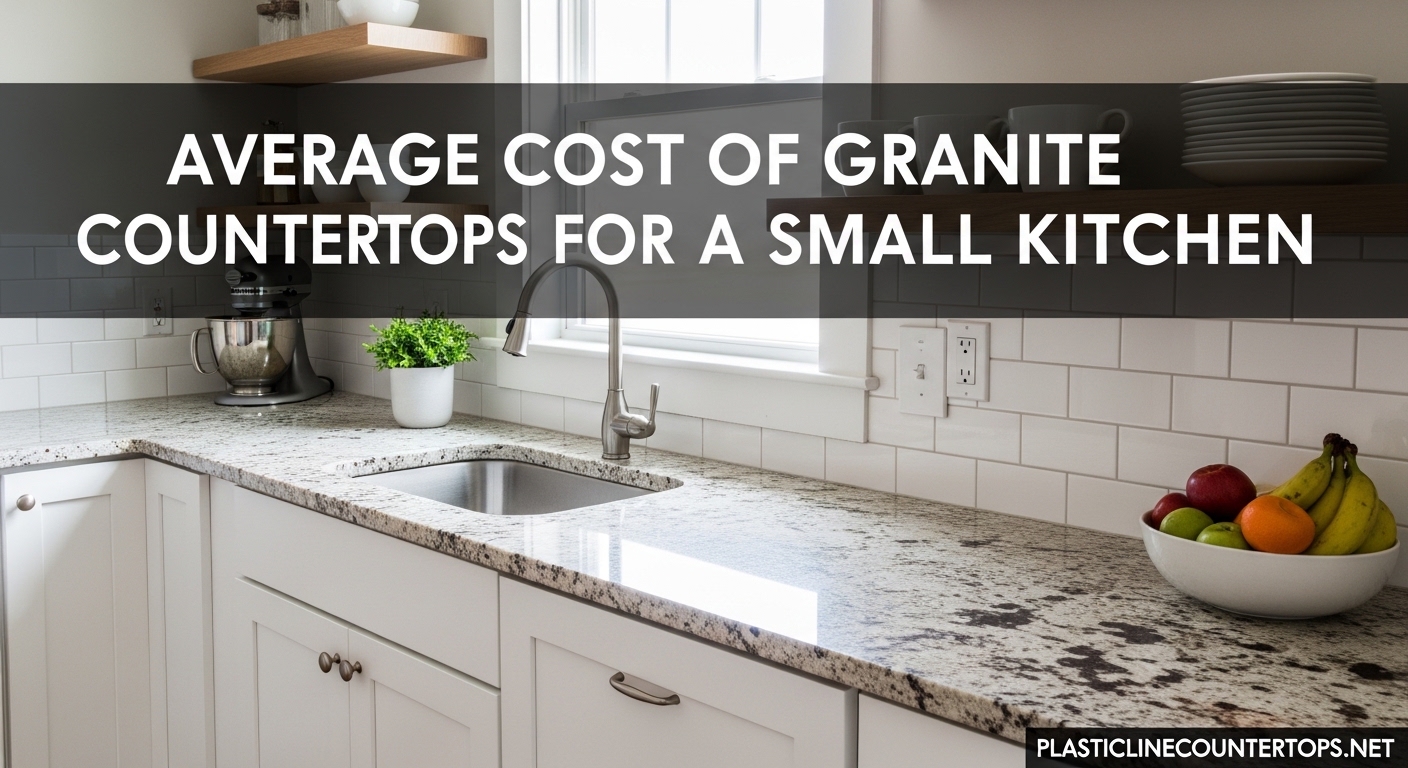
If you are planning a kitchen renovation and want to know the average cost of granite countertops for a small kitchen, you are in the right place. Based on our research into current pricing data and real homeowner experiences, most small kitchens (40 to 60 square feet of countertop space) cost between $2,000 and $4,500 for granite countertops installed. That breaks down to roughly $50 to $100 per square foot when you factor in both the material and professional installation.
Granite remains one of the most popular countertop choices for homeowners who want the look and durability of natural stone without paying marble-level prices. But the cost of granite can swing dramatically depending on the grade of stone you choose, the complexity of your kitchen layout, your location, and the add-ons you select. We have analyzed pricing data from multiple sources, real homeowner reports from renovation forums, and industry pricing guides to give you a clear picture of what to expect.
In this guide, we break down every cost factor, provide step-by-step calculations for small kitchens, explain the granite grading system, compare granite to other materials, and share proven strategies to keep your budget in check. Whether you are working with a galley kitchen, a compact L-shape, or a modest open plan, you will find the numbers you need to plan your project with confidence.
Granite Countertop Cost Overview for 2026
The national average cost of granite countertops installed ranges from $2,000 to $4,500 for a typical kitchen, according to data compiled from Angi, HGTV, and homeowner reports. For a small kitchen specifically, you can expect to pay on the lower end of that range because you are covering less square footage.
Here is how the costs break down by category:
- Material only: $30 to $75 per square foot depending on granite grade
- Installation labor: $15 to $35 per square foot on average
- Total installed cost: $50 to $100 per square foot for most projects
- Additional costs: Edge profiles ($10 to $30 per linear foot), sink cut-outs ($100 to $250 each), and sealing ($150 to $300)
One important thing to understand is that granite pricing is rarely a flat rate. Fabricators and installers typically quote based on the specific slab, the complexity of your cuts, and the edge profiles you select. A homeowner on a renovation forum shared that they received quotes ranging from $30 per square foot for basic entry-level granite to over $100 per square foot for premium exotic slabs, all from different shops in the same city.
The material itself usually accounts for 50 to 60 percent of your total cost, while labor, fabrication, and add-ons make up the rest. This split matters because it means you have room to save on both sides: choosing a more affordable stone and simplifying the installation requirements.
Cost Breakdown by Kitchen Size and Square Footage
Understanding how granite countertop cost per square foot translates to your specific kitchen is the key to building an accurate budget. Small kitchens generally have 40 to 60 square feet of countertop space, while average kitchens fall in the 60 to 80 square foot range. Let us walk through the math.
Step-by-Step Cost Calculation for a Small Kitchen
To estimate your granite cost, follow these steps:
- Measure your countertop area: Measure the length and width of each counter section in inches, then divide by 144 to get square feet. Add all sections together for your total.
- Add 10 percent for waste: Fabricators cut from slabs, and there is always some waste. Multiply your total by 1.10.
- Multiply by your price per square foot: Use $50 for budget granite, $75 for mid-range, or $100 for premium.
- Add the extras: Sink cut-outs, edge profiles, backsplash, and sealing.
Here is what that looks like for common small kitchen sizes:
- 40 square feet (compact galley kitchen): $2,000 to $4,400 installed
- 50 square feet (typical small kitchen): $2,500 to $5,500 installed
- 60 square feet (small L-shaped kitchen): $3,000 to $6,600 installed
How Much Is Granite for a 10×10 Kitchen?
A 10×10 kitchen is a common reference point in the countertop industry. The countertop area in a 10×10 kitchen typically measures about 35 to 45 square feet, depending on the layout and whether there is an island. Using the standard pricing range of $50 to $100 per square foot installed, you can expect to pay $1,750 to $4,500 for granite in a 10×10 kitchen.
How Much Would 20 Feet of Granite Countertop Cost?
Twenty linear feet of granite countertop with a standard 25-inch depth equals approximately 42 square feet. At $50 to $100 per square foot installed, that works out to roughly $2,100 to $4,200 total. Keep in mind that linear feet and square feet are different measurements; always clarify which one your fabricator is quoting.
One forum user reported paying $1,800 for approximately 55 square feet of granite, which included a built-in cutting board. That comes out to about $33 per square foot, which suggests they found a promotional deal on entry-level granite. These deals exist but often come with limited color selections.
Granite Grades and Types: How They Affect Price
The single biggest factor in your granite cost is the grade or level of stone you select. Granite is classified using two common systems: the Level system and the Grade system. Both essentially rank granite from most common and affordable to rarest and most expensive.
Granite Level System (Level 1, 2, 3)
Most granite suppliers and big-box home improvement stores use a level system:
- Level 1 (Entry-Level): $30 to $45 per square foot material-only. These are the most common colors with simple patterns. Common colors include Absolute Black, Santa Cecilia, and Giallo Ornamental. They are widely available and produced in large quantities, which keeps prices low.
- Level 2 (Mid-Range): $45 to $65 per square foot material-only. These feature more interesting veining, richer colors, and slightly more unique patterns. Popular options include Uba Tuba, Bianco Romano, and Golden Persa.
- Level 3 (Premium): $65 to $100+ per square foot material-only. These are rare or exotic granites with dramatic veining, unusual colors like blue or red tones, and limited availability. Examples include Blue Bahia, Van Gogh, and Black Forest.
Granite Grade System (Grade A, B, C)
Some fabricators use a letter grading system instead:
- Grade A (Lowest cost): Equivalent to Level 1. Plentiful, consistent patterns, easy to source.
- Grade B (Mid-tier): Equivalent to Level 2. More visual interest, slightly harder to source.
- Grade C (Premium): Equivalent to Level 3. Rare patterns, unique color combinations, and limited quarry availability.
Do not let the terminology confuse you. Whether a supplier calls their granite Level 1 or Grade A, they are referring to the same category of entry-level, affordable stone. Always ask for the price per square foot rather than getting caught up in the naming conventions.
How Color Affects Granite Pricing
Color plays a direct role in cost because certain granite colors are more abundant in quarries than others. The cheapest granite colors tend to be neutral tones like beige, gray, and basic black because they are quarried in massive quantities. The most expensive colors include blues, reds, and greens with dramatic veining because those mineral deposits are rarer.
Here is a general price tier breakdown by color family:
- Budget-friendly colors: Absolute Black, Santa Cecilia, Giallo Ornamental, Tropic Brown, Baltic Brown ($30 to $50 per sq ft material)
- Mid-range colors: Uba Tuba, Bianco Romano, Colonial White, Moon White, Thunder White ($45 to $70 per sq ft material)
- Premium colors: Blue Bahia, Van Gogh, Black Forest, Costa Esmeralda, Patagonia ($70 to $150+ per sq ft material)
For a small kitchen, choosing a budget-friendly color can keep your total material cost under $1,000 for 40 to 50 square feet. That leaves room in your budget for nicer edge profiles or a higher-quality finish.
Factors That Affect the Average Cost of Granite Countertops for a Small Kitchen
Beyond the granite grade itself, several additional factors can push your total cost up or down. Understanding these variables helps you make informed choices and avoid surprise charges when the final bill arrives.
Slab Thickness: 2cm vs 3cm
Granite slabs come in two standard thicknesses, and the choice affects both cost and appearance:
- 2cm (3/4 inch): Less expensive per square foot, but requires a plywood substrate for support. This adds labor cost and can negate the material savings. The edge appears thinner, which some homeowners find less substantial.
- 3cm (1-1/4 inch): More expensive per square foot but does not require a substrate. This is the standard choice for most residential installations because it provides a thicker, more substantial-looking edge and simplifies installation.
For small kitchens, 3cm granite is usually the better value because the labor savings from not needing a substrate offset the higher material cost. The total price difference between 2cm and 3cm installed is often less than 10 percent.
Edge Profiles
The edge profile you choose affects both the look of your countertops and the price. More intricate edges require more fabrication time, which increases cost:
- Straight edge (ease-in): $0 to $5 per linear foot additional. Often included at no extra charge.
- Bevel edge: $5 to $10 per linear foot. A clean angled cut that adds subtle detail.
- Full bullnose: $10 to $15 per linear foot. A fully rounded edge that is classic and safe for households with children.
- Half bullnose: $8 to $12 per linear foot. Rounded on top, flat on bottom. A popular compromise.
- Ogee: $15 to $30 per linear foot. An S-shaped curve that adds elegance. Most expensive common profile.
For a small kitchen with roughly 15 linear feet of visible edge, upgrading from a straight edge to an ogee profile adds about $225 to $450 to your total. Sticking with a simple bevel or half bullnose keeps costs reasonable while adding visual interest.
Finish Options
The surface finish of your granite also affects the price:
- Polished finish: The most common and usually the least expensive. High-gloss surface that highlights the stone color and pattern.
- Honed finish: Matte appearance that costs 10 to 20 percent more than polished. Gives a softer, more natural look but may require more frequent sealing.
- Leathered finish: Textured surface that costs 15 to 30 percent more than polished. Provides a unique tactile experience and hides fingerprints well.
Sink Cut-Outs and Fixture Holes
Most fabricators charge extra for cutting holes in your granite. Sink cut-outs typically cost $100 to $250 each, depending on whether it is an undermount or top-mount sink. Cooktop cut-outs run $150 to $300. Faucet holes and soap dispenser holes are usually $15 to $25 each.
For a small kitchen with one sink and a standard faucet, expect to add $150 to $350 for cut-outs and holes. This is one area where some promotional packages can save you money, as certain fabricators include standard cut-outs in their per-square-foot price.
Backsplash and Splash Guards
A 4-inch granite backsplash matching your countertops typically costs $15 to $25 per linear foot. For a small kitchen with 10 to 15 linear feet of backsplash needed, that adds $150 to $375 to your total. Full-height backsplashes using granite slabs cost significantly more and are less common in small kitchens.
Regional Price Variation
Where you live has a real impact on granite pricing. Major metropolitan areas tend to have more fabricators competing for business, which can drive prices down. Rural areas and smaller cities may have fewer options, leading to higher per-square-foot rates. Homeowners on forums report paying 20 to 30 percent more for identical granite in smaller markets compared to large cities.
Regions near granite quarries or major shipping ports, such as parts of the southeastern United States, often have lower prices due to reduced transportation costs. The Northeast and West Coast tend to run 10 to 20 percent higher than the national average.
Old Countertop Removal and Disposal
If you are replacing existing countertops, removal and disposal adds $300 to $600 on average. Many homeowners on renovation forums report saving 20 to 30 percent by removing old countertops themselves before the installers arrive. This is a straightforward DIY task if your current counters are laminate, though granite or quartz removal requires more effort and an extra set of hands.
Small Kitchen Specific: Is Granite Worth It?
Small kitchens actually present a unique advantage when it comes to granite countertops. Because you need less material, you can afford higher-grade granite for the same total budget that would only cover entry-level stone in a larger kitchen. This is one of the best reasons to consider granite for a compact space.
The Remnant Advantage
Granite remnants are leftover pieces from larger slab cuts that fabricators sell at a discount. For a small kitchen that only needs 40 to 50 square feet, remnants can be an excellent option. Many fabricators sell remnants at 30 to 50 percent off the per-square-foot price of a full slab. One forum member shared that they found a premium remnant piece for their small bathroom and kitchen bar area at less than half the regular price.
The catch with remnants is limited selection. You may not find the exact color or pattern you originally wanted. But if you are flexible on aesthetics, remnants offer significant savings for small projects.
DIY vs Professional Installation
Granite installation is not a typical DIY project. The slabs are heavy (a standard 3cm slab weighs about 18 pounds per square foot), fragile before installation, and require specialized tools for cutting and polishing. A 50-square-foot small kitchen granite slab weighs roughly 900 pounds.
Professional installation is strongly recommended. The cost of renting equipment, potential slab breakage, and the risk of improper seams usually exceeds any savings from doing it yourself. However, there are parts of the process where DIY makes sense:
- Removing old countertops: Saves $300 to $600 in removal fees
- Template preparation: Clearing the area and ensuring accurate measurements
- Sealing after installation: Most homeowners can apply granite sealer themselves ($20 to $40 for a quality sealer vs $150 to $300 professional charge)
Hidden Cost Checklist: What to Ask Your Contractor
One of the biggest pain points homeowners report is receiving a final bill that exceeds the initial quote by 20 to 30 percent. Use this checklist when reviewing granite countertop quotes to make sure you are comparing apples to apples:
- Is the price per square foot for material only, or does it include installation?
- Are sink cut-outs and faucet holes included, or charged separately?
- What edge profile is included in the base price?
- Is sealing included, or will you need to handle that yourself?
- Does the quote include old countertop removal and disposal?
- Are there charges for the template and measurement visit?
- What is the policy on seams? Some layouts require seams, and visible seams may need additional polishing.
- Is there a delivery fee?
- Does the fabricator warranty their installation work?
- Are there any charges for plywood substrate (if using 2cm granite)?
Getting answers to all of these questions before signing a contract prevents surprises. We recommend getting at least three quotes and using this checklist to compare them on equal terms.
Granite vs Other Countertop Materials: Cost Comparison
Before committing to granite, it helps to see how it stacks up against other popular countertop materials. Here is how the costs compare for a small kitchen with 50 square feet of countertop space:
- Granite: $2,500 to $5,000 installed ($50 to $100 per sq ft)
- Quartz: $2,750 to $6,000 installed ($55 to $120 per sq ft)
- Quartzite: $3,000 to $6,500 installed ($60 to $130 per sq ft)
- Marble: $3,000 to $6,000 installed ($60 to $120 per sq ft)
- Butcher block: $1,500 to $3,500 installed ($30 to $70 per sq ft)
- Laminate: $750 to $2,000 installed ($15 to $40 per sq ft)
- Solid surface (Corian): $2,000 to $4,500 installed ($40 to $90 per sq ft)
Granite vs Quartz: Which Is Better Value?
This is one of the most debated questions in kitchen renovation forums. Granite is a natural stone that needs periodic sealing, while quartz is an engineered surface that is non-porous and maintenance-free. For small kitchens, the price gap between the two is usually small enough that the decision comes down to personal preference.
Granite tends to be slightly less expensive per square foot than quartz of comparable quality. However, quartz offers more consistent patterns and does not require sealing, which saves you time and about $20 to $40 every one to two years. Both materials are heat-resistant, durable, and add resale value to your home.
When Granite Makes the Most Sense for a Small Kitchen
Granite is particularly well-suited for small kitchens when:
- You want the unique character of natural stone that no engineered product can fully replicate
- You are budget-conscious and can find entry-level or remnant granite at a good price
- You plan to sell the home within a few years and want the resale appeal of natural stone
- Your kitchen gets heavy cooktop use and you need superior heat resistance
Quartz may be the better choice when you prefer low maintenance, want a perfectly uniform appearance, or have concerns about staining from red wine, coffee, or cooking oils.
How to Save on Granite Countertop Installation
Saving money on your granite project does not mean cutting corners. It means making smart choices about where your dollars go. Here are proven strategies that real homeowners have used to reduce their granite countertop costs.
1. Ask About Promotional Packages
Many local granite companies run promotions for small kitchens. One forum user reported finding a $1,500 promotion for 50 square feet or less that included material, fabrication, and installation. These deals often feature a limited selection of entry-level colors, but they represent genuine value. Check local fabricator websites and social media pages for current specials.
2. Shop Granite Remnants
As mentioned earlier, remnants are leftover pieces from larger projects. Visit local fabrication shops in person to browse their remnant inventory. The best deals go quickly, so call ahead and ask when new remnants arrive. For a 40 to 50 square foot kitchen, a single remnant may cover your entire project.
3. Choose a Standard Edge Profile
Straight edges and simple bevels cost the least. Save the fancy ogee edges for larger, more visible kitchens where the detail gets noticed. In a small kitchen, a clean bevel or half bullnose looks just as polished at a fraction of the cost.
4. Remove Old Countertops Yourself
This is one of the easiest ways to save $300 to $600. Removing laminate countertops is a straightforward process that requires basic tools and a helper. Turn off the water, disconnect the sink, unscrew the countertops from the cabinets, and carry them out. Many installation companies will credit you for doing this work.
5. Ask About Cash Discounts
Several forum users mentioned receiving 5 to 10 percent discounts for paying with cash. Credit card processing fees eat into fabricator margins, and many are happy to pass those savings along. It never hurts to ask.
6. Get Multiple Quotes
This cannot be stressed enough. Granite pricing varies widely between fabricators, even in the same city. One homeowner reported receiving quotes for the exact same granite ranging from $45 to $80 per square foot installed. Getting at least three quotes ensures you are paying a fair market rate.
7. Time Your Purchase
Granite fabricators, like many home improvement businesses, often offer better pricing during slower seasons. Late fall and winter months tend to have less demand, which means more willingness to negotiate on price and more promotional offers available. If your timeline is flexible, waiting a few months can yield meaningful savings.
FAQ
How much does it cost to put granite countertops in a small kitchen?
The average cost of granite countertops for a small kitchen ranges from $2,000 to $4,500 installed, assuming 40 to 60 square feet of countertop space. This includes material at $30 to $75 per square foot plus installation labor at $15 to $35 per square foot, along with standard cut-outs and a basic edge profile. Choosing entry-level granite and a simple edge can keep your total closer to $2,000.
How much would 20 ft of granite countertop cost?
Twenty linear feet of granite countertop with a standard 25-inch depth equals about 42 square feet. At $50 to $100 per square foot installed, expect to pay $2,100 to $4,200 total. The final price depends on the granite grade, edge profile, and whether sink cut-outs are included.
How much is granite for a 10×10 kitchen?
A 10×10 kitchen typically has 35 to 45 square feet of countertop space. At $50 to $100 per square foot installed, granite for a 10×10 kitchen costs between $1,750 and $4,500. The wide range reflects differences in granite grade, with entry-level colors on the low end and premium exotic stones on the high end.
What color countertops are in for 2026?
Neutral tones remain the top choice for kitchen countertops in 2026. White and light gray granites like Bianco Romano and Colonial White continue to be popular, while warm earth tones like Santa Cecilia and Golden Persa are trending for their ability to work with both modern and traditional cabinet styles. Deep blacks with subtle veining are also in demand for contemporary kitchens.
What is considered a fair price for stone countertops?
A fair price for granite countertops installed is $50 to $100 per square foot, with the national average landing around $65 to $75 per square foot. If a quote comes in below $40 per square foot installed, verify what is included, as some line items may be charged separately. Quotes above $120 per square foot should be for premium or exotic granite grades.
How much should I expect to pay for granite countertops?
For a typical kitchen with 60 square feet of countertop space, expect to pay $3,000 to $6,000 for granite countertops fully installed. For small kitchens with 40 to 50 square feet, the range drops to $2,000 to $4,500. Always get at least three quotes and confirm that each includes material, fabrication, installation, cut-outs, and edge profiling for an accurate comparison.
Why are people not using granite countertops anymore?
Granite has not fallen out of favor, but quartz has gained market share because it requires no sealing, offers more consistent patterns, and is non-porous. Granite remains a strong choice for homeowners who value natural stone character, superior heat resistance, and typically lower cost per square foot compared to quartz. Industry data shows that over 44 percent of homeowners still prefer granite for kitchen renovations.
Making Your Decision
Figuring out the average cost of granite countertops for a small kitchen comes down to understanding your square footage, choosing the right granite grade for your budget, and making smart decisions about edge profiles, finishes, and add-ons. For most small kitchens, you can expect to invest $2,000 to $4,500 for quality granite countertops installed by a professional.
The best next step is to measure your countertop area, identify two or three granite colors you like at different price points, and request quotes from at least three local fabricators. Use the hidden cost checklist we provided to compare those quotes fairly. With the right preparation and a clear understanding of what drives pricing, you can get beautiful granite countertops in your small kitchen at a price that fits your budget.