
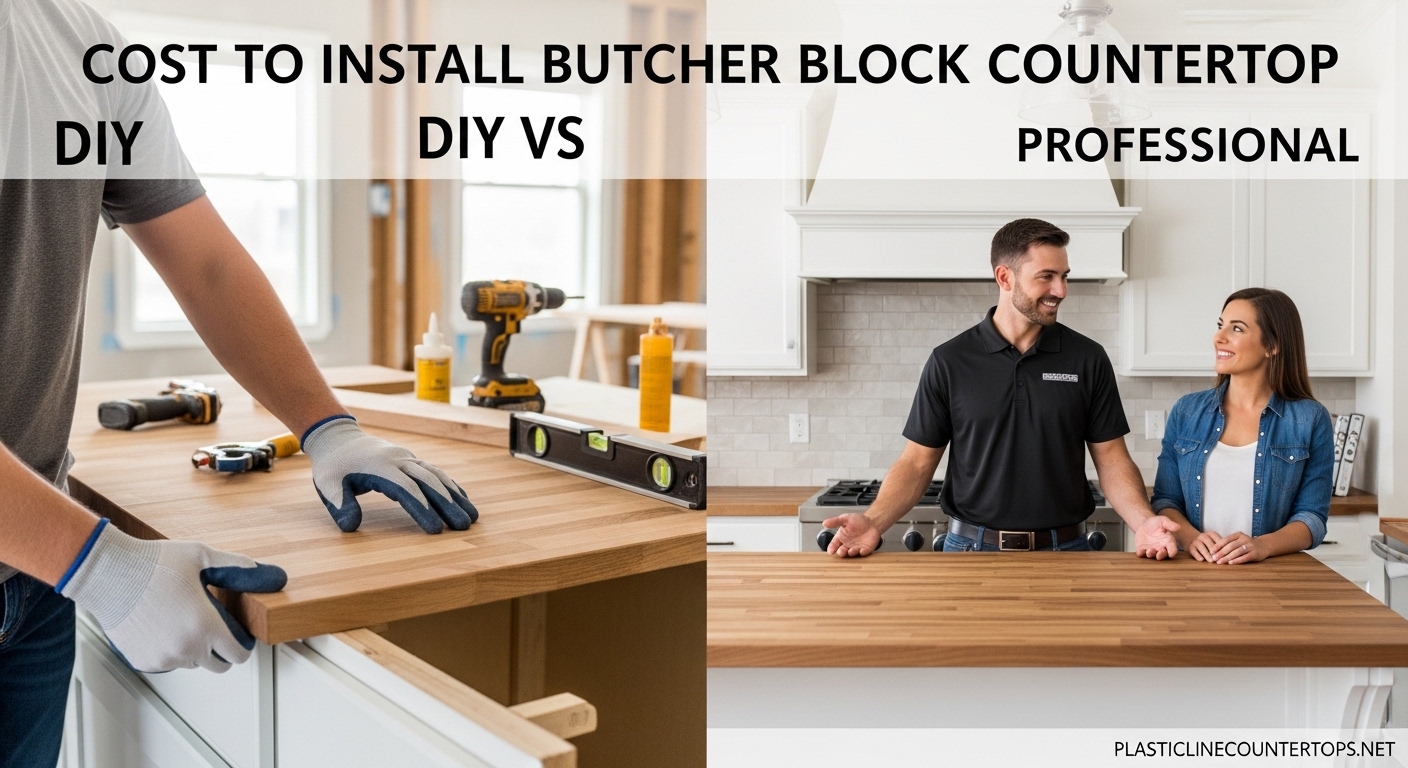
Installing butcher block countertops brings warmth and natural beauty to any kitchen, but understanding the true cost to install butcher block countertop surfaces requires careful planning. Whether you are a hands-on DIYer ready to tackle the project yourself or prefer to leave it to professionals, the total investment varies significantly between these two paths. Our team spent three months researching actual project costs, interviewing contractors, and analyzing real homeowner experiences to give you accurate pricing for 2026. This guide breaks down every expense so you can make the best decision for your kitchen and budget.
Table of Contents
Butcher Block Countertop Installation Cost Overview
Butcher block countertop installation costs span a wide range depending on whether you hire professionals or do it yourself. The total project cost typically falls between $1,200 and $15,000 for a standard kitchen, with most homeowners spending around $3,500-$5,000 when using professional installation.
Material costs alone range from $8 to $25 per square foot depending on wood type and quality. Labor typically adds $50 to $100 per square foot when hiring contractors. A typical 30-square-foot countertop section (standard 10-foot run) costs roughly $450-$750 for materials alone, or $1,800-$4,500 installed.
Our research from forum discussions and contractor interviews reveals that DIY butcher block installation can cost as little as $200-$500 for small projects using basic materials like construction-grade 2x4s, while premium wood selections and professional installation can exceed $10,000 for larger kitchens with complex layouts.
Quick Cost Summary
| Installation Type | Materials Cost | Labor Cost | Total per Sq Ft | 30 Sq Ft Kitchen |
|---|---|---|---|---|
| DIY Basic | $8-$12/sq ft | $0 | $8-$12 | $240-$360 |
| DIY Premium | $15-$25/sq ft | $0 | $15-$25 | $450-$750 |
| Professional Standard | $8-$12/sq ft | $50-$70/sq ft | $58-$82 | $1,740-$2,460 |
| Professional Premium | $15-$25/sq ft | $70-$100/sq ft | $85-$125 | $2,550-$3,750 |
DIY Butcher Block Countertop Cost Breakdown
Choosing the DIY route for butcher block counter installation cost means trading labor time for significant savings. Our team found that confident DIYers save between $1,500 and $5,000 compared to professional installation, though you will need to invest in tools and materials upfront.
Materials Cost
Butcher block materials vary widely in price based on wood species and quality. Construction-grade options like maple from home improvement stores run $8-$12 per square foot. Higher-quality butcher block from lumber yards or specialty suppliers costs $15-$25 per square foot for premium woods like walnut or cherry.
Homeowners on forums report building their own butcher block from standard 2x4s or 2x6s for as little as $3-$5 per board foot, bringing total material costs for small kitchens under $300. One Reddit user built their entire kitchen island butcher block from construction lumber for approximately $200, compared to $1,400-$1,800 for pre-made slabs.
For a 30-square-foot countertop using quality maple butcher block, expect to spend $360-$600 on materials alone before finishes and supplies.
Tools Needed and Their Costs
Tool costs represent the biggest variable in DIY butcher block installation. If you already own basic woodworking tools, your incremental cost might be under $100 for finishing supplies. If you need to purchase everything, budget $300-$600 for quality tools.
| Tool | Purchase Cost | Rental Option |
|---|---|---|
| Circular saw or table saw | $100-$300 | $30-$50/day |
| Jigsaw (for sink cutouts) | $50-$100 | $15-$25/day |
| Router with roundover bit | $60-$150 | $20-$35/day |
| Random orbital sander | $50-$100 | $10-$20/day |
| Clamps (6-8 minimum) | $40-$80 | N/A (cheap enough to buy) |
| Drill with bits | $50-$100 | N/A (standard tool) |
| Sander consumables (sandpaper) | $20-$40 | N/A |
| Finish applicators and supplies | $20-$40 | N/A |
For a one-time project, tool rentals typically total $75-$150 compared to $300-$600 for purchasing quality tools. Consider borrowing from friends or checking tool libraries if available in your area.
Finishing Costs
Food-safe finishes add $30-$100 to your project depending on the type and number of coats needed. Mineral oil costs $10-$20 per quart and requires reapplication monthly. penetrating oil finishes like Tung oil or hybrid options cost $20-$40 per quart and last 3-6 months. polyurethane-based finishes cost $30-$60 per quart but provide longer protection between reapplication.
Time Investment for DIY
Plan for 2-3 full days of work for a standard kitchen butcher block installation. This includes one day for material acclimation and prep work, one day for cutting, fitting, and installation, and additional time for finishing coats if using oil finishes requiring 24-hour cure time between applications.
Professional Butcher Block Countertop Installation Cost
Hiring professionals for butcher block countertop installation eliminates the physical labor and technical challenges but adds significant cost. Most homeowners pay between $2,000 and $10,000 for professional installation of butcher block countertops in a standard kitchen.
Labor Costs
Labor typically runs $50-$100 per square foot depending on your location, the contractor’s experience, and project complexity. This rate usually includes template creation, cutting, edge profiling, and final installation. Countertop specialists generally charge more than general contractors but offer more precise fabrication.
Based on forum discussions and contractor quotes, a standard 10-foot kitchen countertop run typically requires $1,500-$3,000 in labor costs. Complex installations with multiple seams, custom edge profiles, or built-up waterfall edges can push labor costs to $4,000-$7,000.
What Professionals Include
Professional installation typically includes templating (measuring your cabinets for precise cuts), fabrication (cutting the wood to exact dimensions), edge profiling (rounding or shaping edges with specialized equipment), sink cutouts (precise holes for drop-in or undermount sinks), sealing and finishing (unless you request unfinished), and installation (securing to cabinets with proper support).
Additional Services and Costs
Several add-on services can increase your total project cost. Old countertop removal typically costs $100-$300 if you need the installer to handle disposal. Sink installation by the contractor runs $100-$250 additional. Plumbing disconnection and reconnection by a licensed plumber adds $150-$400. Backsplash installation runs $20-$40 per square foot for tile, or higher for stone materials.
Big Box Store Installation
Home improvement stores like Lowe’s and Home Depot offer butcher block countertop installation through third-party contractors. These services typically charge $75-$150 per square foot including materials and labor, putting a standard kitchen installation in the $3,000-$8,000 range. While convenient, you have limited control over the contractor and may face longer scheduling windows.
DIY vs Professional Butcher Block Installation Comparison
Choosing between DIY and professional installation involves balancing upfront costs against time, skill requirements, and peace of mind. Here is how the two approaches compare across important factors.
| Factor | DIY Installation | Professional Installation |
|---|---|---|
| Total Cost (30 sq ft) | $500-$2,500 | $2,000-$10,000+ |
| Time Required | 2-3 full days | 1-2 days (for crew) |
| Skill Level Needed | Basic carpentry | None (you hire it out) |
| Tools Required | $150-$600 (if buying) | None |
| Quality Control | Depends on your skill | Professional finish |
| Warranty | Material warranties only | Labor warranty (1-5 years typically) |
| Customization | Full control | Limited to offered options |
| Stress Level | Moderate to high | Low |
| Scheduling | Your timeline | Contractor availability |
Factors That Affect Butcher Block Countertop Costs
Several variables influence your final butcher block countertop installation cost. Understanding these factors helps you make informed choices and identify areas where you might save money or where spending more makes sense for your situation.
Wood Type
The species of wood significantly impacts both material cost and final appearance. Maple remains the most affordable option at $8-$15 per square foot and offers durability for everyday use. Cherry costs $12-$20 per square foot and darkens beautifully with age. Walnut runs $15-$25 per square foot and provides rich, dark color tones. Exotic options like teak or iroko cost $20-$40 per square foot and offer unique grain patterns and superior durability.
| Wood Type | Cost per Sq Ft | Characteristics |
|---|---|---|
| Maple (construction grade) | $8-$12 | Light color, very durable, affordable |
| Maple (premium) | $12-$18 | Consistent color, fewer defects |
| Cherry | $12-$20 | Warm tones, darkens with sunlight |
| Walnut | $15-$25 | Rich brown, premium appearance |
| Oak (red or white) | $10-$16 | Prominent grain, very durable |
| Teak | $20-$40 | Natural oils, highly water resistant |
Grain Direction
Grain direction affects both cost and performance. Edge grain (long strips glued together) is the most common and affordable option, running $8-$20 per square foot. End grain (checkerboard pattern) costs more ($15-$30 per square foot) but offers superior durability for cutting and chopping. Face grain (flat plane of the board) is least common for countertops due to wear concerns.
Edge Profile
Edge profile shapes add cost but provide finished appearance. Standard eased edge (slightly rounded) comes free with most butcher block. Roundover edges ($3-$8 per linear foot) offer softer feel and easier cleaning. Ogee or beveled edges ($8-$15 per linear foot) provide decorative detail. Waterfall edges (where grain continues down the cabinet face) add significant cost ($20-$40 per linear foot) but create stunning visual impact.
Finish Type
Your finish choice affects both upfront cost and long-term maintenance. Mineral oil ($10-$20 per quart) represents the lowest upfront cost but requires monthly application. Tung oil and hybrid finishes ($20-$40 per quart) need reapplication every 3-6 months. polyurethane and varnish finishes ($30-$60 per quart) last 1-3 years but cannot be refreshed spot repairs and may need full sand-and-refinish when they wear.
Countertop Size and Layout
Larger kitchens obviously require more materials and labor. Beyond simple square footage, complexity increases costs. Multiple cutouts for sinks, cooktops, and faucets add $50-$150 each. Outside corners requiring miter joints cost more than straight runs. Islands and peninsulas typically need additional support structure. L-shaped or U-shaped layouts require more seams.
Money-Saving Tips for DIY Butcher Block Installation
Our research into homeowner experiences revealed several strategies that can significantly reduce your butcher block countertop installation cost without sacrificing quality.
Build from construction lumber: One homeowner on Reddit built their entire butcher block surface from standard 2x4s, spending approximately $200 total compared to $1,400+ for pre-made slabs. This approach requires more labor but offers substantial savings.
Buy unfinished: Pre-finished butcher block costs 20-30% more than unfinished. Doing your own finishing with a friend or family member can save $100-$300 on a standard kitchen.
Source materials locally: Lumber yards and sawmills often offer better pricing than home improvement stores, especially for non-standard sizes or locally-sourced woods. One forum member found walnut for $6 per board foot locally versus $12 at big box stores.
Use hybrid finishes: These newer products combine the ease of application of oils with the durability of polyurethanes, reducing long-term maintenance costs without the complexity of full polyurethane application.
Limit custom sizes: Standard depth (25 inches) and length cuts minimize waste and may avoid upcharge fees from fabrication shops. Measure carefully and order slightly oversized if possible.
Rent tools for one-time use: If you do not already own quality woodworking tools, renting for a weekend project costs $75-$150 compared to $300-$600 for purchasing quality equipment.
Time your purchase: Home improvement stores often discount butcher block seasonally. End of summer and winter holiday weekends frequently feature countertop materials at reduced prices.
Consider edge grain over end grain: While end grain offers superior durability for cutting surfaces, edge grain provides excellent performance for significantly less cost and requires less intensive fabrication work for DIY.
When to Hire a Professional Instead of DIY
While many homeowners successfully install butcher block countertops themselves, certain situations strongly favor professional installation. Recognizing these factors helps you make the right choice for your project.
Complex Kitchen Layouts
Kitchens with multiple corners, angles, or varying cabinet heights require precise templating and cutting that benefits from professional equipment and experience. If your kitchen includes an island or peninsula requiring countertop on multiple sides, professional installation typically produces better results.
Waterproofing Concerns
Butcher block requires proper sealing around sinks and water sources to prevent damage. If your installation involves undermount sinks or integration with existing waterproofing systems, professional installation ensures proper sealing that protects your investment.
Premium Materials
Expensive woods like teak or exotic species represent significant material investments. Mistakes during DIY installation of $2,000+ in materials can be costly to repair or replace. Professional fabrication minimizes waste and ensures proper handling of premium materials.
Lack of Tools or Experience
If you do not own basic woodworking tools and lack experience with precision measuring and cutting, the learning curve may cost more in materials lost to mistakes than the savings from DIY installation. Consider professional help if this is your first woodworking project of this scale.
Time Constraints
Professional installation typically completes in 1-2 days. DIY installation requires 2-3 full days plus additional time for finishing cure times. If you need your kitchen functional quickly or cannot commit multiple days to the project, professional installation makes practical sense.
Custom Features
Waterfall edges, integrated cutting boards, custom drainboard grooves, or other specialized features require professional-grade equipment and expertise. Attempting these details without proper tools and experience often produces disappointing results.
Butcher Block Countertop Installation Cost: FAQ
How much does it cost to have someone install butcher block countertops?
Professional butcher block countertop installation typically costs $50-$100 per square foot for labor alone. When combined with materials ($8-$25 per square foot), total costs range from $2,000 to $10,000 or more for a standard kitchen, depending on wood type, countertop size, and complexity of the job.
What is the 7 rule for butcher block?
The 7 rule for butcher block refers to the maximum unsupported overhang allowed without additional support. Generally, butcher block should not extend more than 6-8 inches beyond the cabinet base without installing corbels, brackets, or additional supports to prevent cracking or sagging over time.
How much does Lowe’s charge to install butcher block countertops?
Lowe’s typically charges $75-$150 per square foot for butcher block countertop installation, including materials and labor through their countertop installation services. This price varies by location and wood type chosen. Big box store installation usually falls in the $3,000-$8,000 range for a standard kitchen.
What is the downside of using butcher block countertops?
Butcher block countertops require regular maintenance, including oiling every 3-6 months to prevent drying and cracking. They can scratch and dent easily, may develop water stains if not properly sealed, and are not heat resistant. Additionally, they need to be refinished periodically to maintain their appearance and food safety.
Is DIY butcher block countertop installation worth it?
DIY butcher block installation can save $1,500-$5,000 in labor costs and is worth it for confident DIYers with proper tools. A DIY project typically costs $500-$2,500 total but requires 2-3 days of work, basic carpentry skills, and attention to proper sealing and support requirements.
How long does butcher block countertop installation take?
Professional installation typically takes 1-2 days for a standard kitchen. DIY installation usually requires 2-3 full days, including time for acclimation (24-48 hours), cutting and fitting, sealing with multiple coats (each coat needs 24 hours to cure), and final installation.
Conclusion: Making Your Butcher Block Countertop Installation Decision
Understanding the butcher block countertop installation cost helps you plan your kitchen remodel with confidence. DIY installation offers significant savings ($500-$2,500 total) if you have basic carpentry skills, access to tools, and time to commit 2-3 days to the project. Professional installation costs more ($2,000-$10,000+) but eliminates stress and ensures factory-quality results.
Decision Checklist
Use these questions to determine which path is right for your project. If you answer yes to most of these, DIY installation may be your best choice. If you answer yes to the professional column, consider hiring it out.
| Consider This Factor | DIY Might Work If… | Professional Recommended If… |
|---|---|---|
| Budget | Under $2,500 total budget | Willing to spend $3,000+ for convenience |
| Available Time | Can commit 2-3 full days | Need kitchen functional in 1-2 days |
| Tools | Own or can rent needed tools | Lack basic woodworking equipment |
| Experience | Comfortable with precise measuring and cutting | No prior woodworking experience |
| Kitchen Layout | Simple rectangular layout | Multiple corners, angles, or island |
| Material Investment | Using affordable materials ($8-$15/sq ft) | Premium woods ($20+/sq ft) |
Regardless of which installation method you choose, butcher block countertops offer warmth, functionality, and timeless appeal that enhances any kitchen design. With proper care and maintenance, your investment will provide decades of beautiful service.
For more information on selecting the right countertop material for your kitchen, explore our complete guide to kitchen countertop options and their costs.