
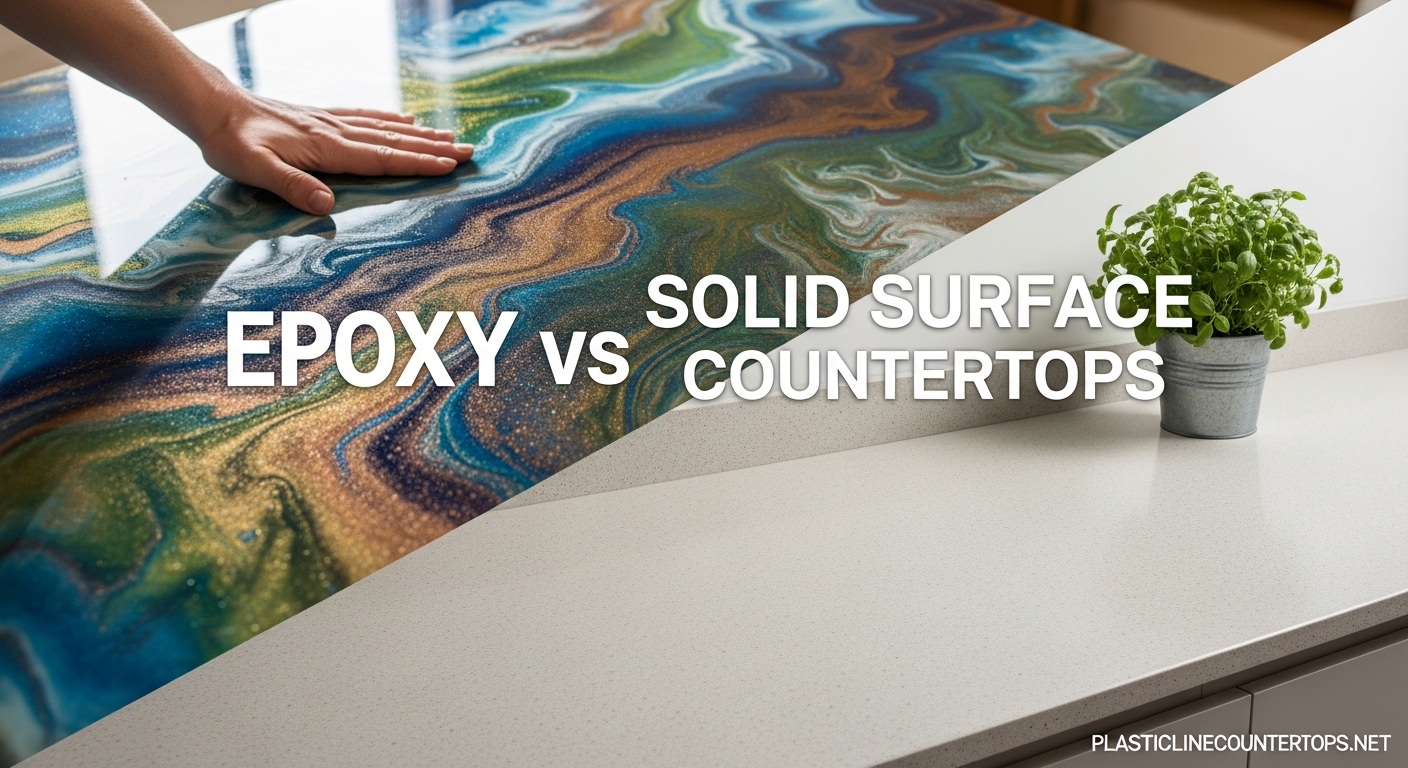
Choosing between epoxy vs solid surface countertops is one of the most significant decisions you’ll make during a kitchen or bathroom renovation. Both materials offer distinct advantages, but they differ substantially in cost, maintenance requirements, durability, and installation complexity. This guide breaks down everything you need to know to make the right choice for your home.
Table of Contents
What Are Epoxy Countertops?
Epoxy countertops are durable, high-gloss surfaces created by applying a liquid resin and hardener mixture over an existing countertop base. The two-part mixture is combined and poured onto the surface, where it self-levels and cures to form a hard, seamless, and remarkably smooth finish. The result is a glossy, glass-like appearance that can be customized with virtually any color, metallic pigments, or decorative effects.
The appeal of epoxy countertops lies largely in their versatility. Because the material starts as a liquid, it can be tinted to match any color scheme and enhanced with glitter, stone-like veining, or metallic sheens that are difficult or impossible to achieve with other countertop materials. This makes epoxy particularly popular among homeowners who want a truly unique aesthetic that reflects their personal style.
Epoxy is typically applied in multiple coats, with each layer curing before the next is added. The process requires meticulous preparation of the underlying surface, careful mixing of the resin and hardener in the correct proportions, and precise timing throughout the application. While some homeowners tackle epoxy installation as a DIY countertop project, the margin for error is slim, and mistakes can be costly to rectify.
Common applications for epoxy include kitchen countertops, bathroom vanities, and even commercial surfaces. The material’s resistance to moisture and chemicals makes it suitable for environments where spills and stains are a concern. However, its performance over time depends heavily on the quality of the initial installation and the commitment to ongoing maintenance.
What Are Solid Surface Countertops?
Solid surface countertops are engineered surfaces manufactured from a blend of acrylic or polyester resin and natural minerals, typically aluminum trihydrate. The mixture is poured into molds to create sheets or slabs, which are then cut and fabricated to fit specific countertop dimensions. Brands like Corian, LG Hi-Macs, and Wilsonart have popularized this material in residential and commercial settings alike.
One of the defining characteristics of solid surface is its seamless appearance. During installation, the slabs are joined together using a specialized adhesive that creates nearly invisible seams. This means large kitchen islands or long runs of countertop can be installed without the visible joints that plague other materials. The non-porous nature of solid surface also means that bacteria and mold have nowhere to embed, making it a hygienic choice for food preparation areas.
Unlike epoxy, which is applied as a liquid and cures in place, solid surface is prefabricated in a controlled manufacturing environment. This results in more consistent quality and performance across the entire surface. The material can be shaped and molded into integrated sinks, curved backsplashes, and other custom features that would be difficult or impossible with other countertop materials.
Solid surface is available in a wide range of colors and patterns, including options that closely mimic natural stone like granite and marble. However, the customization options are bounded by the manufacturer’s offerings, whereas epoxy’s design possibilities are limited only by the installer’s creativity and skill. For homeowners who want a consistent, predictable look, solid surface delivers without surprises.
Epoxy vs Solid Surface Countertops: Side-by-Side Comparison
| Factor | Epoxy Countertops | Solid Surface Countertops |
|---|---|---|
| Cost per square foot | $30-100+ (materials only; DIY can reduce cost) | $40-100+ (materials and professional installation) |
| Typical lifespan | 10-20 years with proper care | 15-30+ years |
| Heat resistance | Sensitive – hot pans can stain or damage surface | Moderate – more heat resistant but not fully heatproof |
| Maintenance | Regular sealing required; careful cleaning needed | Low maintenance; easy day-to-day cleaning |
| Installation complexity | High – one-shot application, no second chances | Professional fabrication and installation required |
| Repairability | Difficult and expensive to repair once cured | Easily repaired and refinished |
| Customization options | Virtually unlimited colors, effects, and patterns | Limited to manufacturer’s available colors and styles |
| Durability | Good stain and moisture resistance when sealed | Excellent overall durability; non-porous |
| Seams | Seamless when properly applied | Nearly invisible seams |
| DIY feasibility | Possible but risky with high failure potential | Not recommended; requires professional tools |
Epoxy Countertops: Pros and Cons
Epoxy Countertops Pros
- Highly customizable appearance: Epoxy can be tinted to any color and enhanced with metallic pigments, glitter, or marbling effects. No two epoxy countertops look exactly alike, giving your kitchen a genuinely unique character.
- Seamless finish: When properly applied, epoxy creates a completely seamless surface with no visible joints or seams, providing a smooth, continuous look that is easy to clean.
- Excellent moisture and stain resistance (when sealed): Properly sealed epoxy surfaces repel water and resist staining from common kitchen substances like coffee, wine, and oils.
- Cost-effective for DIY: If you have the skill and patience to install it yourself, epoxy can be one of the more affordable countertop options since you only pay for materials.
- Good chemical resistance: Epoxy holds up well against most household chemicals, making it suitable for food preparation areas when properly cured and sealed.
- Creative design freedom: From embedded objects to custom patterns and color gradients, epoxy offers creative possibilities that rigid slab materials simply cannot match.
Epoxy Countertops Cons
- One-shot installation with no margin for error: Once epoxy begins to cure, there is no going back. Mistakes made during application are often permanent and extremely expensive to fix.
- Requires meticulous surface preparation: The substrate must be perfectly clean, dry, and properly primed. Any dust, debris, or moisture contamination will ruin the final finish.
- Heat sensitivity: Epoxy can be damaged by hot cookware, and placing a hot pan directly on an epoxy surface may cause burns, discoloration, or surface damage. Always use trivets and hot pads.
- Long-term yellowing concerns: Over time, especially in areas exposed to UV light, epoxy surfaces may yellow or amber, particularly light-colored and white finishes.
- Difficult and costly repairs: If an epoxy countertop is damaged, repair typically requires removing and redoing the entire surface, which can cost as much as the original installation.
- Strong VOC emissions during installation: The epoxy mixture releases potentially harmful volatile organic compounds during curing, requiring excellent ventilation and possibly respiratory protection.
“The attention required is constant – you can’t walk away during the curing process.”
– Reddit user on r/HomeImprovement, discussing DIY epoxy countertop challenges
Homeowners drawn to epoxy countertops often cite the appeal of a completely custom look at a relatively accessible price point. However, forum discussions reveal a recurring theme: many DIY installers dramatically underestimate the complexity and precision the process demands. Bubbles forming during cure, uneven self-levelling, and improper mixing ratios are among the most commonly reported frustrations.
Solid Surface Countertops: Pros and Cons
Solid Surface Countertops Pros
- Seamless and discreet joints: Solid surface sheets are joined with adhesive that bonds at a molecular level, creating seams that are virtually invisible to the eye and impervious to moisture infiltration.
- Easy to repair: Scratches, minor burns, and surface damage can be sanded out and refinished on site without replacing the entire countertop. This repairability extends the material’s usable life significantly.
- Wide range of colors and patterns: From solid whites to speckled patterns mimicking natural stone, solid surface manufacturers offer hundreds of options to suit virtually any kitchen design.
- Non-porous and hygienic: The homogeneous, non-porous nature of solid surface prevents bacteria, mold, and mildew from embedding into the surface, making it an excellent choice for kitchens and bathrooms.
- Low maintenance over its lifetime: Unlike epoxy, solid surface does not require regular sealing. Day-to-day cleaning requires only soap and water or a mild household cleaner.
- Professional quality assurance: Because solid surface is fabricated by trained professionals in a controlled environment, the quality and consistency of the finished product is more predictable.
- Integrated sink options: Solid surface can be thermoformed into integrated sinks and backsplashes that share the same seamless appearance as the countertop surface.
Solid Surface Countertops Cons
- Higher upfront cost: Professional fabrication and installation of solid surface countertops typically costs more upfront than a DIY epoxy project, though the long-term maintenance picture may be more favorable.
- Vulnerable to heavy impacts: While solid surface resists scratching, a sufficiently heavy dropped object can dent, chip, or crack the surface, particularly near edges and corners.
- Heat sensitivity: Like epoxy, solid surface can be damaged by prolonged exposure to extreme heat. Hot pots and pans should always be placed on trivets.
- Limited customization compared to epoxy: You are restricted to the colors and patterns offered by the manufacturer, and creating truly unique designs is not possible without significant cost.
- May show seams in large installations: While the seams are nearly invisible, very large kitchen layouts with multiple seams may eventually show slight differences in color or sheen between sheets.
- Considered less trendy by some: Some homeowners and design professionals consider solid surface a more traditional option, and design-conscious buyers may prefer the look of quartz or natural stone.
“Solid surface requires less constant attention than epoxy – once installed, it just works without needing regular resealing or special care.”
– Forum user on sawmillcreek.org, comparing long-term ownership experiences
Installation: Epoxy vs Professional Fabrication
Installation is one of the most significant differences between epoxy and solid surface countertops, and it is often the factor that determines which material is the right choice for a given homeowner.
Installing epoxy countertops is a high-stakes, single-stage process. The resin and hardener must be mixed in exact proportions, applied at the correct temperature, and given adequate time to self-level and cure. The entire process can take several days, and during that time, the installer must monitor for bubbles, uneven areas, and contamination. If the substrate was not perfectly prepared, if the mixture was improperly ratioed, or if environmental conditions shifted during curing, the result can be a flawed surface that requires costly remediation. This is why many homeowners who pursue epoxy countertops choose to hire experienced professionals rather than risk a DIY failure.
Solid surface installation follows a more conventional path. After precise measurements are taken, the slabs are cut and fabricated in a workshop, with seams planned to fall in visually unobtrusive locations. The finished pieces are then transported and installed in the home, where any final adjustments are made on site. The reliance on professional fabricators introduces a cost premium, but it also introduces a layer of quality control and expertise that epoxy’s one-shot process simply cannot match.
For budget-conscious homeowners who are comfortable with DIY projects, epoxy may seem like the more accessible option. However, the hidden costs of potential failures, the expense of proper safety equipment, and the value of your own time should all factor into the true cost comparison. The money saved on a DIY epoxy installation can quickly evaporate if the results are disappointing or require professional remediation.
Maintenance and Care Comparison
Ongoing maintenance is a critical factor that many homeowners overlook when comparing countertop materials. The daily realities of cleaning and caring for your surfaces will shape your experience with your countertops for years to come.
Epoxy countertops demand consistent attention to maintain their appearance and protective properties. The surface should be cleaned with mild soap and warm water after each use, and harsh chemical cleaners, including bleach-based products like Clorox wipes, should be strictly avoided as they can break down the epoxy finish and cause clouding or discoloration. Epoxy surfaces also benefit from periodic resealing to maintain their moisture and stain resistance, and homeowners should inspect the surface regularly for signs of wear, scratches, or areas where the seal may be compromised.
Solid surface countertops are considerably more forgiving in day-to-day use. Routine cleaning requires nothing more than a soft cloth, warm water, and a mild soap or household cleaner. The non-porous surface resists staining without the need for sealing, and minor surface scratches can be removed with a gentle abrasive pad or sandpaper. Deeper scratches or damage that goes beyond the surface can be professionally refinished, restoring the countertop to near-original condition without requiring full replacement.
From a practical, day-to-day perspective, solid surface requires far less active maintenance than epoxy. For busy households where the kitchen sees heavy use, this difference can translate into meaningful time savings over the life of the countertop. Epoxy, while not impossibly difficult to maintain, rewards homeowners who are willing to invest the extra care required to preserve its distinctive appearance.
Both materials benefit from the use of cutting boards, trivets, and coasters to protect the surface from scratches and heat damage. While both are marketed as durable options, neither is immune to damage from misuse, and exercising reasonable care will extend the life of either material significantly.
Frequently Asked Questions
What is the downside of epoxy countertops?
The main downsides include installation complexity (one-shot with no room for error), heat sensitivity causing damage from hot cookware, long-term yellowing concerns especially with light-colored epoxy, difficulty and cost of repairs, and the need for regular maintenance sealing. Many DIY enthusiasts underestimate the skill and attention required for successful epoxy installation.
Are solid surface countertops outdated?
Solid surface countertops are not inherently outdated – they are a mature, reliable technology still widely used in homes and commercial applications. While design trends have shifted toward materials like quartz, solid surface remains an excellent choice for its repairability, seamless appearance, and practical performance. Brands like Corian and LG Hi-Macs continue innovating with new colors and patterns to stay current with contemporary design tastes.
Can you use Clorox wipes on epoxy countertops?
No, you should avoid using Clorox wipes or other bleach-based cleaners on epoxy countertops. Harsh chemicals can break down the epoxy finish and cause clouding or discoloration. Instead, clean epoxy surfaces with mild soap and warm water. For stubborn stains, use a soft cloth with a gentle, non-abrasive cleaner specifically designed for epoxy surfaces.
How long do epoxy countertops last?
With proper installation and maintenance, epoxy countertops typically last 10-20 years before showing significant wear. The lifespan depends heavily on how well the surface was prepared, the quality of the epoxy used, and how consistently maintenance is performed. Yellowing may become noticeable after several years, particularly in areas exposed to UV light.
Which is better for kitchen use – epoxy or solid surface?
For kitchen use, solid surface generally offers better long-term value due to its lower maintenance requirements and easier repairability. However, if you want unique customization and do not mind the maintenance commitment, epoxy can create a stunning one-of-a-kind look. Consider your lifestyle: if you cook frequently and want hassle-free upkeep, solid surface is the better choice. If you prioritize aesthetics and don’t mind extra care, epoxy offers more design freedom.
Making Your Decision: Epoxy vs Solid Surface Countertops
Choosing between epoxy vs solid surface countertops ultimately comes down to your priorities, your willingness to invest time in maintenance, and your aesthetic vision for your space. Epoxy countertops suit those who want truly unique aesthetics and are prepared to invest the effort required for proper care. Solid surface countertops are the better choice for those who prioritize practical convenience, long-term durability, and low-maintenance ownership.
Consider your budget, your household’s lifestyle, and how you use your kitchen before making a final decision. When in doubt, consult with professional fabricators and installers who can assess your specific situation and provide tailored recommendations. Whether you choose epoxy or solid surface, investing in quality installation will pay dividends in performance and longevity for years to come.