
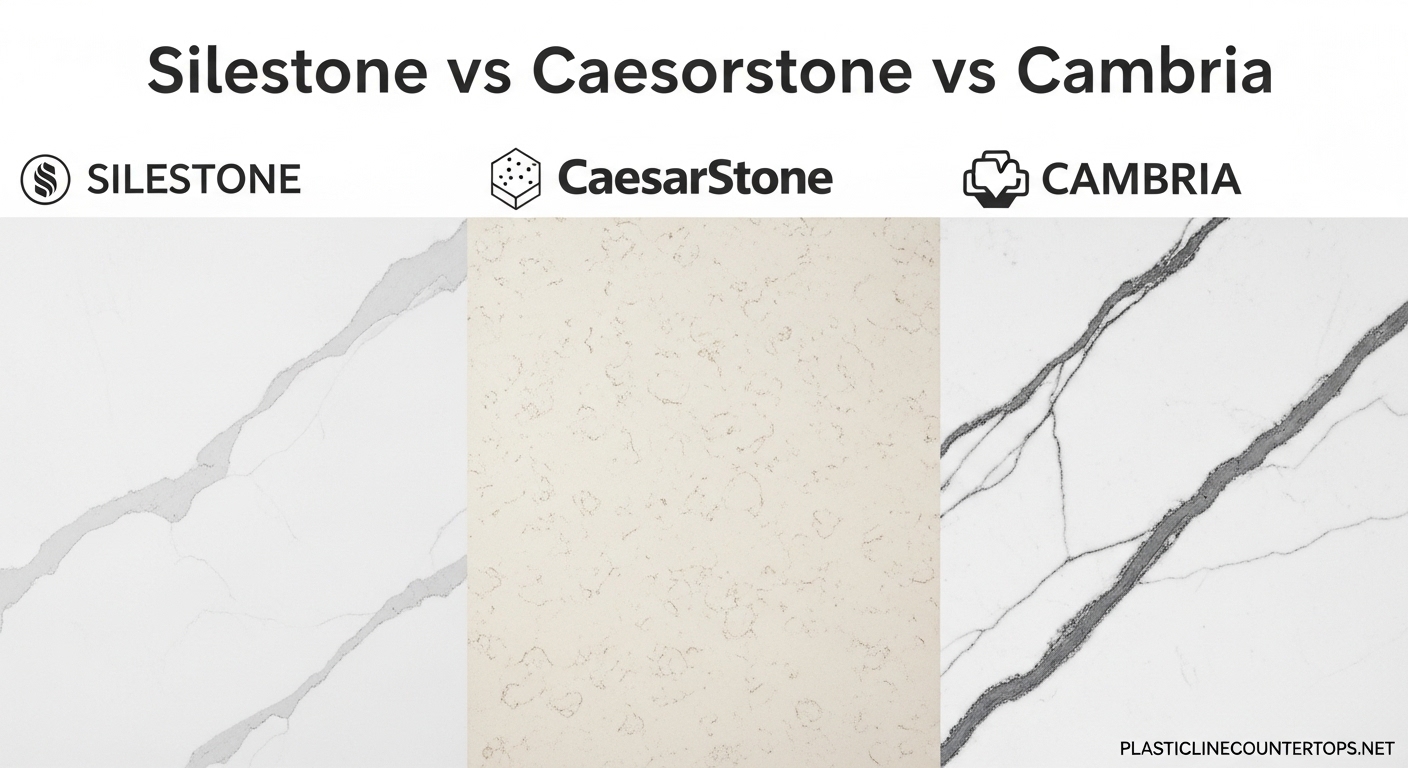
Choosing new countertops for your kitchen or bathroom is a big decision, and if you have narrowed your search to engineered quartz, you are probably weighing the Silestone vs Caesarstone vs Cambria differences right now. These three brands dominate the premium quartz countertop market, and for good reason. All three produce beautiful, durable surfaces made from natural quartz bound with resins and pigments. But despite sharing similar roots in the Breton manufacturing process, each brand brings something different to the table when it comes to design philosophy, warranty coverage, and long-term performance.
Our team has spent months researching these brands, digging through forum discussions, installer feedback, and real homeowner experiences to give you an honest, side-by-side comparison. We are not here to sell you on one brand over another. Instead, we want to arm you with the facts so you can pick the surface that fits your home, your lifestyle, and your budget.
One thing worth clearing up right away: many people assume all quartz countertops are basically the same product with different labels. That is partially true since Silestone, Caesarstone, and Cambria all use the patented Breton stone manufacturing technology. However, the quartz content percentages, resin formulations, antimicrobial treatments, design catalogs, and warranty terms differ meaningfully between these three. Understanding the Silestone vs Caesarstone vs Cambria differences will help you avoid costly mistakes and get the best value for your renovation.
Table of Contents
Silestone vs Caesarstone vs Cambria Differences at a Glance
Before we get into the details, here is a quick comparison table that breaks down the key differences between these three quartz brands. This is the snapshot most homeowners need when starting their research.
| Feature | Silestone | Caesarstone | Cambria |
|---|---|---|---|
| Origin | Spain (Cosentino Group) | Israel | USA (Minnesota) |
| Founded | 1990 | 1987 | 2000 |
| Quartz Content | Up to 95% | Up to 93% | Up to 93% |
| Design Options | 100+ colors, multiple finishes | 80+ designs, contemporary focus | 150+ designs, natural veining |
| Antimicrobial | Built-in Microban protection | No built-in treatment | No built-in treatment |
| Warranty | 25 years limited | Lifetime limited (residential) | Lifetime limited |
| Standout Feature | Low-silica HybriQ technology | Design-forward aesthetics | 100% American-made |
| Maintenance | No sealing required | No sealing required | No sealing required |
As you can see, the differences are real even though the core material is similar. Let us explore each brand in depth so you understand what you are actually getting.
Silestone Overview: The Global Innovator
Silestone is produced by the Cosentino Group, a family-owned company based in Almeria, Spain. Since its launch in 1990, Silestone has expanded to over 90 countries and built a reputation as one of the most innovative quartz surfaces on the market. It was the first quartz brand to introduce built-in Microban antimicrobial protection, which inhibits the growth of bacteria, mold, and mildew on the surface.
One of the biggest differentiators for Silestone is its HybriQ technology, introduced as part of the brand’s commitment to sustainability. This manufacturing innovation reduces the crystalline silica content in the slab while maintaining the durability and performance quartz is known for. For homeowners who are conscious about the health and environmental aspects of silica dust, Silestone currently leads the industry in low-silica quartz development.
Silestone offers over 100 colors across several finish types, including polished, suede (matte), and the unique Volcano texture that mimics the feel of natural stone. The brand’s color range runs from crisp whites and subtle grays to bold blacks and rich earth tones. This variety makes it easy to find a look that works whether you are designing a modern minimalist kitchen or a warm traditional space.
The warranty on Silestone covers 25 years for residential installations. While this is shorter than the lifetime warranties offered by Cambria and Caesarstone, 25 years is still a substantial commitment that covers most of the time a homeowner will own their countertops. The warranty protects against manufacturing defects but does not cover damage from improper installation, heat exposure, or normal wear and tear.
Caesarstone Overview: The Design Standard
Caesarstone holds the distinction of being the pioneer of engineered quartz surfaces. Founded in 1987 in Kibbutz Sdot Yam, Israel, the company literally invented the category of quartz countertops as we know them today. That heritage gives Caesarstone a depth of manufacturing experience that no other brand can match.
The brand is known for its sleek, contemporary aesthetic. Caesarstone designs tend to lean modern, with clean lines and sophisticated patterns that work especially well in updated and transitional kitchens. Their collections include looks that mimic concrete, rough-cut stone, marble veining, and even metallic finishes. With over 80 designs in the catalog, Caesarstone focuses more on curated quality than overwhelming quantity.
Caesarstone surfaces contain up to 93% natural quartz, combined with resins and pigments. The company holds ISO 14001 environmental certification, reflecting its commitment to sustainable manufacturing practices. While Caesarstone does not include built-in antimicrobial treatment like Silestone’s Microban, the non-porous surface still resists bacterial growth naturally because there are no pores or crevices for microbes to inhabit.
The residential warranty for Caesarstone is a lifetime limited warranty, which is a significant advantage over Silestone’s 25-year term. This warranty transfers to subsequent homeowners, which can be a selling point if you plan to sell your home in the future. Coverage applies to manufacturing defects under normal residential use.
Forum discussions reveal that Caesarstone users are generally satisfied, though some have reported issues with chipping at edges and around cutouts for sinks. The brand’s customer service reputation is mixed, with some homeowners praising responsive warranty support while others describe frustrating claim experiences. As with any large brand, individual experiences vary.
Cambria Overview: The American Original
Cambria stands apart from Silestone and Caesarstone in one major way: it is the only major quartz countertop brand made entirely in the United States. Manufactured in Le Sueur, Minnesota by the Davis family, Cambria has built its identity around American craftsmanship and quality control. For homeowners who prioritize buying domestic products, Cambria is the clear choice among premium quartz brands.
Industry professionals often refer to Cambria as the “Mercedes of quartz,” and that reputation comes with a premium price point to match. Cambria surfaces feature some of the most realistic natural veining in the quartz industry, with designs that convincingly replicate the look of marble, granite, and other natural stones. The brand offers over 150 designs across multiple collections, giving it the largest catalog of the three brands.
Like Caesarstone, Cambria surfaces contain up to 93% natural quartz. The manufacturing process uses Breton technology just like the other two brands, but Cambria has developed proprietary techniques for creating their distinctive veining patterns and depth of color. The result is a surface that many designers consider the most visually sophisticated engineered quartz available.
Cambria’s lifetime limited warranty matches Caesarstone’s offering and exceeds Silestone’s 25-year term. The warranty covers manufacturing defects under normal residential use and is transferable. Cambria has generally strong customer service reviews, though the premium price means some homeowners expect flawless performance, and any minor issue can feel like a disappointment relative to the investment.
One practical advantage of Cambria for American buyers is faster lead times and more consistent availability. Because the product is made domestically, supply chain disruptions that can affect imported brands like Silestone and Caesarstone are less of a concern.
Head-to-Head Feature Comparison
Now that we have covered the basics of each brand, let us dig into the specific features that matter most when comparing Silestone vs Caesarstone vs Cambria differences. Understanding how these brands perform across durability, heat resistance, stain resistance, design, and warranty will help you make an informed decision.
Durability and Scratch Resistance
All three brands rank highly on the Mohs hardness scale for quartz surfaces, typically scoring around 7 out of 10. That means they resist scratches from knives, keys, and everyday kitchen tools. No quartz surface is completely scratch-proof, but you would need to work hard to damage any of these three brands under normal use.
Where durability differences show up is in edge performance. Forum users report that Silestone can be more prone to chipping along edges and around sink cutouts compared to Cambria. Caesarstone falls somewhere in the middle. Our research found that edge chipping is more related to fabrication quality and installation technique than the brand itself, but the anecdotal pattern is worth noting if you are choosing an edge profile.
For busy family kitchens, all three brands hold up well against daily wear. The key is proper installation by a certified fabricator who follows the manufacturer’s guidelines for support, seam placement, and edge finishing.
Heat Resistance
Here is the honest truth that many comparison articles skip: none of these three brands recommend placing hot pans directly on the surface. Quartz countertops of any brand can suffer thermal shock, which causes cracks, discoloration, or warping when exposed to sudden extreme temperature changes.
Silestone, Caesarstone, and Cambria all advise using trivets or hot pads under hot cookware. The resin binder in engineered quartz begins to soften at temperatures above 300 degrees Fahrenheit, and a pan fresh off the stove can easily exceed that. This is one area where natural stone like granite actually outperforms quartz.
Some homeowners report placing hot items on their quartz counters for years without issue, but that is a gamble, not a recommendation. The brands do not cover heat damage under their warranties, so a cracked slab from a hot pan is an expensive mistake you will pay for out of pocket.
Stain Resistance and Non-Porous Properties
All three brands are non-porous, which means they do not need to be sealed like granite or marble. Liquids, including wine, coffee, and cooking oils, sit on the surface rather than soaking in. This makes all three excellent choices for kitchens where spills are a daily occurrence.
Silestone has a slight edge in stain and bacteria resistance thanks to its built-in Microban antimicrobial technology. Microban is integrated into the surface during manufacturing and continues to inhibit bacterial growth for the life of the product. It does not eliminate the need to clean your counters, but it provides an extra layer of protection that Caesarstone and Cambria do not offer.
In practical terms, all three brands resist common household stains effectively. Coffee rings, tomato sauce, and lemon juice should wipe away from any of these surfaces without leaving marks. The main staining risk for any quartz surface comes from harsh chemicals, permanent markers, and some food colorings that may require more aggressive cleaning.
Design and Color Options
This is where personal taste becomes the deciding factor. Cambria leads with over 150 designs featuring some of the most realistic natural veining in the industry. Their designs convincingly mimic marble, soapstone, and granite while maintaining the low-maintenance benefits of engineered quartz. Designers often choose Cambria when the aesthetic needs to impress.
Silestone offers over 100 colors with something the other two brands lack: multiple finish textures. In addition to the standard polished finish, Silestone offers a suede (matte) finish and a Volcano texture that has a slightly rough, natural-stone feel. This variety in texture gives Silestone a unique advantage for homeowners who want more than just a smooth glossy surface.
Caesarstone takes a more curated approach with over 80 designs that skew toward contemporary aesthetics. Their Metropolitan Collection features industrial-inspired looks like concrete and oxidized metal, while their Classici collection offers timeless marble and stone reproductions. The brand is a favorite among interior designers working on modern kitchens.
Warranty Coverage Comparison
Warranty terms reveal real differences in how these brands stand behind their products. Cambria and Caesarstone both offer lifetime limited warranties for residential installations, while Silestone provides a 25-year limited warranty.
All three warranties cover manufacturing defects under normal residential use. None of them cover damage from improper installation, heat exposure, chemical damage, misuse, or normal wear and tear. Reading the fine print is essential because “lifetime warranty” sounds more comprehensive than it actually is.
For what it is worth, forum discussions suggest that warranty claim experiences vary widely across all three brands. Some homeowners report smooth, hassle-free resolutions while others describe months of back-and-forth with customer service. Your fabricator’s relationship with the brand often plays a bigger role in warranty satisfaction than the warranty terms themselves.
What Real Users Say: Durability Issues and Complaints
We spent time reading through Reddit threads on r/CounterTops and r/HomeImprovement, Houzz discussions, and other homeowner forums to find out what real people experience with these brands. The picture that emerges is more nuanced than the marketing materials suggest.
Silestone users frequently report issues with chipping, particularly along edges and around sink cutouts. Multiple forum posts describe chips appearing within the first year of ownership, even without obvious impacts. Some users also express frustration with the warranty claim process, noting that Cosentino’s customer service can be slow to respond or reluctant to approve claims. On the positive side, many Silestone owners praise the surface for its color variety and overall value relative to Cambria.
Caesarstone has a more mixed reputation. Some users share what they call “horror stories” about cracking, staining, and unresponsive customer service. However, the majority of Caesarstone owners in forum discussions report satisfaction with their countertops, especially those who have had them for several years without issues. The brand’s longevity in the market means there are many installations that have performed well over decades.
Cambria receives the most consistently positive feedback in forum discussions, which aligns with its premium positioning and pricing. Users praise the realistic veining patterns and the peace of mind that comes with an American-made product and lifetime warranty. The main complaint about Cambria is the price, which is often the highest of the three brands.
A common theme across all forums is that fabrication and installation quality matters as much as, or more than, the brand you choose. A poorly installed premium surface will perform worse than a properly installed budget option. We strongly recommend choosing an experienced, certified fabricator regardless of which brand you select.
Silica Content: A Growing Concern
One topic that almost no competitor articles address is crystalline silica content in engineered quartz. This is becoming increasingly important as health research around silica dust exposure during fabrication has gained attention in 2026.
Traditional engineered quartz surfaces contain significant amounts of crystalline silica, typically above 90%. When fabricators cut, grind, or polish these slabs without proper dust control and respiratory protection, they can be exposed to hazardous silica dust. This is a worker safety issue, not a consumer safety issue, since installed countertops pose no silica dust risk to homeowners.
Silestone has taken the lead on this front with its HybriQ technology, which reduces the crystalline silica content to below 50% while maintaining performance. This makes Silestone the most forward-thinking brand on silica reduction. Caesarstone and Cambria have not yet introduced comparable low-silica product lines to the US market, though the entire industry is moving in this direction.
For homeowners who want to support safer fabrication practices, Silestone’s HybriQ products represent the most responsible choice available right now. This is a content gap we felt was important to address honestly.
How to Choose the Right Quartz Brand for Your Home
After comparing every aspect of these three brands, the right choice comes down to your personal priorities. Here is a decision framework to help you sort through the Silestone vs Caesarstone vs Cambria differences and find your match.
Choose Silestone If…
You want built-in antimicrobial protection from Microban technology, you value a wide variety of color and texture options including the unique suede and Volcano finishes, or you are interested in lower-silica quartz technology through HybriQ. Silestone also tends to be the most budget-friendly of the three brands, making it a strong choice for larger projects where every dollar matters.
Choose Caesarstone If…
You prefer a contemporary, design-forward aesthetic with curated color options that lean modern. Caesarstone’s legacy as the inventor of engineered quartz gives it unmatched manufacturing experience, and the lifetime warranty provides long-term peace of mind. This is a great choice for homeowners who want a trusted global brand with a design sensibility that works in updated kitchens.
Choose Cambria If…
You want the most realistic natural veining available in engineered quartz and American-made quality matters to you. Cambria’s 150+ design options give you the largest catalog to choose from, and the lifetime warranty is among the best in the industry. This is the brand most designers recommend for high-end kitchens where visual impact is the top priority, but expect to pay a premium for that level of refinement.
Maintenance Tips for All Three Brands
Regardless of which brand you choose, the maintenance routine is essentially the same. Wipe up spills promptly with a soft cloth and mild soap or a pH-neutral cleaner. Avoid abrasive scouring pads, bleach, and harsh chemical cleaners that can dull the surface finish over time. Always use trivets under hot pots and cutting boards when chopping. These simple habits will keep any of these quartz surfaces looking great for decades.
Avoid exposing your quartz countertops to strong chemicals including drain cleaners, oven cleaners, paint removers, and solvents. If any of these products come in contact with the surface, rinse immediately with plenty of water. Even though all three brands are highly resistant to stains and chemicals, prolonged exposure to harsh substances can cause permanent damage that is not covered under warranty.
FAQ
Is Cambria or Silestone better?
Cambria is generally considered the premium option with the most realistic natural veining, American-made quality, and a lifetime warranty. Silestone offers better value with built-in Microban antimicrobial protection, unique texture finishes, and lower-silica HybriQ technology. Choose Cambria for visual impact and domestic manufacturing, or Silestone for antimicrobial features and budget flexibility.
Which is better, Caesarstone or Silestone?
Caesarstone offers a lifetime warranty and pioneering manufacturing experience as the inventor of engineered quartz. Silestone counters with built-in Microban antimicrobial protection, more finish texture options, and lower-silica HybriQ technology. Silestone tends to be slightly more affordable. Both are excellent choices, so the better option depends on whether you value warranty length (Caesarstone) or antimicrobial features and innovation (Silestone).
What is better, Caesarstone or Cambria?
Cambria offers more design options (150+ vs 80+), American manufacturing, and realistic natural veining patterns that many designers prefer. Caesarstone provides a more contemporary aesthetic, the heritage of being the original quartz surface brand, and a comparable lifetime warranty. Cambria typically costs more. Choose Cambria for maximum design variety and domestic production, or Caesarstone for modern aesthetics and proven track record.
What are the top 5 quartz countertops?
The top 5 quartz countertop brands are Cambria, Silestone, Caesarstone, MSI Q, and Vicostone. Cambria leads for American-made premium surfaces, Silestone for antimicrobial innovation, Caesarstone for design heritage, MSI Q for budget-friendly options, and Vicostone for international availability. All five use similar Breton manufacturing technology but differ in design catalogs, warranty terms, and price points.
What are the negatives of Silestone?
The main negatives of Silestone include a shorter warranty period (25 years vs lifetime from competitors), reports of edge chipping from some homeowners, and mixed reviews about warranty claim experiences. Silestone also does not offer the same level of natural veining realism as Cambria, and some users find the color options overwhelming rather than curated.
Are all three brands made using the same manufacturing process?
Yes, Silestone, Caesarstone, and Cambria all use the Bretonstone manufacturing process, which combines natural quartz crystals with resins and pigments under vacuum vibration compaction. However, each brand has proprietary differences in resin formulations, quartz content percentages (Silestone up to 95%, Caesarstone and Cambria up to 93%), and additional treatments like Silestone’s Microban integration and HybriQ low-silica technology.
Which quartz brand has the best warranty?
Cambria and Caesarstone both offer lifetime limited warranties for residential installations, which is the best warranty coverage among the three major brands. Silestone offers a 25-year limited warranty. All three warranties cover manufacturing defects under normal residential use, but none cover heat damage, chemical damage, improper installation, or normal wear and tear. The practical difference between 25 years and a lifetime warranty is modest for most homeowners.
Final Verdict: Which Brand Should You Pick?
After comparing every angle of the Silestone vs Caesarstone vs Cambria differences, the honest answer is that there is no single winner. Each brand excels in different areas, and the best choice depends on what matters most to you.
If American manufacturing and the most realistic natural veining are your top priorities, Cambria is the clear leader. If you want built-in antimicrobial protection, unique surface textures, and lower-silica technology, Silestone is your best bet. If contemporary design, a lifetime warranty, and the heritage of the original quartz brand appeal to you, Caesarstone delivers on all fronts.
Our strongest recommendation is to visit a local showroom and see these surfaces in person. Small sample swatches do not capture the way light plays across a full slab, and colors often look different under your kitchen lighting than they do in a showroom. Bring your cabinet door, paint samples, and flooring swatches so you can compare everything together before making a final decision.
Whichever brand you choose, invest in a certified, experienced fabricator. The quality of the installation will have a bigger impact on your long-term satisfaction than any minor difference between these three excellent quartz surfaces. Take your time, get multiple quotes, and ask to see examples of your fabricator’s past work before signing a contract.