
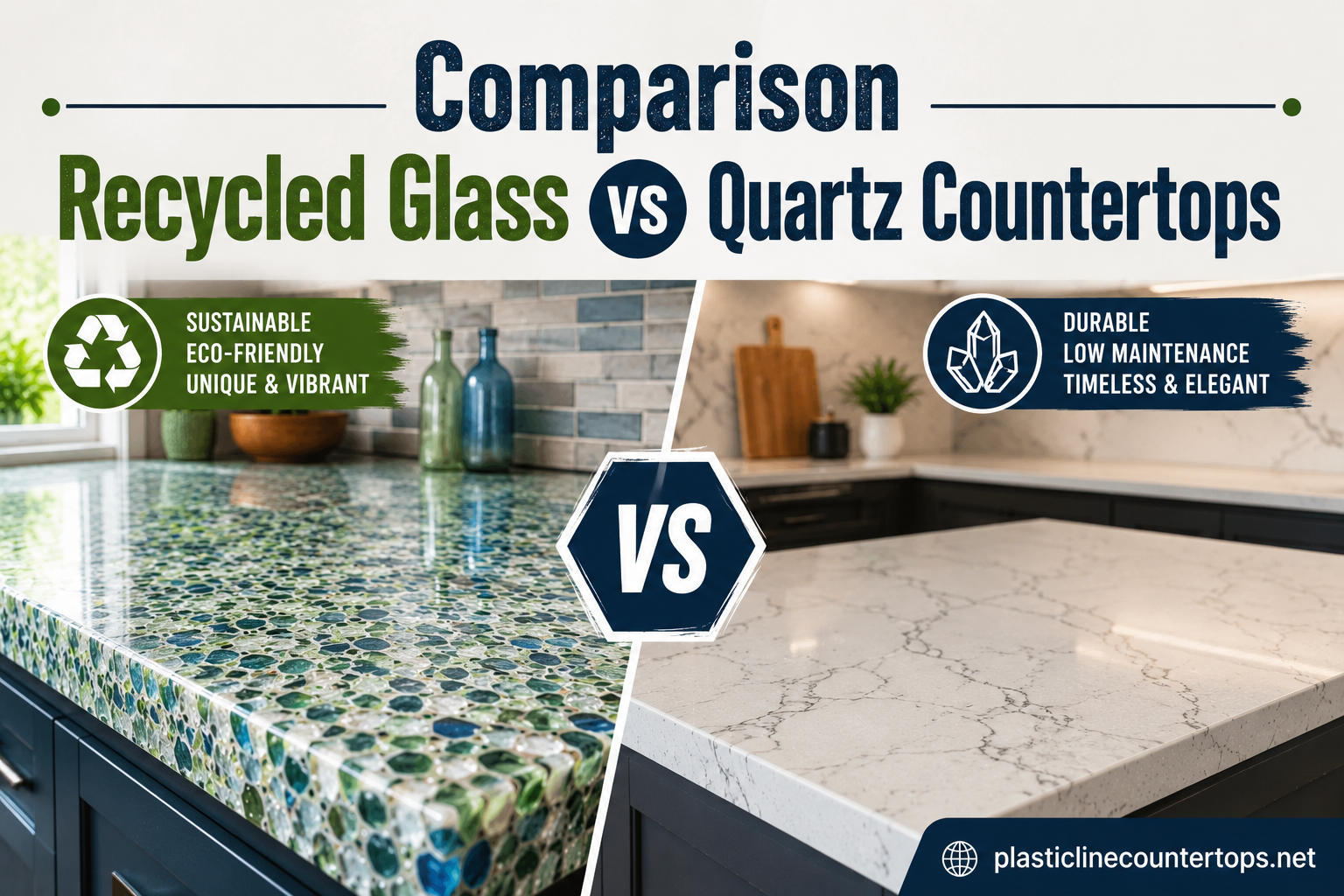
Choosing between recycled glass vs quartz countertops comes down to what matters most to you. Recycled glass offers superior sustainability and unique visual character, while quartz provides slightly easier maintenance and more consistent patterns. Both materials are durable, non-porous, and resistant to stains, but they differ significantly in composition, environmental impact, and long-term performance.
Our team has compared these materials extensively. We have spoken with fabricators, analyzed real user experiences, and examined the environmental credentials of both options. This guide will walk you through everything you need to know to make the right choice for your kitchen or bathroom renovation.
By the end of this article, you will understand the key differences in material composition, durability, cost, maintenance, and environmental impact. You will also see a direct comparison table and get answers to the most common questions homeowners ask.
Table of Contents
What Is Recycled Glass Composite?
Recycled glass countertops are engineered surfaces made primarily from crushed post-consumer and post-industrial glass. The glass content typically ranges from 60% to 80% by weight, bound together with cement or polyester resin binders.
The manufacturing process involves collecting discarded glass bottles, windows, and industrial glass waste. This glass is then crushed into various sizes, cleaned, and mixed with the binding material. The mixture is poured into molds and cured under heat and pressure to create solid slab surfaces.
The visual result is striking. You can see the individual glass fragments embedded throughout the surface, creating a shimmering, mosaic-like appearance. The colors vary depending on the glass source, ranging from ocean blues and forest greens to neutral earth tones and vibrant custom blends.
Popular brands in this category include Vetrazzo, Curava, GEOS, and IceStone. Each manufacturer has its own proprietary blend and aesthetic approach, giving consumers diverse options within the recycled glass category.
What Is Engineered Quartz?
Engineered quartz countertops are manufactured surfaces composed of approximately 90% to 95% ground natural quartz crystals combined with polymer resins and pigments. The quartz content makes these countertops extremely hard and durable.
The production process involves mining natural quartz rock, crushing it into fine particles, and mixing it with resins and colorants. This mixture is then subjected to high pressure and heat in a vacuum environment to create dense, non-porous slabs.
Unlike natural stone such as granite, engineered quartz has a more uniform appearance. The color and pattern remain consistent across slabs, which appeals to homeowners seeking a predictable, modern aesthetic. The surface can mimic the look of natural stone like marble or granite, or present solid contemporary colors.
Leading quartz manufacturers include Cambria, Silestone, Caesarstone, and MSI. The quartz market has become commoditized over time, with many lower-cost imports entering the market, which has affected pricing and quality perception.
Material Composition: How They Differ
The fundamental difference between these materials lies in their aggregate composition. Recycled glass countertops use crushed glass as the primary aggregate, while quartz countertops use ground quartz crystals.
Silica Content Comparison: This is an important distinction many homeowners overlook. Engineered quartz contains crystalline silica, which is the mineral form of silicon dioxide found in nature. Recycled glass contains amorphous silica, which is the non-crystalline form. From a health perspective during fabrication and cutting, crystalline silica dust requires careful handling. Once installed, both materials are safe for household use.
The binding agents also differ. Recycled glass countertops typically use either cement-based binders (like IceStone) or polyester resin binders (like Vetrazzo). Cement-based options are more heat resistant but may require sealing. Resin-bound options offer better stain resistance but can be more vulnerable to heat damage.
Quartz countertops uniformly use polymer resins as binders, typically making up 5% to 10% of the material. This resin content gives quartz its non-porous quality but also creates heat sensitivity that homeowners should understand.
Durability and Performance
Both materials are engineered for durability, but they have different strengths and weaknesses. Understanding these differences helps you match the material to your lifestyle and usage patterns.
Heat Resistance
Recycled glass countertops with cement-based binders generally offer better heat resistance than quartz. You can place hot pots on cement-based recycled glass without immediate damage, though manufacturers still recommend using trivets. Resin-based recycled glass and quartz are both vulnerable to heat damage. Prolonged exposure to temperatures above 150 degrees Fahrenheit can cause discoloration or cracking in the resin.
Scratch Resistance
Quartz is slightly harder on the Mohs scale, typically rating around 7. Recycled glass rates between 6 and 7 depending on the binder type. Both materials resist scratching from normal kitchen use. However, forum discussions reveal that quartz can show scratches and leave what users describe as “sand-like residue” when damaged. Recycled glass may show chips more readily at edges due to the visible glass fragments.
Chip and Crack Resistance
Both materials are strong, but quartz has a slight edge in overall chip resistance due to its uniform composition. Recycled glass can be more prone to chipping at edges where the glass fragments meet the surface, particularly in high-traffic areas. Proper edge profiling and professional installation mitigate this risk significantly.
Longevity Expectations
With proper care, both materials last 20 to 30 years or more. Recycled glass countertops with cement binders may develop a patina over time, which some homeowners appreciate. Quartz maintains its appearance consistently throughout its lifespan, though forum users report that some lower-quality quartz can yellow when exposed to direct sunlight over extended periods.
Cost Comparison
Price is always a factor in countertop selection. Here is how these materials compare in 2026.
Material Costs
Recycled glass countertops typically range from $65 to $125 per square foot installed. The price varies based on brand, color complexity, and local availability. Premium colors and custom designs push costs toward the higher end.
Engineered quartz ranges from $50 to $150 per square foot installed. Entry-level quartz from commoditized imports sits at the lower end, while premium domestic brands like Cambria command higher prices.
Installation Considerations
Both materials require professional installation due to their weight and fabrication requirements. Recycled glass slabs can be heavier than quartz depending on the binder type, potentially increasing labor costs. Quartz fabrication is more standardized, which can reduce installation complexity.
Long-Term Value
When evaluating cost, consider the total lifecycle. Recycled glass offers unique aesthetic value that can increase home appeal for eco-conscious buyers. Quartz provides consistency and warranty backing from established manufacturers. Neither material requires the ongoing sealing costs associated with natural stone like granite.
Maintenance Requirements
Both materials are marketed as low-maintenance options compared to natural stone. Here is what that actually means for daily care.
Daily Cleaning
Both recycled glass and quartz clean easily with mild soap and water. Neither material harbors bacteria due to their non-porous surfaces. Avoid abrasive cleaners on both materials, as they can dull the finish over time.
Sealing Requirements
Resin-based recycled glass and all quartz countertops do not require sealing. Cement-based recycled glass countertops may need periodic sealing depending on the manufacturer specifications. Check your specific product warranty and care instructions.
Stain Resistance
Both materials resist staining from common kitchen substances like coffee, wine, and oils. Resin-based recycled glass and quartz offer excellent stain resistance. Cement-based recycled glass is more porous and may require prompt cleanup of acidic substances.
Repair Considerations
Minor scratches on quartz can sometimes be buffed out by professionals. Recycled glass repairs are more challenging due to the visible aggregate pattern. Professional fabricators can repair chips on both materials, but the repair may be more visible on recycled glass due to its unique composition.
Maintenance Do’s and Don’ts
Do: Use cutting boards to protect the surface. Clean spills promptly. Use trivets under hot cookware. Use pH-neutral cleaners.
Don’t: Place hot pots directly on resin-based surfaces. Use harsh abrasives or bleach. Cut directly on the countertop. Stand on countertops to reach high cabinets.
Environmental Impact and Sustainability
This is where recycled glass countertops truly distinguish themselves. For environmentally conscious homeowners, the difference is significant.
Recycled Content
Recycled glass countertops contain 60% to 85% post-consumer or post-industrial recycled content. Each installation diverts hundreds of pounds of glass from landfills. This aligns perfectly with circular economy principles.
Quartz countertops contain minimal recycled content. The quartz is mined from the earth, and while some manufacturers have begun incorporating recycled materials, the percentage remains low compared to recycled glass.
Manufacturing Carbon Footprint
The recycled glass manufacturing process generally has a lower carbon footprint than quartz production. Mining and processing quartz requires significant energy input. Some recycled glass manufacturers also use regional sourcing, reducing transportation emissions.
End-of-Life Recyclability
Recycled glass countertops can potentially be recycled again at the end of their useful life, depending on the binder type. Cement-based options are more easily repurposed as aggregate. Quartz countertops are difficult to recycle due to the resin content and typically end up in landfills.
Why Homeowners Choose Recycled Glass for Environmental Reasons
Forum discussions consistently show that homeowners choosing recycled glass prioritize sustainability. They appreciate knowing their countertops diverted waste from landfills. The visible glass fragments serve as a daily reminder of their eco-friendly choice. For many, this aligns with broader values around sustainable living and responsible consumption.
Appearance and Aesthetics
The visual difference between these materials is immediately apparent.
Recycled glass countertops offer a unique, artistic appearance. The visible glass fragments create depth, sparkle, and conversation-worthy character. Each slab has variation, giving you a one-of-a-kind surface. The aesthetic works well in contemporary, coastal, and eclectic design styles.
Quartz countertops provide consistency and predictability. The patterns are uniform across slabs, making it easier to match sections for large installations. Quartz can mimic natural stone or present solid colors. The aesthetic suits modern, traditional, and transitional design styles.
Forum users describe recycled glass as having a “funky, chunky” look that stands out from standard kitchen designs. If you want your countertops to be a focal point, recycled glass excels. If you prefer subtlety and uniformity, quartz may better serve your vision.
Quick Comparison Table
| Feature | Recycled Glass | Engineered Quartz |
|---|---|---|
| Composition | 60-80% crushed glass + resin/cement | 90-95% quartz + polymer resin |
| Recycled Content | 60-85% post-consumer | Minimal to none |
| Heat Resistance | Good (cement) to Moderate (resin) | Moderate |
| Scratch Resistance | Good (6-7 Mohs) | Excellent (7 Mohs) |
| Stain Resistance | Excellent (resin) to Good (cement) | Excellent |
| Price Range | $65-$125/sq ft installed | $50-$150/sq ft installed |
| Sealing Required | Sometimes (cement-based) | No |
| Appearance | Unique, visible glass fragments | Uniform, consistent patterns |
| End-of-Life | Recyclable potential | Difficult to recycle |
Pros and Cons Summary
Here is a concise breakdown to help you evaluate at a glance.
Recycled Glass Countertops
Pros:
- High recycled content (60-85%)
- Unique, artistic appearance
- Excellent sustainability credentials
- Non-porous (resin-based)
- Heat resistant (cement-based)
- Supports circular economy
Cons:
- Limited color selection compared to quartz
- May chip more easily at edges
- Higher price point than entry-level quartz
- Fewer fabricators experienced with installation
- Some brands may require sealing
Engineered Quartz Countertops
Pros:
- Extremely durable and hard
- Low maintenance (no sealing)
- Wide color and pattern selection
- Consistent appearance across slabs
- Established manufacturer warranties
- Easy to find experienced installers
Cons:
- Minimal recycled content
- Vulnerable to heat damage
- Can yellow with sun exposure (lower quality)
- Commoditized market with variable quality
- Difficult to recycle at end of life
- Some users report scratch visibility
Which Should You Choose?
The right choice depends on your priorities.
Choose recycled glass if: Sustainability is your top priority. You want a unique, conversation-starting surface. You appreciate the visible recycled content story. You are willing to pay a premium for environmental benefits. You prefer cement-based options for heat resistance or resin-based for stain resistance.
Choose quartz if: You want the lowest maintenance option. You prefer consistent, predictable patterns. You need the widest color selection. You want established brand warranties. Budget is a primary concern and entry-level options work for you.
Our team at Plasticline Countertops believes recycled glass represents the future of sustainable kitchen design. The material offers performance comparable to quartz while dramatically reducing environmental impact. For homeowners who view their kitchen as an expression of their values, recycled glass is the clear winner.
FAQ
Are recycled glass countertops better than quartz?
Recycled glass countertops are better than quartz for homeowners prioritizing sustainability and unique aesthetics. They contain 60-85% recycled content and offer distinctive visual character. Quartz is better for those wanting the lowest maintenance and most consistent appearance. Both materials are durable and stain-resistant.
How long do recycled glass countertops last?
Recycled glass countertops last 20 to 30 years or more with proper care. Cement-based options may develop a patina over time while maintaining structural integrity. Resin-based options retain their appearance longer. Both types outlast many traditional countertop materials.
What is the cost of recycled glass countertops?
Recycled glass countertops cost between $65 and $125 per square foot installed. Prices vary by brand, color complexity, and location. Premium colors and custom designs cost more. While more expensive than entry-level quartz, the price is comparable to mid-range quartz and premium granite.
Why do people not mind using recycled glass?
People do not mind using recycled glass because it offers significant environmental benefits, unique aesthetics, and comparable durability to other engineered surfaces. The visible glass fragments create a distinctive appearance that many homeowners prefer. Additionally, the material performs well in kitchens and bathrooms while supporting sustainable consumption.
What are the disadvantages of using quartz glass?
Quartz countertops have several disadvantages: they contain minimal recycled content, are vulnerable to heat damage, can yellow with sun exposure, are difficult to recycle at end of life, and come from a commoditized market with variable quality. Some users also report visible scratching over time.
What is the newest trend in countertops?
The newest trend in countertops is sustainable materials with recycled content. Recycled glass, paper composite, and reclaimed materials are gaining popularity as homeowners prioritize environmental responsibility. Unique textures and visible recycled content are particularly sought after in 2026 kitchen designs.
Final Thoughts
When comparing recycled glass vs quartz countertops, both materials offer excellent performance for kitchen and bathroom surfaces. Your choice should reflect your priorities. If sustainability, unique aesthetics, and environmental responsibility matter most, recycled glass is the superior option. If consistency, lowest maintenance, and broad availability are your top concerns, quartz may serve you better.
We believe the future of countertops lies in materials that combine performance with planetary responsibility. Recycled glass delivers on both fronts. The material has evolved significantly, and 2026 options offer durability and beauty that rivals or exceeds conventional alternatives.
Before making your final decision, request samples from reputable manufacturers. Seeing the materials in your actual lighting conditions helps you visualize the finished result. Consult with experienced fabricators who can guide installation and edge treatment options.
Your countertop choice is a long-term investment in your home and values. Choose the material that aligns with how you want to live.